
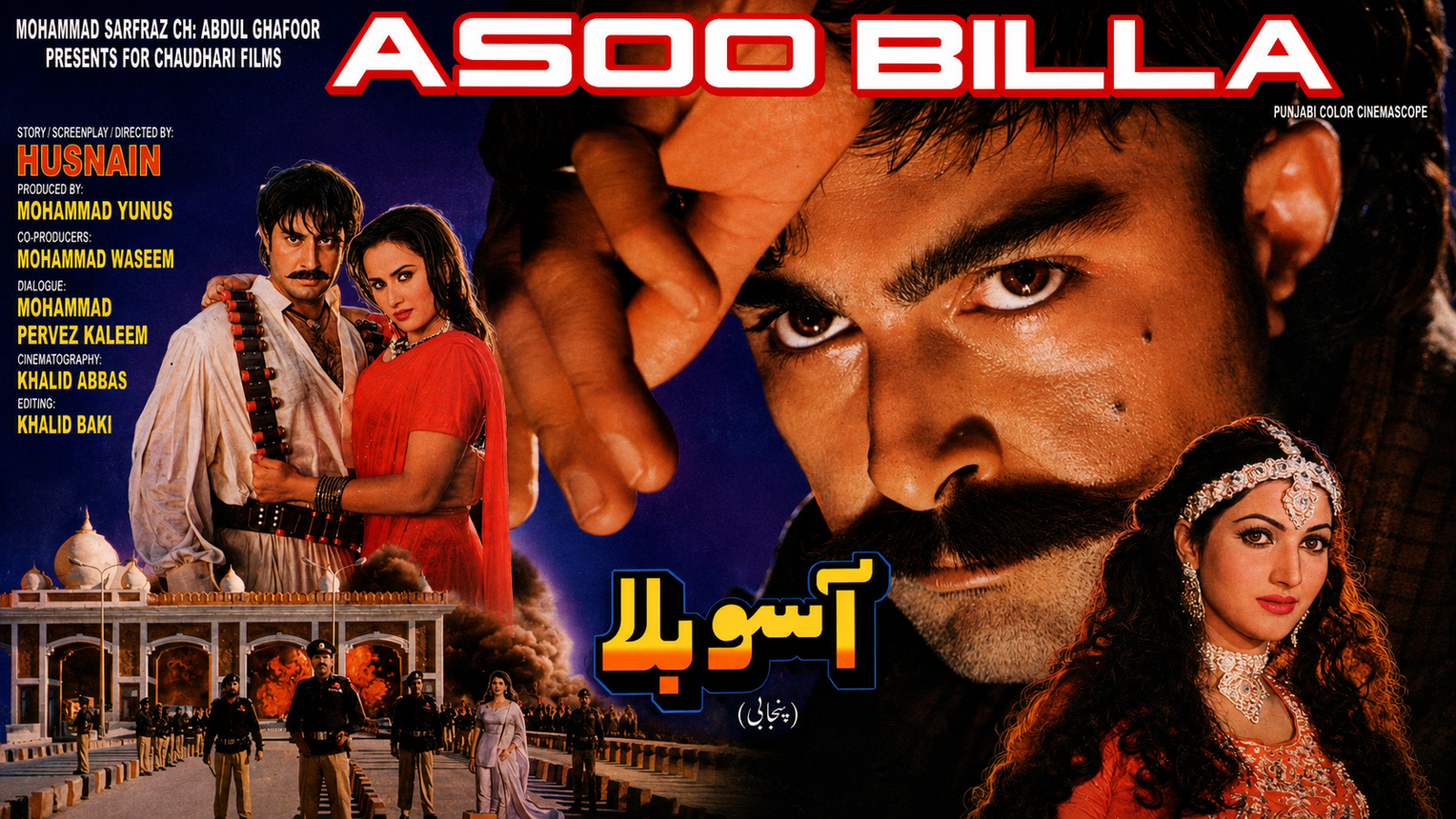
Asoo Billa (2001)
Cast: Shaan, Baber Ali, Sana, Nargis, Naghma, Bahar, Tahir Shah
Director: Hasnain
Synopsis: Typical masala action revenge flick became a sizeable hit in 2001.
Reviewed by: Omar Khan
Asoo Billa became a sizeable box office smash in the first half of 2001, running to packed houses nationwide in the pre-Osama lull before the storm. It is difficult to imagine why this particular film scored a bull’s eye while so many others that appear identical in theme, execution, and actors failed.
The film is your typical run-of-the-mill revenge and mayhem potboiler. In the done-to-death storyline, we watch the mild-mannered, law-abiding, peace-loving, god-fearing Asoo (Shaan), confronted by a series of terrible circumstances that ultimately force him to take up a violent crusade of his own against the perpetrators of evil and injustice. This theme is a blueprint for 90% of all Lollywood Punjabi movies, and it seems to be nothing short of a miracle that the audiences lap this sort of thing up time after time.
This film features Shaan in the title role, and for half the movie, we watch him in subdued mode as the mild-mannered innocent blue-eyed boy, who lives only for the joys of saying his prayers and serving his goody-two-shoes parents. Asoo has a mate, Ghiasia, who has just been released from jail, where he did time for murdering the men who looked at his sister with a “dirty eye”. Now Ghiasia (Baber Ali resembling Pran in Don with his brown curly wig), is back in the pind, and life is blissful until one fateful day, everything goes wrong.
Asoo’s father works in a local godown and finds that “poh-durr” (heroin) is being smuggled from the spot. He, the upright, virtuous (idiotic) type, decides to blow his own trumpet and go to the police to blow the whistle on the nefarious drug smuggling operation under his very nose at the behest of his employers.
Asoo’s dad, however, meets a terrible fate as the head of police turns out to be a party to the drug smuggling ring and, instead of rewarding the poor man for his civic sense and courage, thrashes him to a pulp. Then the old man is fraudulently charged with the theft of Rs. 2 lac, publicly humiliated and disgraced, and thrown into a prison cell. Meanwhile, a shell-shocked Asoo arrives at the police station, where he is told that his father has been accused of stealing. Unless he manages to get the money, matters will get out of hand.
When poor Asoo fails to turn up with the money on time, the corrupt officer turns up at his home, humiliates Asoo’s mother, hits her, and worse, causes the dupatta to fall from her head. This indignity for Asoo is the last straw, and he arrives at the Police station in a fury, only to find his dad hammered into a meatball.
This, for young Asoo, is too much to take, and all of a sudden, the mild-mannered Asoo is transformed into a drooling, axe-wielding maniac who proceeds to bludgeon to death what seems like the entire local police force.
The next day in court Asoo pleads guilty to murder and is sentenced to death so vehemently by the judge that he snubs his nib while writing the word death, deep, meaningful symbolism in Lollywood style!
The blood bath begins as his friend, Ghiasia, whisks Asoo away from jail in a deadly grenade attack. Asoo takes refuge with Sana, the golden-hearted sex worker who shows up habitually to launch into a
Asoo Billa frenetically energetic dance, complete with serious pelvic thrusting and torso twisting.
Asoo Billa becomes the local Robin Hood, stealing from the rich to provide for the needy, and now it remains to be seen if he can complete his mission of destroying all his enemies before he is struck down. It doesn’t take a genius to guess what transpires.
The usual blood bath showdown follows, with fat-bellied men with tits running around in ridiculous wigs and outfits, gunning each other down in comical style, and various virtuous people leaping in the way of bullets and saving other equally righteous folks. The best dramatics are kept effectively until the end (a reason for the film’s humungous success, maybe?) when the power of Faith has the final say.
As Asoo is obliterating all his rivals in the last rampage to glory, he is about to blow off the head of a scumbag policeman when the muezzin starts his call to prayer; suddenly, Asoo cannot pull the trigger. At this point, the rest of the police open fire, and a volley of bullets are pumped into a sagging Asoo’s body. Then, a sagely, pious, and earnest police chief arrives and calls an immediate cease-fire, admonishing his men for firing. At the same time, the prayer is ongoing, and he praises the criminal Asoo for having the decency to respect the sanctity of the prayer by halting his killing spree. Asoo staggers forth and slumps in a” sajda” (bowing) in front of the mosque while the muezzin wails away.
Not a dry eye in the house then, as director Hasnain manages to strike a chord with the masses with his melodramatic climax scene.
There is another extraordinary, memorable moment when, in police custody, a wild-eyed Almas Bai (Sana), violently strangles a slimy snitch before (the police’s) startled eyes, using her shackles as an instrument of death. These Jatti’s are indeed made of stern stuff. The heavy-handed drama, plus the fact that the film moves along at a rapid pace, despite the utterly predictable nature of the plot, helped the film to attain widespread popularity.
The other critical ingredient in the film’s success is the highly seductive, typically vulgar gyrations of the two leading ladies, Sana and Nargis, who contort, twist, thrust, and twitch their body parts tantalizingly, much to the delight of the hungry masses. Both girls are more than adept at milking the vulgar dance for all its worth. Nargis primarily employs wonderfully sleazy facial expressions that send the vulgarity factor of her dances into a different stratosphere. No wonder she was packing them in during her infamous live theatre act that was so sadly cut short by the morality police, the protectors of the nation’s virtues. The film is formulaic, offers nothing new or fresh, and is what one expects from a typical Punjabi masala potboiler—perhaps this is precisely why the film clicked big time—its predictability.


0 Comments
Leave a Comment