
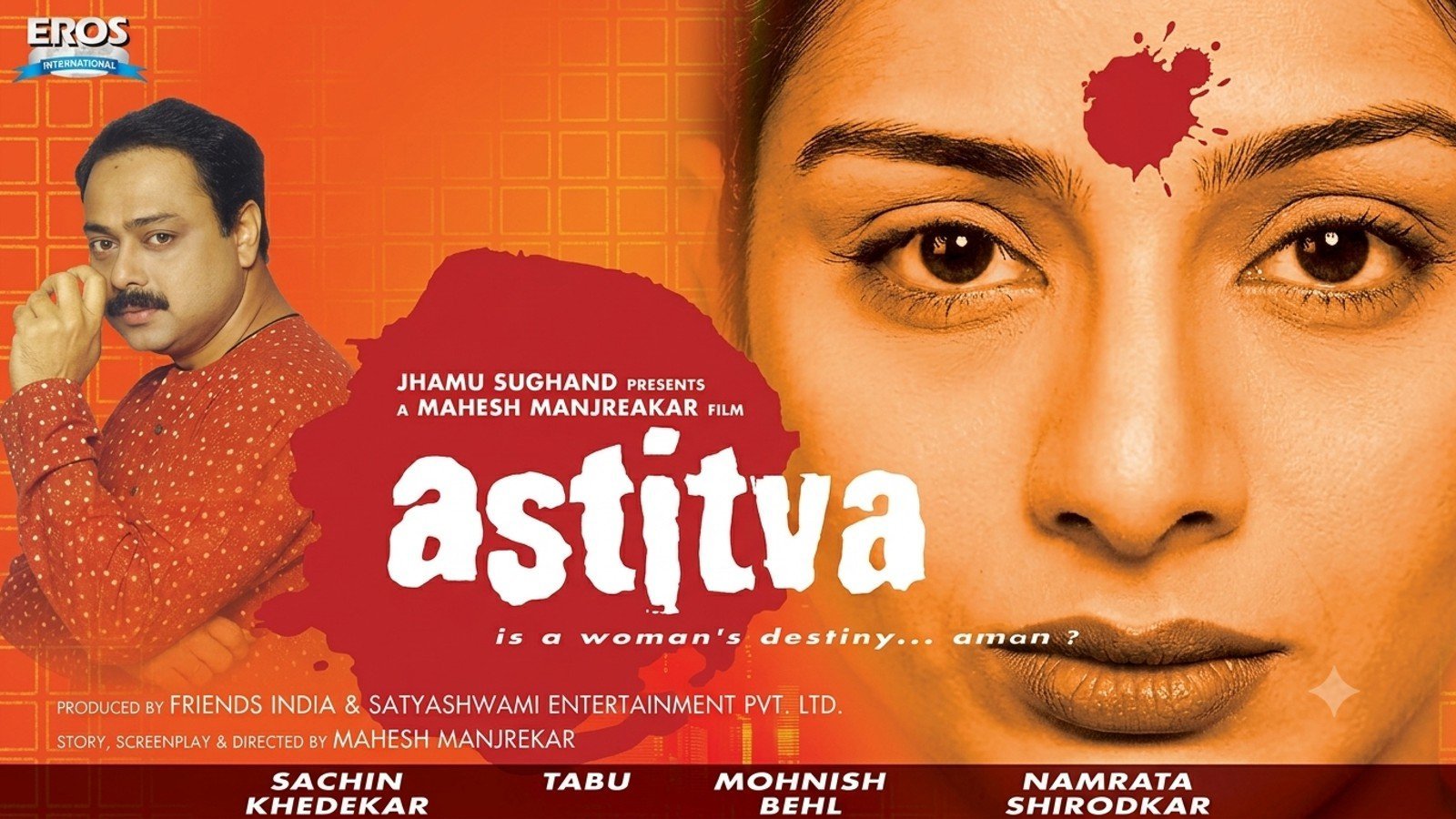
Astitva (2000)
Starring: Tabu, Sachin, Mohnish Bahl, Smita Jaykar
Director: Mahesh Manjrekar
Music Director: Sukhwinder Singh
Synopsis: A thought-provoking and dynamic film. Strong direction and performances all around.
Reviewed by: Faiz Khan
Mahesh Manjrekar burst onto the scene with Vaastav, a powerful film about the gradual descent of a young man into Mumbai’s murky underworld. Astitva bears little resemblance to that film in terms of subject, but it approaches its central theme with the same realism, conviction and emotional force.
The film opens in 1997, with an elderly man (Mohnish Bahl) making his way to an office where he signs an important document. The story then moves forward two years.
Shrikant, or Shri (Sachin Khedekar), and Aditi (Tabu) appear to be a perfectly ordinary, happily married couple in their forties. They have a grown-up son and have shared more than twenty-five years of married life. Shri, however, is an understated but unmistakable male chauvinist. He is the breadwinner, the head of the household and the man who assumes control over every aspect of their lives. He is not presented as a monster but as an almost recognisably ordinary man.
When a letter arrives addressed to Aditi, Shri opens it automatically, as though it were his unquestionable right. She does not object. The letter reveals that a man has died and left his entire estate to her. At first, the matter is laughed off amid the drunken revelry of Shri’s reunion with an old friend and his newly married wife. Shri, however, is deeply unsettled by the discovery and begins investigating why such a considerable fortune should have been left to Aditi.
He learns that the man was Malhar Kamat, the music teacher who taught her more than twenty-five years earlier. Turning to his old diaries, Shri begins piecing together the events of their marriage.
As a young man, Shri was ambitious and determined to make something of his life. He was unwilling, however, to allow his wife the same opportunity. Aditi was not encouraged to seek employment or develop an independent existence. Her duty was to remain at home and wait for him to return. Music lessons were acceptable as a means of passing the time, but the possibility that she might take her talent seriously or build a life around it was dismissed immediately.
Shri travelled extensively and Aditi became increasingly lonely and neglected. Her music lessons provided almost her only escape. During one of her husband’s prolonged trips abroad, she surrendered to that loneliness and slept with her teacher. She is clear that it was not an act of love, for she continued to love Shri, but a moment of weakness born from an overwhelming need for comfort and affection.
Aditi became pregnant but was unable to tell Shri the truth, particularly when confronted by his delight at the prospect of becoming a father. Twenty-five years later, he finally realises that he may not be the biological father of their son and confronts her. Faced with the choice, Aditi confesses rather than continue the deception.
For Shri, the revelation destroys everything. Twenty-five years of companionship, loyalty, support and care are swept aside in a single moment. Aditi’s one act of infidelity becomes sufficient justification for him to humiliate and condemn her, allowing him to appease his wounded pride, masculine ego and distorted sense of honour.
Astitva is a thought-provoking and dynamic film, made all the more remarkable by the fact that it examines a woman’s position within marriage from such a fair and balanced perspective. Mahesh Manjrekar deserves considerable praise for approaching a difficult subject with sensitivity and restraint.
The film is beautifully structured, unfolding gradually and maintaining the audience’s interest throughout. These are recognisable, believable people. Shri personifies male insecurity and chauvinism, and it is possible to see aspects of him in countless apparently respectable men. He does not consider himself oppressive; his attitudes have simply been reinforced by a society that has always granted him authority.
Aditi, meanwhile, represents the role traditionally assigned to women: mother, wife and homemaker. Beyond that threshold, she is barely permitted to exist. Her desires, ambitions and emotional needs are considered secondary to those of her husband. There is little sense of true equality within the marriage. What is acceptable for the man is certainly not acceptable for the woman.
It would be wrong to claim that this represents every marriage or every man, but there remain many within society who continue to subscribe to precisely these double standards.
The acting is superb throughout. Tabu is extraordinary and completely commands the film. It is impossible not to be riveted by the intelligence, pain and dignity she brings to Aditi. There is arguably no actress of her generation who can match the depth and consistency of her body of work.
Sachin Khedekar is equally impressive, bringing Shri vividly to life without reducing him to a crude villain. It is an unsympathetic role, but also an uncomfortably realistic portrait of an ordinary man whose liberal exterior collapses the moment his authority and pride are threatened.
Mohnish Bahl has less scope but gives a sensitive performance as the music teacher. It is pleasing to see him offered something more substantial than the routine villainous roles that so often come his way.
The film also boasts a distinctive and impressive musical score that never intrudes upon the narrative. Mahesh Manjrekar remains firmly in control throughout, resisting hysteria and melodrama and allowing the story to reveal itself carefully, layer by layer, exposing the hypocrisies and double standards that continue to shape relationships.
Astitva is not a perfect film. One may reasonably wonder why it took Shri twenty-five years to realise that he might not be his son’s biological father. Yet ultimately, the contrivance matters less than the moral and emotional dilemma it creates.
This is not what one would conventionally describe as a “man’s film”, and it may therefore struggle to find the audience it deserves. Nevertheless, it is an important, intelligent and deeply affecting work that demands to be seen.

0 Comments
Leave a Comment