
Awakening of the Beast (1969)
Cast: Andréa Bryan, Annik Malvil, Graveto, Ítala Nandi, José Mojica Marins as Coffin Joe, Lurdes Vanucchi, Ribas
Director: Jose Mojica Marins
Synopsis: The ultimate descent into Mojica Marins’s unique vision of hell! incredible.
Reviewed by: Omar Khan
At Midnight I'll Take Your Soul (1964)
Every great horror icon has an origin story.
Dracula emerged from the imagination of Bram Stoker.
Frankenstein's Monster was born during a stormy night at Lake Geneva.
Coffin Joe, however, came into existence in altogether stranger circumstances.
He was dreamt.
Not dreamt in the ordinary sense, but conceived during a terrifying fever nightmare that nearly claimed the life of the man who created him.
José Mojica Marins had been gravely ill. Bedridden with a mysterious fever that baffled doctors and left his family fearing the worst, he drifted in and out of delirium. Some even believed he had become possessed. Then, during one particularly violent fever, Marins experienced a nightmare so vivid that it would alter the course of Brazilian horror cinema forever.
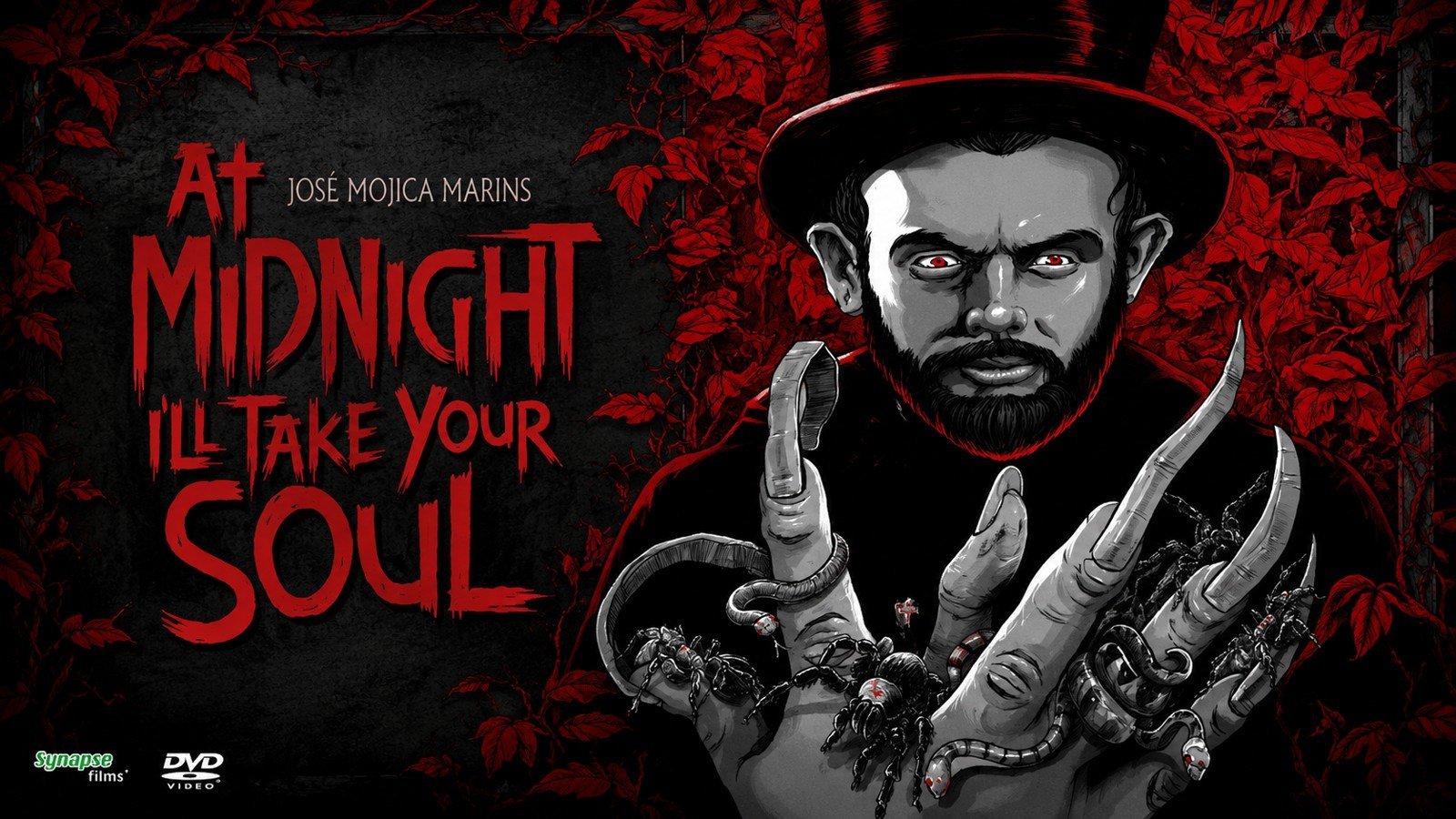
In his dream, a sinister figure clad in black, wearing a tall top hat and sporting grotesquely elongated fingernails, seized him and dragged him relentlessly towards an open grave.
Terrified, Marins struggled to escape.
Then came the final horror.
The man dragging him to his own grave...
was himself.
When he awoke the following morning, the fever had broken.
Instead of returning to bed, he began writing with almost manic urgency, determined to capture the extraordinary vision before it faded.
That nightmare became At Midnight I'll Take Your Soul.
Looking back today, it remains one of the most remarkable beginnings to any filmmaking career. The film was completed in an astonishing thirteen days, working with almost no money and under conditions that most directors would have considered impossible. Virtually the entire production was confined to an area measuring little more than six hundred square yards, forcing Marins to rely not on lavish production values but on sheer imagination.
Ironically, the greatest obstacle proved to be finding someone willing to play Coffin Joe.
No respectable actor wished to jeopardise his reputation by portraying such a monstrous, blasphemous and thoroughly unpleasant character. Faced with the prospect of abandoning the project altogether, Marins simply stepped in front of the camera himself.
It proved one of horror cinema's happiest accidents.
Dressed in a black cloak, immaculate suit and towering top hat, his naturally elongated fingernails transforming into the character's terrifying talons, Marins became Zé do Caixão—better known to the rest of the world as Coffin Joe.
The performance is extraordinary.
Unlike Dracula, Frankenstein's Monster or the Wolf Man, Coffin Joe possesses no supernatural powers. He is simply a man.
A monstrously intelligent...
utterly ruthless...
and profoundly blasphemous man.
The film opens with Coffin Joe himself addressing the audience directly. Speaking calmly and with unnerving certainty, he dismisses conventional ideas of morality and religion before explaining his own philosophy of existence.
Life, he argues, has only one true purpose.
The continuation of the bloodline.
Everything else—love, compassion, faith, even human decency—is meaningless.
It is an astonishingly provocative opening, particularly considering that the film emerged from one of the most devoutly Catholic nations on Earth.
Yet Marins was only getting started.
The wonderfully surreal opening titles immediately plunge the audience into another world. Strange typography hurtles towards the camera like vampire bats while fleeting images hint at the horrors yet to come.
Then comes one of horror cinema's great introductions.
A witch appears.
Clutching an oversized skull and blessed with perhaps the most magnificently maniacal cackle ever committed to film, she issues a warning directly to the audience.
"Don't watch this film.
Go home."
Moments later, church bells begin tolling.
The witch smiles.
It is too late.
The film has already begun.
Now...
the audience must suffer.
She promises that before midnight she will claim their souls.
It is a mesmerising sequence.
Shot in shimmering black and white, it feels less like the opening of a conventional horror film than the beginning of a particularly vivid nightmare. Reality and fantasy merge almost seamlessly, creating an atmosphere that recalls the lurid pages of EC horror comics brought thrillingly to life.
Within only a few minutes, José Mojica Marins establishes something that many horror directors spend an entire career trying to achieve.
A world entirely his own.
Once you enter it...
there is no escape.
At Midnight I'll Take Your Soul (1964) – Part Two
Coffin Joe is unlike almost any horror villain who had appeared before him.
He is not a vampire.
He is not a werewolf.
He is not a ghost, a demon or some supernatural creature lurking in the darkness.
He is something far more disturbing.
He is a man who has abandoned every conventional notion of morality and replaced it with a philosophy entirely of his own making.
That philosophy is terrifyingly simple.
Only the continuation of one's bloodline has meaning.
Everything else is weakness.
Religion.
Compassion.
Love.
Friendship.
Mercy.
All are dismissed as meaningless illusions created by lesser men.
From the moment he first appears, Coffin Joe delights in attacking everything his deeply religious community holds sacred. He openly ridicules Christianity, mocks local customs and deliberately provokes those around him into blaspheming simply so that he can watch their horror.
He is less interested in shocking people than proving his own intellectual superiority over them.
That arrogance makes him an utterly fascinating creation.
Marins reportedly imagined Coffin Joe as a man who had returned from the horrors of war emotionally shattered and spiritually empty. Betrayed by life itself, he rejects every comforting belief that ordinary people cling to and instead constructs his own ruthless code for living.
It is madness.
But it is internally consistent madness.
That is what separates Coffin Joe from so many horror villains.
His actions follow a warped logic.
Once one accepts his philosophy, every atrocity he commits becomes, in his own mind at least, entirely justified.
He does not kill for pleasure alone.
He kills because obstacles must be removed.
His mistress cannot produce the perfect heir.
Therefore she dies.
His closest friend stands between him and the woman he has chosen to bear his child.
Therefore he dies.
Anyone who questions his authority becomes equally expendable.
Joe dispenses punishment with astonishing brutality, often carrying out the murders personally with almost ritualistic determination. Whether hacking at hands with broken glass, gouging eyes with his impossibly long fingernails or inflicting prolonged psychological torment upon his victims, every act seems calculated not merely to destroy the body but to crush the spirit.
Yet however shocking these moments remain, violence alone is never what lingers longest in the memory.
It is Joe himself.
Marins gives him an extraordinary physical presence.
The black suit.
The cape.
The towering top hat.
The unnaturally long fingernails.
The piercing stare.
He strides through the village with complete certainty that everyone around him is morally and intellectually inferior.
Long before Freddy Krueger donned his striped jumper or Leatherface picked up his chainsaw, Coffin Joe had already demonstrated the extraordinary power of creating an unforgettable horror icon through costume, posture and personality alone.
What makes the character even more remarkable is that he possesses no supernatural powers whatsoever.
His greatest weapon is fear.
The villagers are terrified of him long before he ever raises a hand against them. Rumours, superstition and his own carefully cultivated reputation have transformed him into a living nightmare. Occasionally someone attempts to challenge him.
It never ends well.
Only one figure consistently refuses to yield.
The witch.
Forever cackling, forever warning him that divine justice cannot be avoided, she becomes the film's moral conscience. While everyone else fears Coffin Joe's physical strength, she alone recognises that his greatest enemy lies elsewhere.
Within himself.
Around these unforgettable characters, Marins constructs a cinematic universe unlike anything being produced elsewhere in the world at the time.
His village feels simultaneously real and dreamlike.
Funerals merge effortlessly into nightmares.
Churches become battlegrounds.
Cemeteries seem almost inviting.
Every location appears suspended somewhere between waking reality and feverish hallucination.
The influence of EC horror comics is unmistakable, yet Marins never merely imitates them.
Instead, he creates the unsettling sensation that we are wandering through somebody else's recurring nightmare.
Perhaps the most astonishing achievement of all is that almost the entire film was created within an incredibly small studio space. Forests, taverns, houses, cemeteries and village streets all emerge from the same remarkably limited resources through nothing more than clever staging, imaginative lighting and inventive camerawork.
It is a masterclass in cinematic resourcefulness.
Modern filmmakers frequently complain about budgets.
Marins simply made films.
Watching At Midnight I'll Take Your Soul today remains a powerful reminder that imagination has always been cinema's most valuable special effect.
Money merely makes life easier.
It has never been a substitute for vision.
At Midnight I'll Take Your Soul (1964) – Part Three
Remarkably, At Midnight I'll Take Your Soul succeeds on almost every level.
It is shocking.
It is provocative.
It is frequently surreal.
And, despite its microscopic budget, it possesses an energy and visual confidence that many vastly more expensive productions never come close to matching.
There is a rawness to Marins' filmmaking that becomes one of its greatest strengths. The film crackles with nervous, almost manic energy, as though its creator simply could not wait to transfer the extraordinary images in his imagination onto the screen before they escaped him forever.
That urgency becomes infectious.
Every frame feels alive.
Watching the film is rather like leafing through a particularly twisted EC horror comic that has somehow sprung into motion. Reality constantly gives way to nightmare, while nightmare repeatedly intrudes upon reality until the distinction between the two almost disappears altogether.
For all its moments of startling violence, however, perhaps the film's greatest act of rebellion lies elsewhere.
Religion.
Brazil in the early 1960s was an overwhelmingly Catholic nation, and Marins' decision to place at the centre of his film a protagonist who openly mocked religious belief, ridiculed superstition and blasphemed with almost evangelical enthusiasm was nothing short of incendiary.
Coffin Joe is not merely an atheist.
He is a militant anti-believer.
He delights in desecrating everything that his neighbours consider sacred.
Small wonder the authorities reacted with alarm.
The film repeatedly found itself banned or heavily restricted throughout Brazil. Only the fact that Coffin Joe ultimately confronts the consequences of his actions saved it from disappearing altogether. Had Marins allowed his monstrous creation to triumph completely, the film might well have remained suppressed indefinitely.
Ironically, censorship only enhanced its reputation.
Whenever restrictions were lifted in another province, audiences flocked to see the mysterious horror film everyone had been told they should never watch. The controversy surrounding Coffin Joe became almost as famous as the character himself, and the film gradually established itself as one of Brazilian cinema's great cult successes.
History, as it so often does, eventually proved kinder than the censors.
Today At Midnight I'll Take Your Soul is recognised not merely as Brazil's first great horror film but as one of the landmark achievements of world cult cinema. It announced the arrival of a filmmaker unlike any other—a director who ignored convention, embraced the bizarre and remained fiercely independent throughout his career.
José Mojica Marins was never interested in making polite films.
He wanted to disturb.
To provoke.
To challenge.
Above all, he wanted audiences to remember what they had seen.
Few filmmakers have ever succeeded so completely.
Watching the film today, one is struck not by how dated it feels but by how startlingly original it remains. It refuses to resemble the horror films of its era. There are echoes of Carnival of Souls in its dreamlike atmosphere and occasional hints of German Expressionism in its visual design, yet ultimately At Midnight I'll Take Your Soul belongs entirely to José Mojica Marins.
There simply is nothing else quite like it.
Coffin Joe himself deserves to stand alongside horror's greatest icons.
He may never have achieved the worldwide recognition enjoyed by Dracula, Frankenstein's Monster, Leatherface or Michael Myers, but he is every bit their equal as an unforgettable cinematic creation. His philosophy, appearance and sheer force of personality make him one of the genre's most distinctive antiheroes—a villain who remains fascinating precisely because he believes, with absolute conviction, that he is right.
That is the mark of a truly memorable monster.
For many years José Mojica Marins remained one of horror cinema's best-kept secrets. Fortunately, the arrival of DVD introduced his extraordinary work to a new generation of viewers, and he finally began receiving the international recognition that had eluded him for decades. Film festivals celebrated him. Horror fans embraced him. Critics rediscovered him.
It was long overdue.
At Midnight I'll Take Your Soul is not simply an outstanding horror film.
It is one of those rare cinematic discoveries that reminds us how much extraordinary filmmaking exists beyond the familiar boundaries of Hollywood and Europe. Created with almost no money but limitless imagination, it demonstrates that originality will always triumph over budget and inspiration will always outlive spectacle.
José Mojica Marins dreamed Coffin Joe into existence.
The rest of us have been living with the nightmare ever since.
And horror cinema is infinitely richer because of it.

0 Comments
Leave a Comment