
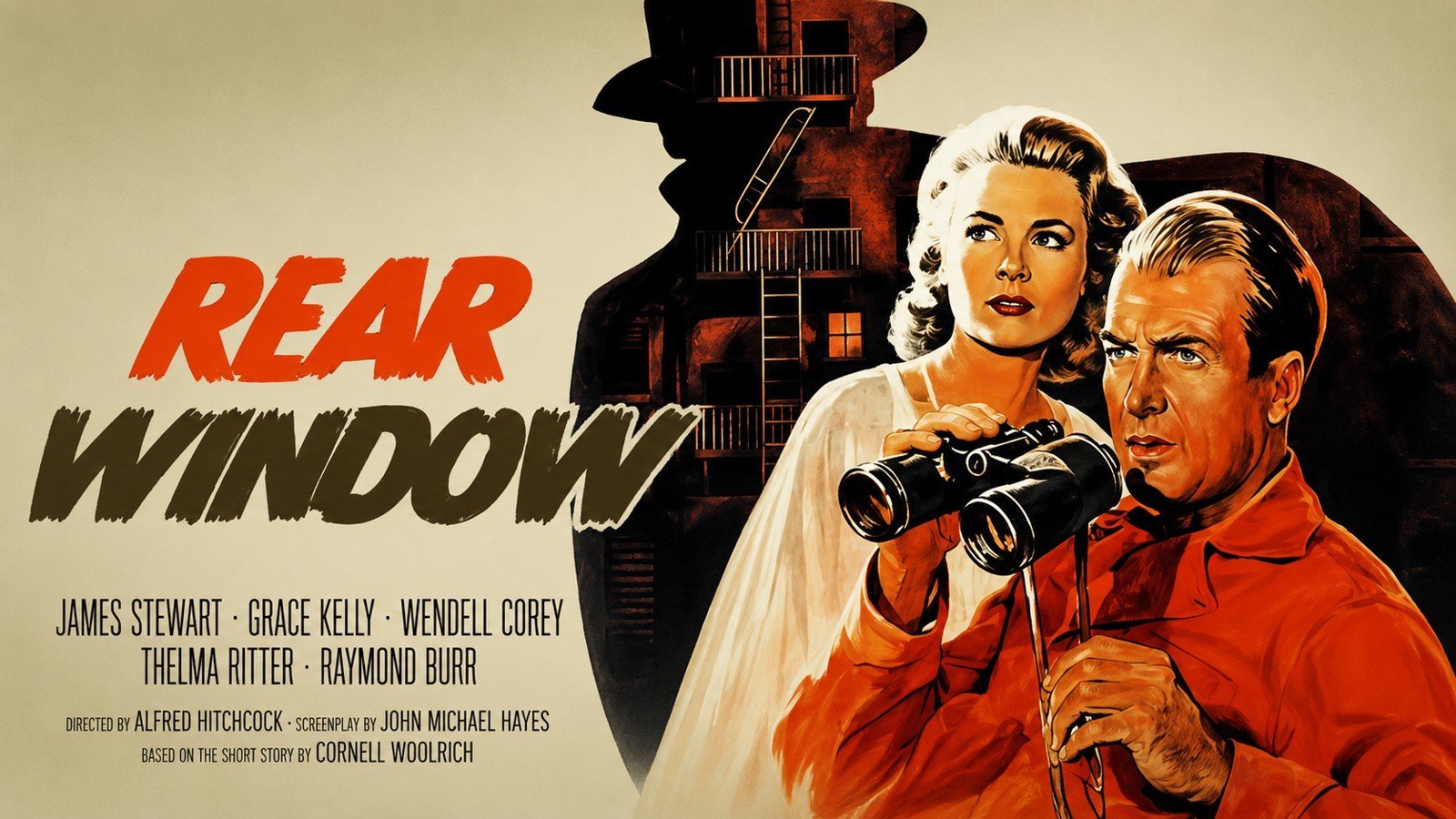
Rear Window (1954)
Starring: James Stewart, Grace Kelly, Thelma Ritter, Raymond Burr
Director: Alfred Hitchcock
Synopsis: Hitchcock's biggest commercial bonanza
Reviewed by: Shaharyar M. Khan
Early in his career, Alfred Hitchcock realised that, if he wished to express himself fully through cinema, he first had to capture the audience's imagination. From his earliest sound films onwards, he therefore chose the thriller as the perfect vehicle for his creative impulses.
There were, of course, critics who questioned whether the thriller could ever be considered a suitable medium for serious artistic expression. History has long since answered that question. After decades of critical reappraisal, Alfred Hitchcock is now universally acknowledged as one of cinema's greatest creative geniuses, with masterpieces such as Vertigo, Psycho, Notorious and North by Northwest firmly securing his place amongst the immortals.
Rear Window belongs only to a fraction below that exalted company.
One of Hitchcock's most ingenious and perfectly constructed thrillers, it emerged during the richest creative period of his remarkable career, a succession of films that have since become permanent fixtures in the history of cinema.
The film was built around an extraordinary self-imposed challenge.
Almost the entire drama unfolds over roughly seventy-two hours during a sweltering New York heatwave. The action never leaves the courtyard of a Greenwich Village apartment block, while—with one notable exception towards the conclusion—the camera never abandons the perspective of James Stewart's apartment.
Confined to a wheelchair with a broken leg, Stewart's photographer can do little except observe the lives of his neighbours through the rear window of his apartment. Gradually, boredom gives way to curiosity, curiosity to suspicion and suspicion to obsession.
More importantly, Hitchcock quietly transforms both Stewart and the audience into voyeurs.
Throughout the film, we see only what Stewart can see. We know only what he knows. His doubts become ours, his frustrations become ours, and, ultimately, so does his growing certainty that somewhere across the courtyard a murder has been committed.
Like all truly great filmmakers, Hitchcock expresses himself primarily through images rather than dialogue.
To portray a wealthy, pampered socialite in To Catch a Thief, he does not rely upon lengthy speeches or elaborate performances. Instead, he simply shows Jessie Royce Landis casually extinguishing a cigarette in the poached egg she has ordered for breakfast in bed.
One image says everything.
The same principle governs Rear Window. One particularly brilliant sequence shows the bedridden salesman's wife unexpectedly entering the room while her husband is making a suspicious telephone call. We hear none of the conversation, yet through body language, movement and Hitchcock's impeccable visual storytelling, we understand perfectly the tensions that exist within their marriage.
It is cinema in its purest form.
The performances are uniformly superb.
James Stewart is outstanding as the frustrated photographer whose enforced inactivity gradually develops into dangerous curiosity, while Grace Kelly gives perhaps the most radiant and effortlessly glamorous performance of her career. Even the supporting roles are beautifully judged, particularly Thelma Ritter as Stewart's wonderfully down-to-earth visiting nurse.
Yet it is Hitchcock's use of the camera that elevates Rear Window from an excellent thriller to something approaching greatness.
The lens itself becomes the audience.
Perhaps the finest example comes after the discovery of the elderly couple's dead dog. One by one, the occupants of every apartment emerge onto their balconies in response to the commotion.
Everyone...
except one.
Across the courtyard sits Lars Thorwald alone in darkness, the glowing tip of his cigar the only visible sign of life.
No explanation is required.
The image tells us everything.
Hitchcock's mastery extends beyond the visuals. Sound is employed with equal intelligence throughout the film. Indeed, one of the film's most important events—the murder itself—is never actually shown.
It is heard.
That simple decision proves far more powerful than any explicit depiction could ever have been.
Although I would stop just short of placing Rear Window alongside the towering achievements of Vertigo and Psycho, it nevertheless remains one of Hitchcock's most brilliant, inventive and thoroughly entertaining works. Rarely have suspense, humour, visual storytelling, and sheer cinematic pleasure been blended with such effortless assurance.
It remains one of the supreme demonstrations of Alfred Hitchcock's extraordinary command of the motion picture medium.

0 Comments
Leave a Comment