
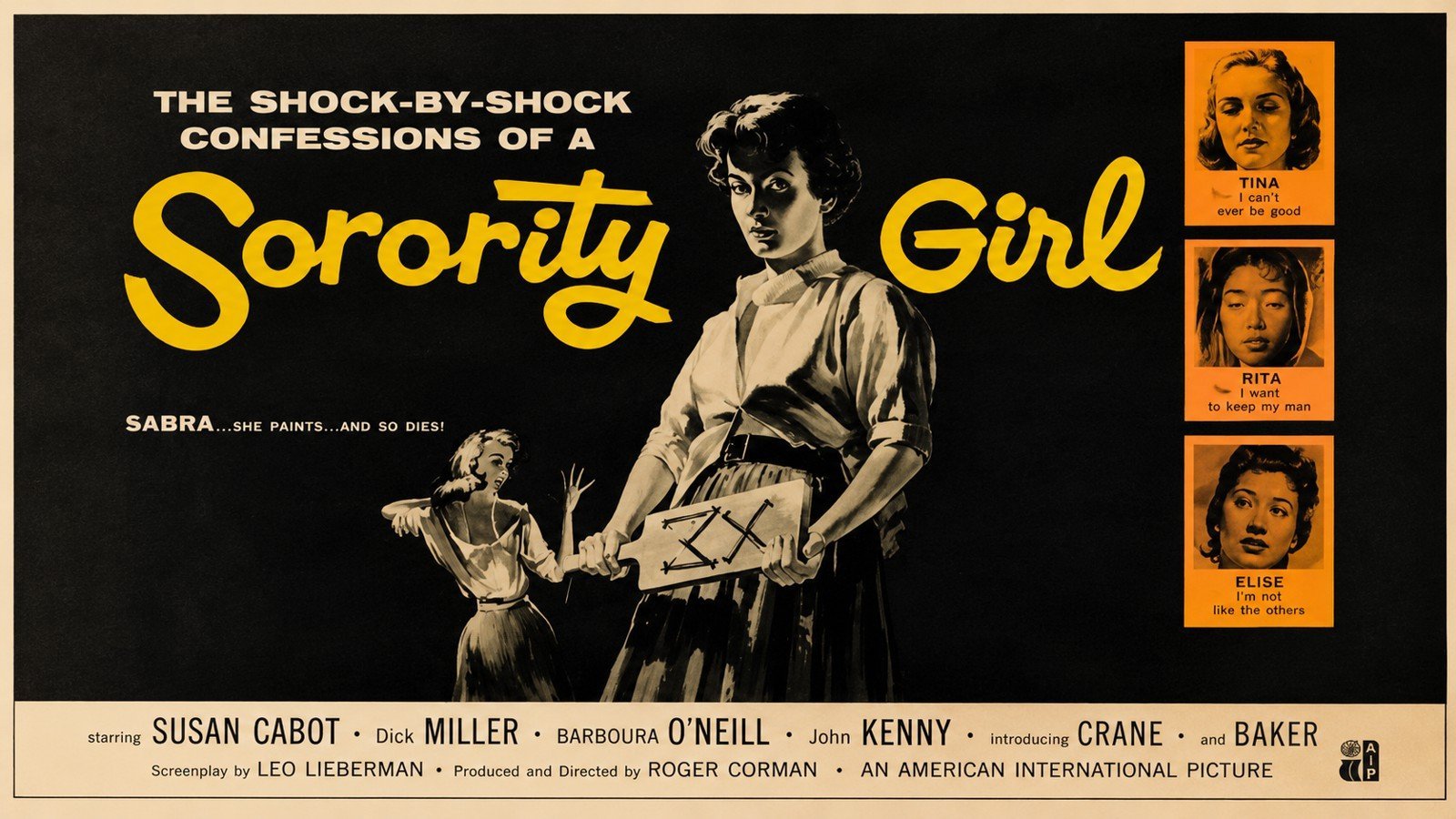
Sorority Girl (1957)
Starring: Susan Cabot, Dick Miller, Barboura O'Neill, Barbara Crane
Director: Roger Corman
Synopsis: Bad girl Sabra lies, cheats, blackmails, extorts and drives folks to suicide!
Reviewed by: Omar Khan
The film opens with one of the most striking title sequences of its era, instantly recalling a period—the late 1950s and early 1960s—that produced some of the finest opening credits ever committed to film. Vertigo immediately springs to mind, and Sorority Girl is certainly worthy of being mentioned in the same breath. The beautifully stylised artwork by Bill Martin accompanies the credits perfectly, creating an atmosphere of unease long before the story itself begins.
Sorority Girl stands proudly as one of the great cult classics, carrying the unmistakable stamp of quality that accompanies the work of Roger Corman at his best.
At the centre of it all is Susan Cabot as Sabra—a girl blessed with beauty, intelligence and vitality, but rotten to the very core. While the other sorority girls spend their time at parties, on the beach, playing sports and chasing boyfriends, Sabra derives her only real pleasure from making everyone else's life as miserable as possible.
She exists to torment.
Her favourite victim is poor Ellie (Barbara Crane), a painfully shy and hopelessly impressionable pledge whom Sabra keeps firmly under her thumb. Ellie is subjected to endless humiliation and psychological cruelty. She is forced through punishing exercise routines while constantly being reminded how plain and unattractive she supposedly is. At one point, she innocently holds a pretty dress against herself and asks Sabra how she looks.
"It looks fine..."
"...but you..."
It is vintage Sabra—cruel, effortless and utterly devastating.
Ellie endures the abuse because she secretly idolises Sabra, whose response to any display of affection is cold contempt.
"Keep your hands off me."
Instead, Sabra happily uses the unfortunate girl to wash her stockings and perform whatever degrading task happens to amuse her that day.
Nor does Sabra reserve her venom solely for Ellie.
She despises her own mother, a feeling that appears to be entirely mutual.
"Darling," remarks her mother with wonderful venom, "I knew you were a rat the day you were born."
"So it's hereditary then."
It is one of the film's best exchanges and perhaps the only clue that Sabra's bitterness did not emerge entirely from nowhere.
In truth, Sabra seems to despise almost everyone—perhaps even herself. Beneath the poisonous exterior lies a lonely young woman who quietly admits,
"I would trade places with any one of them."
Yet she appears utterly incapable of escaping her own twisted nature.
She torments Ellie, blackmails Rita, attempts to extort money from Mort after he rejects her and threatens Tina into becoming an accomplice to her schemes, all without the faintest trace of remorse. Inevitably, however, her carefully constructed world begins to collapse around her, and for the first time, she is forced to confront the consequences of her own malice.
Roger Corman fashions one of the great teenage psychological dramas of the 1950s, proving once again that he could achieve remarkable results on the smallest of budgets. The film is less interested in juvenile delinquency than in emotional cruelty, and Corman handles the material with surprising intelligence and restraint.
Susan Cabot is magnificent.
Her portrayal of Sabra is not merely unpleasant but fascinating. She somehow manages to make an utterly hateful character impossible to ignore, and it remains one of the defining performances of her career.
It is all the more tragic to remember the extraordinary circumstances of Cabot's own death. At the age of fifty-nine, she was bludgeoned to death in her Encino home by her twenty-two-year-old son during a violent confrontation. It was a shocking and deeply sad end for one of cult cinema's most distinctive leading ladies.
Fortunately, performances such as this—and, of course, her unforgettable turn in Corman's The Wasp Woman—have ensured her lasting place in cult movie history.
Sorority Girl deserves every accolade it has received and stands as yet another reminder of Roger Corman's remarkable talent.
The film's most unforgettable sequence comes when Sabra calmly administers a merciless paddling to poor Ellie, smiling with almost frightening satisfaction throughout the punishment.
"All I did was spank her a little... she's a pledge and had to be disciplined."
The scene perfectly encapsulates both Sabra's warped personality and Susan Cabot's extraordinary performance.
Sorority Girl is every bit as good as its reputation suggests—
perhaps even better.

0 Comments
Leave a Comment