
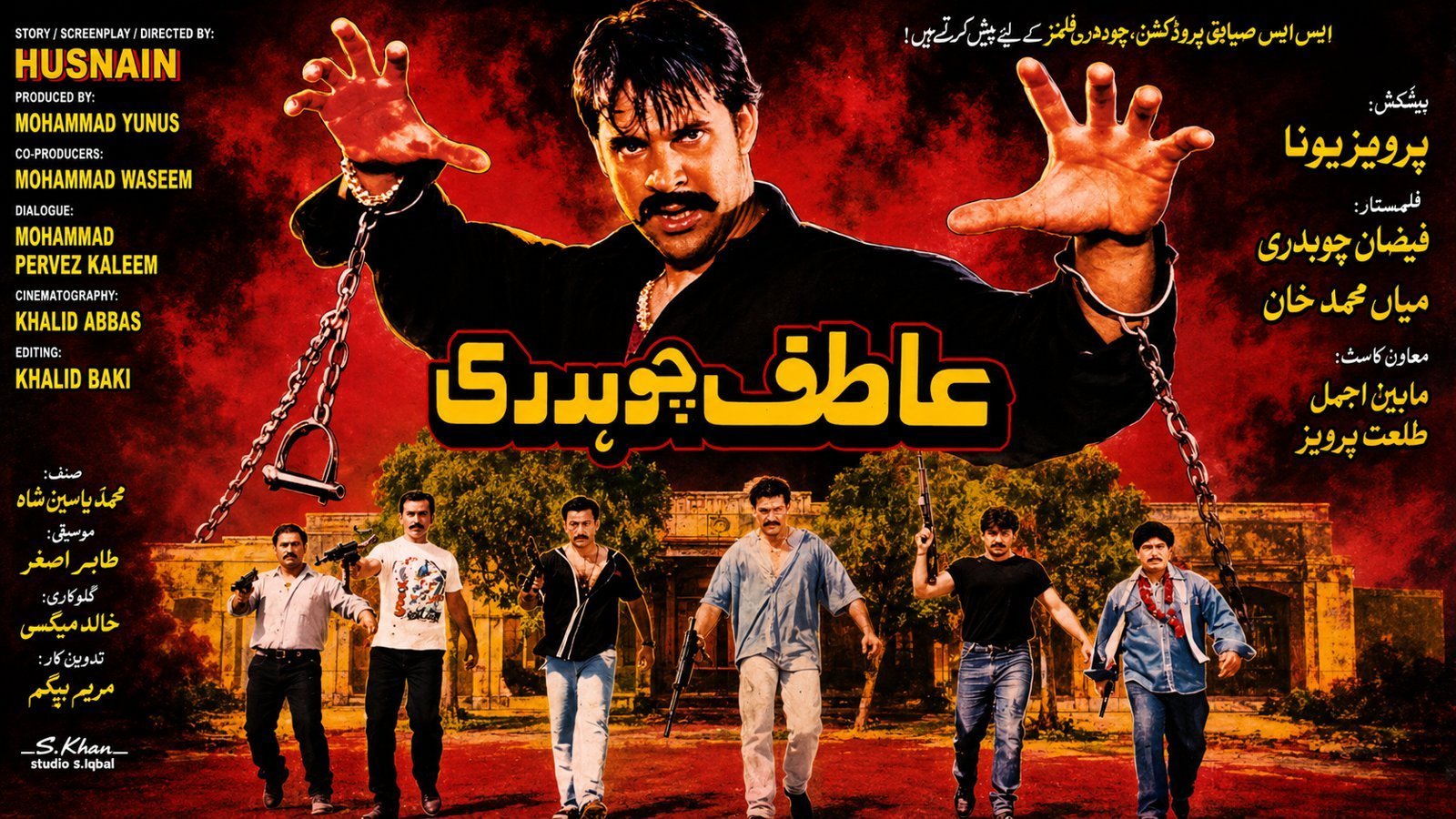
Atif Chaudhary (2002)
Cast: Moammar Rana, Saima, Naghma, Babar Ali, Saud, Nirma, Resham, Shafqat Cheema
Director: Parvez Rana
Synopsis: Based on fact, this violence-laden epic was a surprise hit in 2002.
Reviewed by: Omar Khan
The Atif Chaudhary who inspired this film was supposedly once a brilliant young student marked for greatness. Sadly, fate intervenes cruelly, and he is forced to shun his books and turn to a life of savagery and violence to survive the mean city streets where only the hardened and the meanest pull through.
In the initial scenes, we are shown an elderly couple gushing over the achievements of their wonderful young cherub, Atif. The couple, played by ex-siren Naghma and some crinkled, Kala-Kola dyed chappie in a stiff, crisp shalwar suit, delight at their child’s brilliance—a genius at his schoolwork but also fabulous at memorizing entire tracts from his Holy scriptures. Atif is just perfection itself—with the world at his feet, but we, the audience, know that it is only a matter of time before things start going pear-shaped in a big way.
The fateful day arrives sooner than expected the very next afternoon. As Atif leaves the school, having bid a respectful farewell to his teacher, he notices a fellow student, a rather uncouth ruff sort, taking a brazen piss on the school gate right in front of the horrified teacher’s gaze. Atif, feeling outraged, pummels the disrespectful lout mercilessly to a pulp. Just then, the police arrive, and one of the cops is the father of the pissing and now profusely bleeding runt; they drag poor
Atif away to the local thana to teach him a lesson. Late Atif’s parents are hauled into the thana, humiliated and insulted by the corrupt policemen.
The seeds of doom are sown on this fateful day, and by the time the sun sets, a young Atif has sworn to take up arms and set right the wrongs that the corrupt inflicted on him.
After a stint in prison, Atif has made quite a name for himself as a ruthless gang leader, and thus is perfect for being exploited by the local politicians, who need student thugs as their “militant” party cadre. Atif’s mother is less than thrilled at seeing her cherubic son mutate into a hardened Sultan Rahi clone after his stint in jail, and is even more shocked at his criminal tendencies and liquor intake.
However, through the tears, she can still see that his struggle is one against wrongdoing, even if it is a struggle that can only end in disaster and bloodshed. She warns her son of impending disaster and that she will one day perish due to her son’s Mafioso lifestyle. As campaigning in the district picks up, so does the related intimidation and gang violence with Atif Chaudhary and his cronies. Agha (Babar Ali), Arbaaz Khan, and other muscle-bound, strutting heavies on one side battling the evil, snarling Babar Chaudhary (no, not a long-lost brother!) and his heavies, including a scowling Saud and other mangy specimens.
Time and again, the audience is treated to posturing and swaggering showdowns between the two warring actions, which usually end up with bullets flying and comically dodged. The FEDS inevitably appear in the shape of a good, pious cop, Syed Shah (veteran Asad Bokhari), and a bent cop, Goshay (Shafqat Cheema). The wounded gangs disperse to lick their wounds only to bounce back a few moments later for another bout of swaggering, slanging, and testosterone-charged bravado, and posturing takes place—followed by
Atif Chaudhary more comical, automated mayhem. Good old Syed Shah arrives to spoil the party, if only momentarily.
In between, the director has found time for crowd-pleasing gyrations and pelvic thrusting dances by the three beauties on display: Saima, Resham, and Nirma. They play the three tarts with hearts but have barely any screen time and are only used to add a bit of lewd décor and necessary vulgarity to proceedings, to keep their 100% male audience from nodding off. Saima remains in remarkable order considering her advancing years, even though she has hardly any screen time. Some consolation is that the one very tuneful song by Naseebo Lal (Jind Vech ke) has been choreographed on her rather than the other girls. Nirma looks as tawdry as ever and tries desperately hard to ensure some frontbenchers notice her twitching and thrusting antics because there is little to note about her—acting or otherwise. Granted that the girl has a great sense of humour, though, claiming in recent interviews that she was “the next Shabana Azmi”. If nothing else, Resham has the least screen time, which is a credit to Nirma’s PR charms.
Moammar Rana has won plaudits for his title role and is expected to walk away with numerous awards for his portrayal, truly excessive though it was. One wonders how many packs of lozenges he had to go through while shooting this shout-fest. The film is a strung-together jumble of set pieces, tacked together in sequence to give the viewer an illusion of cohesive continuity and plot. Miraculously it works, in a way that the film appears to have a beginning, middle, and an end, even if they are indistinguishable content-wise. The film is also supposed to be a “message” movie since it is a “true story”. The message calls for an end to violence, but in actuality, it simply glorifies violence and gangsters to extremes and offers no solutions other than those of violence and destruction. It is a film with a deranged, schizophrenic moral, whose anti-violence message is obliterated by the kind of gratuitous orgy of bloodletting and demented logic displayed on the screen. The “message” of the exploitation of student leaders at the hands of cunning politicians is also sadly lost in the mayhem on screen.
In conclusion, Parvez Rana’s film is a shamble, bereft of subtlety, artistry, or even essential storytelling skill. The film is essentially one loud, bellicose posturing and swaggering about, looped on repeat with a cast of predominantly fat, loud, ugly men with jet-black dyed hair, behaving like utter morons, shouting very loudly. Some might suggest a bit like the prevailing political scene in the nation.
Atif Chaudhary is a soulless, vile, and ultimately disturbing film because perhaps it only successfully casts a chilling reflection of a fallen society. Spare a thought for audiences accustomed to regularly digesting intellectually bankrupt garbage like this. Moral of the story: Look the other way when your class fellow decides to have a slash on the school gates.



0 Comments
Leave a Comment