
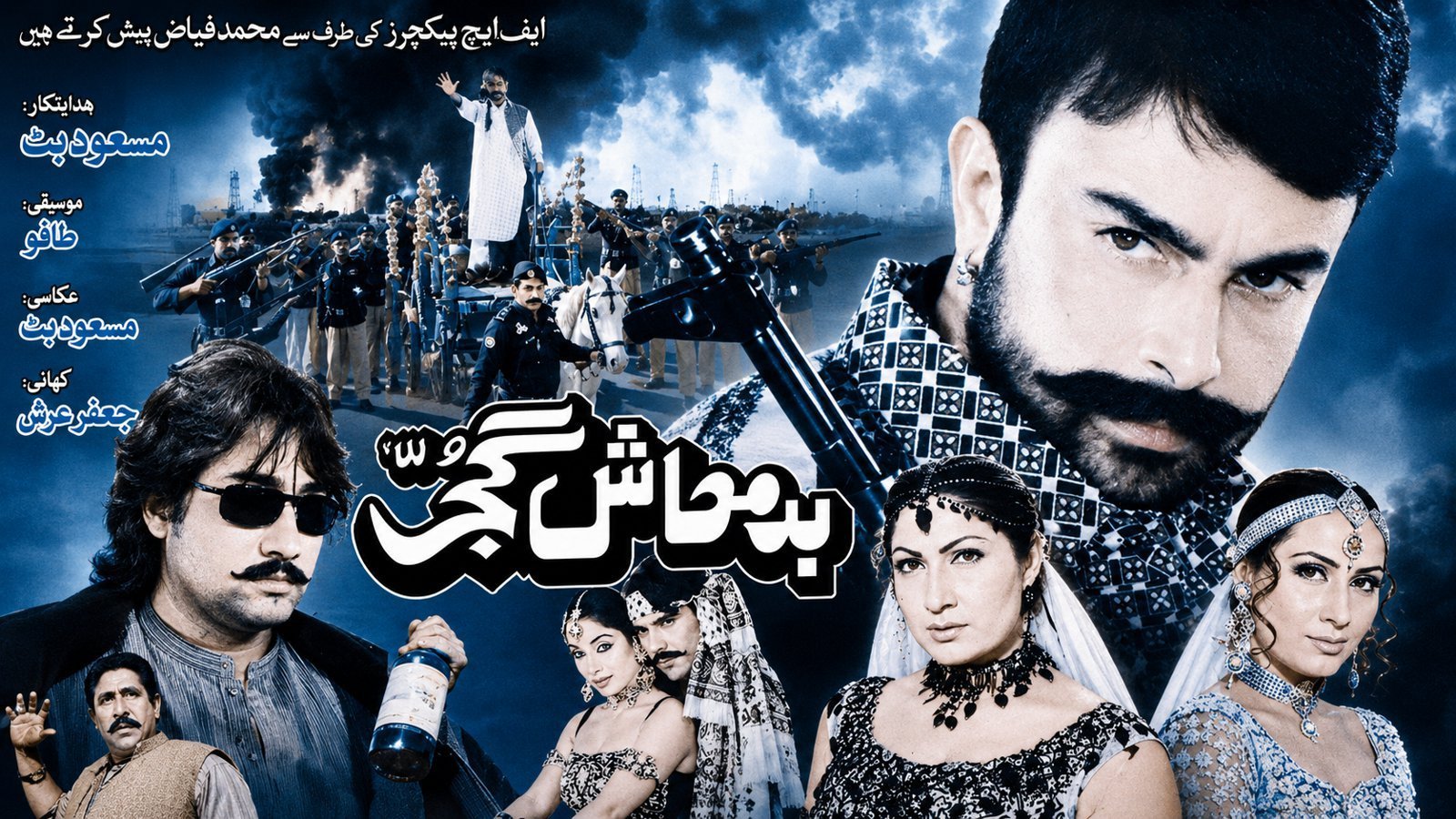
Badmash Gujjar (2002)
Cast: Shaan, Saima, Moammar Rana, Nirma, Saud, Shafqat Cheema
Director: Masood Butt
Synopsis: Circumstances force a god-fearing man to turn into a murdering vigilante! A metaphor rang out loud in the UN General Assembly by our leadership to resounding approval at home.
Reviewed by: Omar Khan
Feeling somewhat adventurous, we decided last night to brave the local cinema hazards to watch one of Lollywood’s recent hit, actionpacked masala potboilers Badmash Gujjar. It’s a waste of time, even bothering to mention the cast. Perhaps now I understand why, as in most screen credits these days, the cast is never mentioned—the simple reason is that every single film has a virtually identical cast, give or take a face here or there. Shaan, the hero playing the title role of this film, appeared in over 50% of all movies released in 2001—surely some record?
Anyway, it’s the same old firm of Shaan and Saima as the lead pair supported by Moammar Rana, Nirma, pre- “Boxed-up” Nargis and Shafqat Cheema as the usual assortment of fat, loudmouthed villains and simpering mothers. The plot is threadbare at best—it’s the same old stale-as-cheesy-socks clan revenge yarn written by the evergreen Nasir Adeeb, who must have written over six million films by now (almost all of which are identical).
For the record, it goes something like this. Shaan is a charming, rustic, god-fearing local lad who honours and reveres his local Maulvi and hangs out at the local Madrassah, where his brother excels at memorizing the holy verses word for word. Shaan is of the finest Gujjar stock, but as his name Shareef implies, he is a peace-loving, godfearing, humble sort. The local milk delivery wench with the oversize mammary glands has a massive crush on him and serenades him with a sizzling dance or two whenever the opportunity arises.
Shareef Gujjar’s best buddy, Bhola (pronounced Pola), acted by Moammar Rana, is a loud, intellectually faltering buffoon who just about manages a paan stall. His most significant problem is his infatuation with the local prostitute Nirma, despite her avidly entertaining rich men every night of the week. However, she recognizes true love in Pola, even if he isn’t the wealthy prince in shining armour she hoped for. One day, some nasty villainous goons led by Saud and Cheema swagger into town and go to Nirma’s Kotha, where she is booked to entertain. When Pola hears of this indignity, he arrives at the Kotha, where a terrible shoot-out follows. To cut a long story short, Nirma is “saved” from the life of being a tawaif by Rana, who is then framed by the police and imprisoned.
Later, Cheema and Saud hunt for Nirma to force her to return to the Kotha. Eventually, their search for Nirma leads them to Rana’s best buddy Shareef, who is having an almighty celebration for his brother, who has memorized every word of the Holy Scripture, a highly commendable feat. The goons gatecrash the celebrations and demand Nirma. When they are met with resistance, they gun down the celebrating lad mercilessly with no regard for his recent memorizing of the holy book.
Finally, Shareef Gujjar realizes that to survive and compete in this horrid world, one must have a change of name and heart. So, he announces no less than five times very loudly that he is now to be known as Badmash Gujjar rather than Shareef Gujjar, and as if to prove his point, he guns down about 60 police officers in the next 30 seconds.
Badmash Gujjar
The rest of the film is more of the usual loud posturing and shouting confrontations, followed by more ludicrous fight scenes where no one ever seems to land a single punch. The film winds down to its utterly predictable end, and finally, the torture is over.
The question that begs is who ought to be blamed for the deplorable levels of filmmaking in Lollywood these days. Should the filmmakers alone be held responsible for plunging standards, or should the audience take its fair share of the burden? After all, they have propelled some of the most dubious films in recent history into becoming big-money spinners: Sultana Daku, Billo 420, Ishtehari Gujjar, Asoo Billa, Hamayun Gujjar, Makha Jatt,
Ghunda Tax, Badmash Gujjar and possibly the sleaziest of them all, Sher e Lahore and Dada Badmash—among the biggest successes of the lot.
If the filmmakers are guilty of churning out new levels of vulgarity and mindless violence, the public provides their verdict with their ticket-buying power. That verdict is clear that the more vulgar and lewd the dances and the cruder the dialogues and situations, the more the public will dish out their money. OK, once in a while, a half-decent film comes along that does very well at the Box Office (Tere Pyar Main, Khoay Ho Tum Kahan), but how many of these kinds of films flop before one hits the jackpot? On the other hand, a certain level of vulgarity and a set of sleazy dances almost always guarantee a decent profit. Why, after all, should filmmakers spend their time and money making family socials for empty halls when all the punters seem to be willing to pay for is some raunchy sleaze?
Let’s face it, Sher-e-Lahore packed them in simply on the strength of the raunchy, sleazy songs (the infamous Nirma dance that the censors have now excised), and the same can be said for Dada Badmash as well as Ghunda Tax and Gujjar Badmash. The new version of Wehshi Jatt has also run into problems with the new Mary Whitehouse-type censors who have been adamant about removing a song or two from the film. Oh, the hypocrisy of it all!
0 Comments
Leave a Comment