
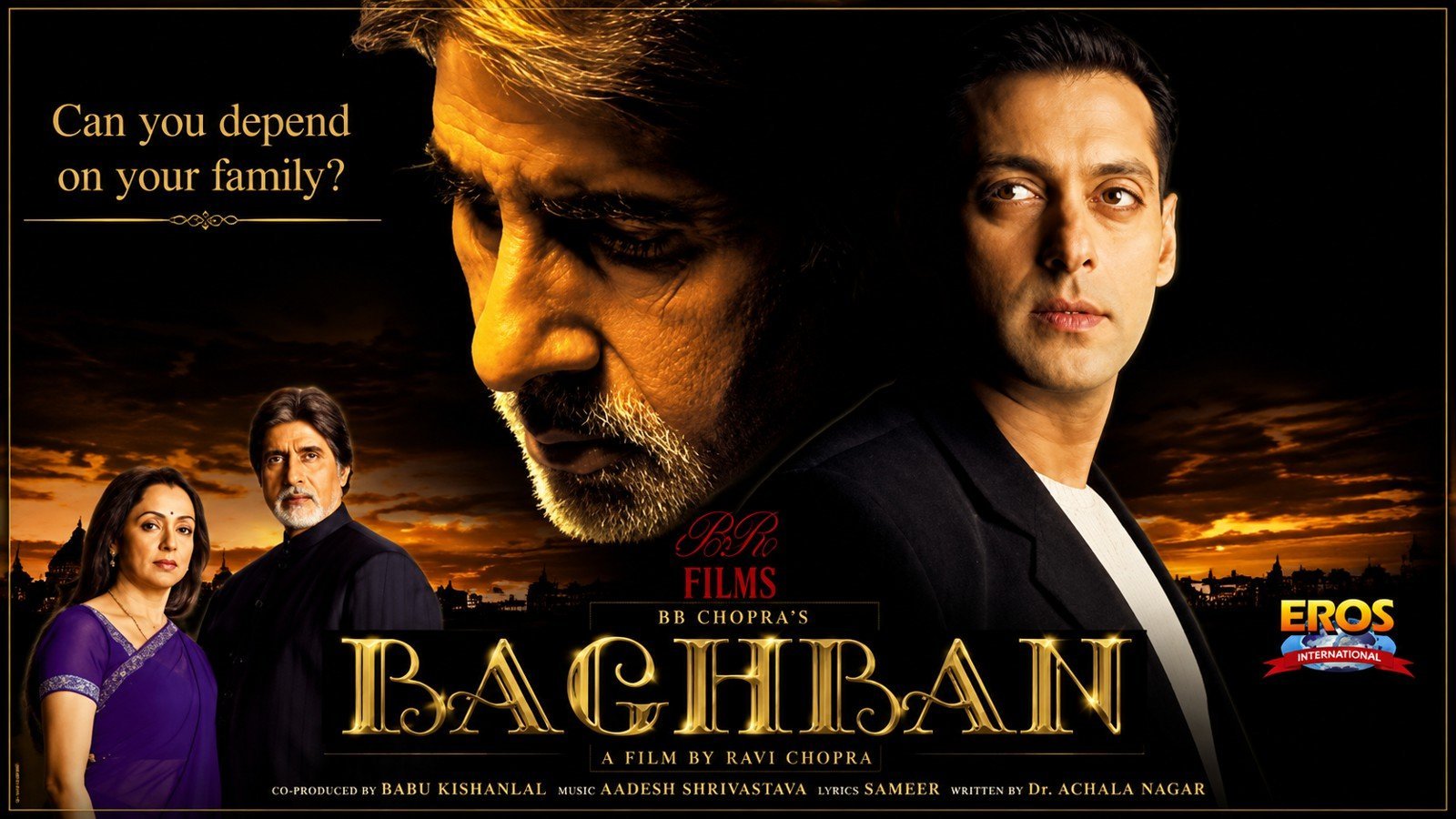
Baghban (2003)
Cast: Amitabh Bachchan, Hema Malini, Paresh Rawal, Lillette Dubey, Sameer Soni
Director: Ravi Chopra
Music Director: Aadesh Srivastava
Synopsis: Old-fashioned charm. Highly recommended.
Reviewed by: Faiz Khan
It's been 22 years since Amitabh Bachchan and Hema Malini last came together for a film. Their pairing began way back in 1973 with Kasauti, when Hema ruled the roost, and Bachchan was little more than a supporting player. Their previous collaboration was Satte Pe Satta 22 years ago. Whilst Bachchan was more commonly paired with Rekha or Zeenat Aman and Hema with Dharmendra or Shashi Kapoor, Baghban reunites the two stars and, even after so many years, there is a freshness to their pairing not seen in either the Amitabh-Rakhee combination in Ek Rishtaa or Amitabh and Jaya Bachchan in Kabhi Khushi Kabhie Gham.
Baghban is a story as old as the hills.
Raj (Amitabh Bachchan) and Puja Malhotra (Hema Malini) are on the verge of celebrating 40 years of marriage. Here we find two people who are as devoted to each other now as they ever were. The love remains strong, as does the companionship between them. Shown in typical Bollywood fashion, with Puja coming to the door before Raj has even had a chance to knock, it nevertheless drives home the point that this couple are still very much in love. They have four sons, three of whom are married and one unmarried. There is also an "adopted son", Alok (Salman Khan), whom Raj and Puja brought up as one of the family. It is all happy families until Raj decides to retire. The parents now wish to spend the rest of their lives with their children and leave it to them to decide who will take on the responsibility of looking after them first.
Sitting by themselves, Raj and Puja wonder whether the delay in reaching a decision is because their children are arguing over who should have the privilege of caring for them. The truth could not be more different. Each son agrees to take responsibility for only one parent, for six months at a time. The reasoning is that each child wants "a bit" of each parent. Shocked, Raj refuses to be separated from Puja, declaring, "They want to separate us, not share our love." Puja, however, believes the suggestion comes from genuine affection, and Raj eventually agrees.
Slowly, reality dawns on them both. Raj and Puja are relegated to the background, treated with indifference, disrespect and a complete lack of appreciation. Wives take precedence over the weak-willed sons and, with Raj now having no money to speak of, there is little reason for anyone to pander to him. Raj at least finds companionship in a kindly couple (Paresh Rawal and Lillete Dubey), who ease his loneliness. Puja, meanwhile, is virtually caged indoors with no company and no say in anything. It is a miserable existence for them both, and they yearn to be together again. Alok (Salman Khan) and his wife Arpita (Mahima Chaudhry) eventually re-enter their lives, but by then Raj and Puja have already moved on.
What makes Baghban different is not the story itself, but the manner in which it is told. There have been umpteen films on this subject before, but they usually dealt with situations taken to ridiculous extremes. Mothers were reduced to working as naukranis while the bahus resembled harridans with leather whips tucked away in their back pockets. Torn clothing, masses of white hair and endless indignities became the norm for elderly parents. Not so in Baghban. Raj and Puja are a modern yet traditional couple. Growing old does not mean giving up on looking after yourself. Puja, for one, does not have a single white hair and good for her. They are simply a couple who have happily devoted their lives to their children whilst never forgetting to nurture the love they have for one another.
Ravi Chopra has put together a sincere and sensitive film which, at times, suffers from small bouts of excess. Alok's character, his re-emergence into the lives of Raj and Puja and some of his actions are undeniably cringeworthy, but they exist purely to illustrate, in the starkest possible terms, the difference between him and the Malhotras' own flesh and blood. Likewise, the scene in which Puja arrives at the disco to rescue her granddaughter from being molested is straight out of Bollywood, with Hema's emphatic "You scoundrel!" bringing the house down.
Chopra's depiction of the bahus is also somewhat hackneyed and, whilst there are other inconsistencies, by and large the film remains engrossing without becoming excessively melodramatic. For once, it also delivers a thoroughly satisfying climax. Raj and Puja eventually emerge with their dignity intact, although the film leaves you wondering about those elderly parents who lack the financial means to escape and remain at the mercy of their unappreciative children.
Amitabh Bachchan brings tremendous restraint and sensitivity to his role, although one could have done without the many songs he has been given to sing. In fact, the telephone conversation between Raj and Puja, later turned into a song, is far more moving when they are simply talking to one another.
Still, Bachchan once again demonstrates what a consummate performer he is, delivering a solid and deeply moving performance. Hema Malini is an absolute delight, looking beautiful while bringing enormous grace and charm to her character. It is her regal presence that lifts the film a notch or two above your usual run-of-the-mill family drama. Ultimately, Baghban belongs to these two wonderful performances and to the enduring charm of its central pairing. Paresh Rawal and Lillete Dubey provide some welcome light relief in what could otherwise have become a much heavier film. The rest of the cast acquit themselves well. The music, however, is ordinary.
Old-fashioned charm. Highly recommended.

0 Comments
Leave a Comment