
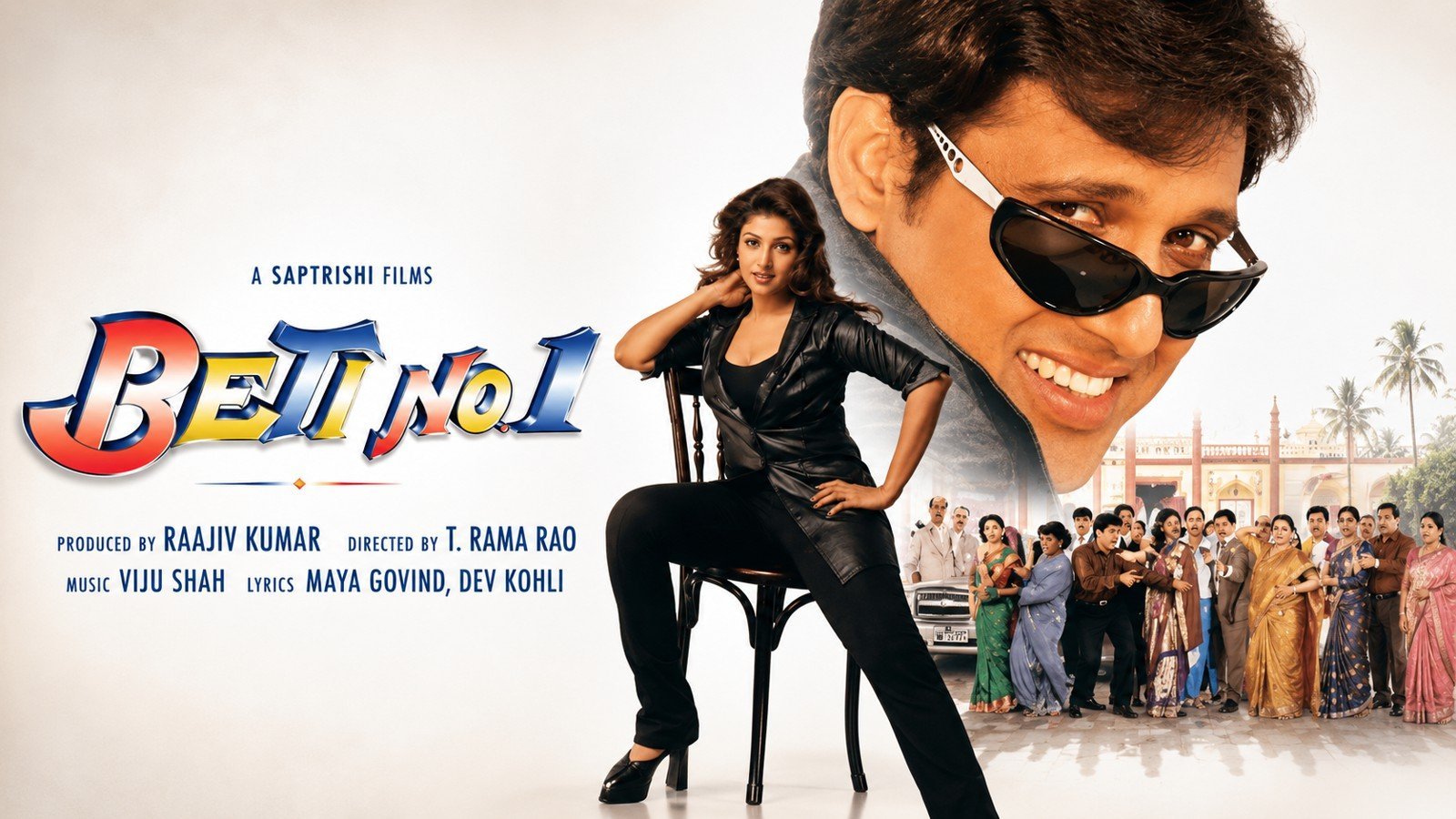
Beti No.1 (2000)
Starring: Govinda, Rambha, Aruna Irani, Prem Chopra
Director: T.Rama Rao
Music Director: Viju Shah
Synopsis: horrendous, time warped sexist crap that T. Rama Rao specializes in.
Reviewed by: Faiz Khan
It defies logic that a film like this should be attempted in this day and age—a film with nothing whatsoever to say, no redeeming qualities and a totally regressive plot. It's all dressed up as a typical Govinda comedy, but where are the laughs? Actually, to be fair, it had me in fits—albeit totally unintentionally. Sometimes a film can be so unbelievably awful that you actually end up enjoying its sheer mediocrity.
This one falls squarely into the Govinda family comedy mould. Durga Devi (Aruna Irani) has three sons—Govinda, Ashok Saraf and Laxmikant Berde. The latter two are married but have so far produced only daughters, much to their mother's disgust. Laxmikant Berde's wife has already been packed off to her father's house for committing the unforgivable crime of giving birth to yet another girl, and the family's only remaining hope now rests with Ashok Saraf's pregnant wife, who everyone is praying will produce a boy.
Why should the sex of the child matter? Because Durga Devi intends leaving her entire fortune to the grandchild who carries the family name forward. Hence the mad scramble to procreate as quickly as possible in the hope of inheriting the family riches.
As fate would have it, Saraf's wife gives birth to yet another daughter and both mother and child are promptly shunned. Meanwhile, the youngest son, Govinda, begins romancing the elephantine Rambha, a girl of humble means but decidedly ample girth, who works in a telephone booth. Love blossoms but, naturally, mother dearest refuses to accept a girl with nothing to offer. So, with the help of his father (Prem Chopra), two lakhs are produced by way of dowry and the couple are duly married off.
They live in blissful harmony until Durga Devi discovers the deception and lashes out at both her weak-willed husband and her son. Her punishment is to sack the household maid, leaving the nai dulhan to assume the role of the naukrani. How will she ever redeem herself?
Luck appears to be on Rambha's side when she falls pregnant and Durga Devi's father predicts that this child will bring great happiness to the family. Naturally, everyone assumes this can only mean she is carrying a boy because, after all, how could the birth of a girl possibly bring happiness? Durga Devi immediately changes tack and suddenly becomes sweetness and light towards the favoured bahu who is destined, so she believes, to provide the long-awaited heir.
However, during a visit to the doctor, Govinda and Rambha are informed that they are expecting a girl.
Quelle horreur.
Now all the goodwill will evaporate, not to mention any hope of inheriting the family fortune. The couple therefore decide to keep up the pretence that the baby is a boy.
When the time comes for the delivery, Johnny Lever's wife also goes into labour. Both women give birth at the same hospital. The following is a shortened version of events.
Durga Devi collapses and is admitted to the very same hospital. Govinda's father (Prem Chopra) sees Govinda holding Johnny Lever's baby boy, mistakes him for his own grandson and promptly runs off with the child in an effort to revive the ailing Durga Devi. Three days later she is ready to take her precious grandson home.
But what of poor Johnny Lever and his wife, who have been left with a baby girl who is not even theirs?
Well, they are persuaded to move into the neighbourhood and what follows is a series of increasingly ridiculous scenes involving mothers running from one house to another to feed, comfort and put the "correct" baby to sleep before quietly returning the infants to maintain the deception by morning.
The story drags on until the inevitable, cliched realisation by Durga Devi that perhaps she made a mistake. One cannot even summon the energy to be offended by the film's utterly regressive attitudes because it isn't made with so much as a single iota of intelligence. Even the ending fails to offer any meaningful message in defence of the betis, who have been subjected throughout to one of the most mindless and pathetic pieces of filmmaking imaginable.
The final insult arrives when the feckless husband finally raises his hand against his domineering wife, prompting his father-in-law to applaud him with words to the effect that only now has he become a real man.
Pardon me for wanting to vomit.
There is little one can say about the cast. It is rather sad that Govinda wastes himself in roles like this. The film itself looks terribly dated and has all the hallmarks of a production that spent far too long in the making. The less said about the remainder of the cast, the better. There are one or two hummable songs, but nothing that lingers in the memory.
T. Rama Rao has directed many stinkers over the years, most of them so forgettable that none immediately spring to mind. This one can happily join the list.

0 Comments
Leave a Comment