
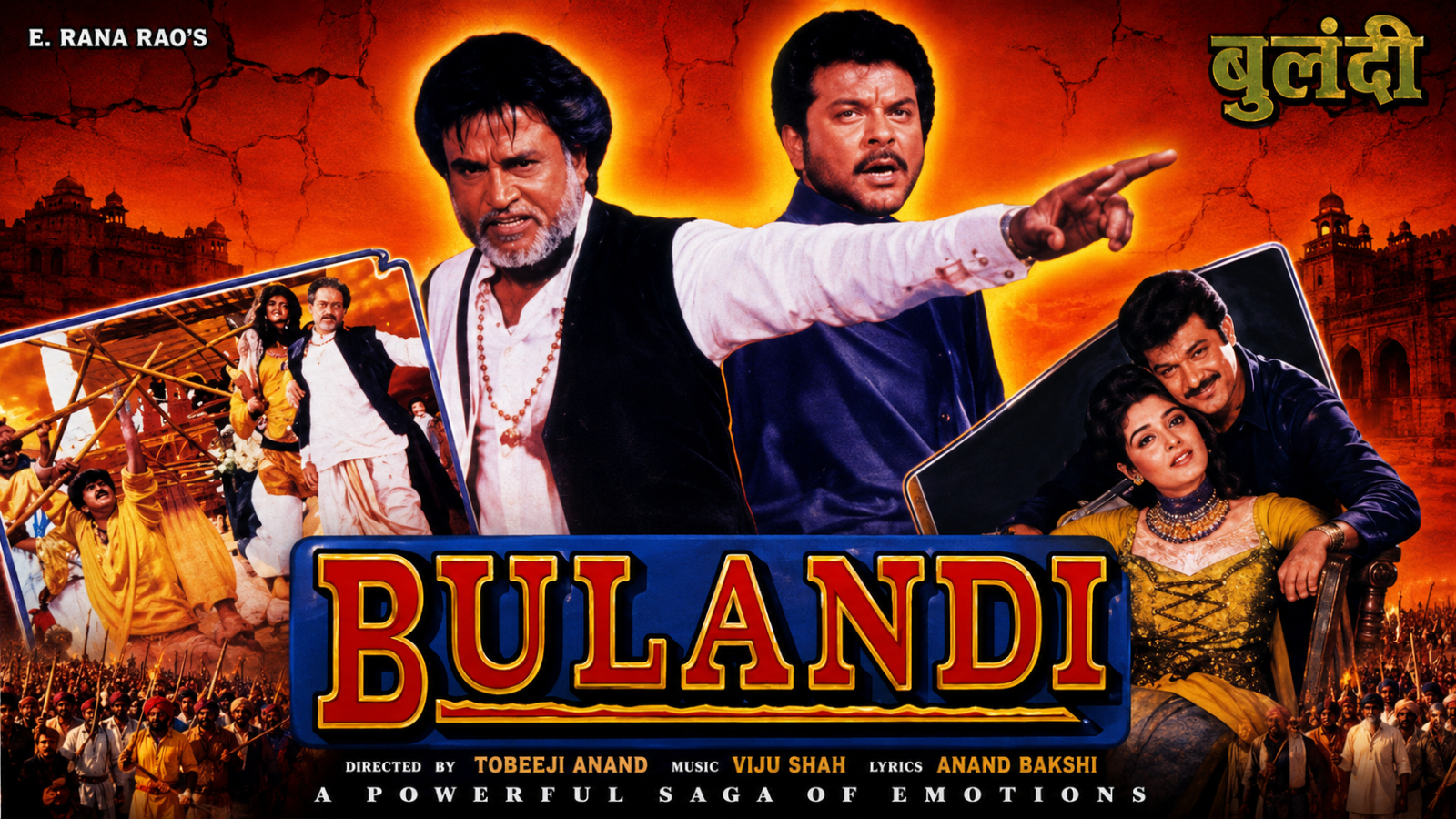
Bulandi (1999)
Starring: Rekha, Anil Kapoor, Raveena Tandon, Shakti Kapoor, Aruna Irani, Ranjeet, Rajnikant
Director: T. Rama Rao
Synopsis: Twisted tale of South Indian family traditions
Reviewed by: Omar Khan
Bulandi begins auspiciously enough with slow-motion shots of Dada Thakur striding purposefully towards his destiny while, in the background, a heavenly chorus strains away as though desperately trying to convince us that we are witnessing the arrival of someone truly extraordinary.
Clearly, Dada Thakur is a very special man. At the same time, however, let us not overlook his wife, who is nothing less than the very perfection of womanhood—ravishingly beautiful, endlessly self-sacrificing and, most importantly, utterly servile. She is the patron saint of dutiful wives. Naturally, she cooks flawlessly and sings like an angel as well, because how could it possibly be otherwise?
This blissfully contented slave is played by the ever-reliable Rekha. Anil Kapoor plays Dada Thakur, her devoted husband and the town's saintly patriarch, somehow managing to maintain a straight face whilst delivering some of the most mind-altering dialogue committed to celluloid in recent years.
The plot is so convoluted that it almost defies description. Suffice to say that Bulandi is one of the most morally twisted and ideologically deranged films to emerge in quite some time.
Rekha's idea of the perfect wife is really that of an unpaid nurse who appears on cue bearing tea, water and cups of "prasad", all whilst looking immaculate. The film's message is delivered with all the subtlety of a motorised sledgehammer. It makes abundantly clear that everyone in the "perfect society" has a predetermined place and purpose, and that true harmony can only exist if every individual dutifully accepts that assigned role. The moment anyone dares aspire to something different or better, the very fabric upon which society is built begins to unravel. Clearly, there is no room whatsoever for independent thought or any alternative viewpoint in Bulandi's ideal world.
This preordained "social order" applies within the home as well, where every member of the family has a predestined role to fulfil if life is to proceed according to plan. It also extends to society at large, where each lowly peasant is expected to feel positively thrilled with his miserable lot. The simple act of aspiring to anything better would upset society's carefully balanced apple cart and threaten the established order.
There is probably very little point in reading too deeply into the morality and motivations behind this lumbering South Indian phantasmagoria. It is probably best taken entirely at face value. Yet there remains something oddly fascinating about the mindset capable of producing such a warped fantasy.
Just when you think proceedings have finally staggered towards their utterly predictable climax, however, the director delivers a genuine jaw-dropper—a scene so astonishingly bizarre that even John Waters, the self-proclaimed Prince of Puke, might have watched it with a degree of professional envy.
During the film's insanely ridiculous climax—part fistfight, part childbirth—Rekha, acting as midwife, receives a generous splash of some mysterious liquid across her face, an event that appears to satisfy her enormously. Just bear in mind that there isn't a bucket, tap or faucet anywhere in sight.
You decide what that mysterious substance was supposed to be.
Do keep a barf bag handy, though.
Enough said.

0 Comments
Leave a Comment