
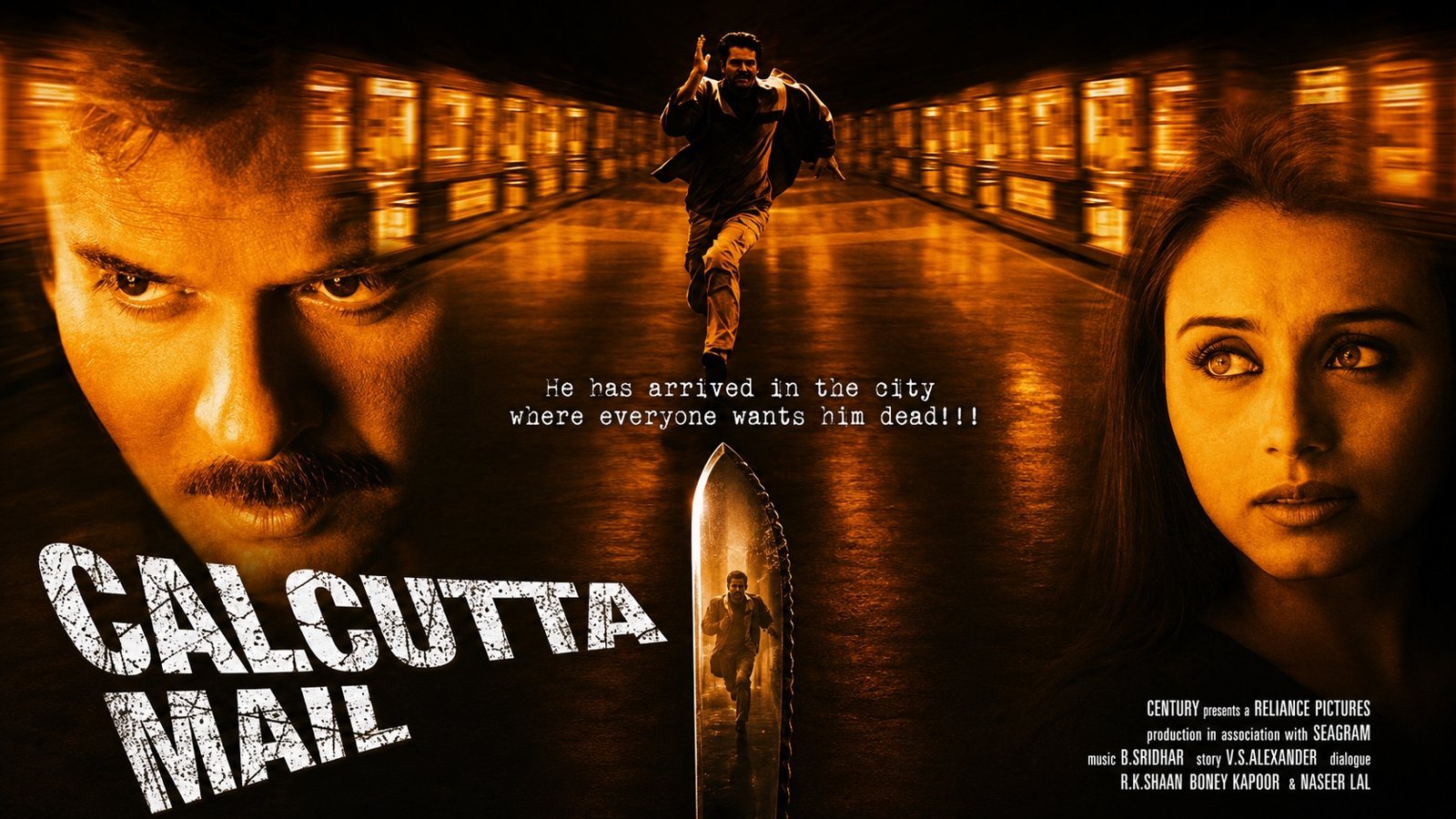
Calcutta Mail (2003)
Cast: Anil Kapoor, Manisha Koirala, Rani Mukherji, Satish Kaushik
Director: Sudhir Mishra
Music Director: Anand Raaj Anand/Viju Shah
Synopsis: a look at the slimy underbelly of Calcutta's underworld - disappointing fare
Reviewed by: Faiz Khan
The film opens with Avinash (Anil Kapoor) stepping off the Calcutta Mail at Kolkata's Howrah Station, emerging into a sea of humanity with a very definite purpose. He is a man driven by a mission, relentlessly searching for one Lakhan Yadav (Sayaji Shinde). His quest takes him deep into the city's criminal underworld in pursuit of the elusive gangster.
Lakhan Yadav, we soon discover, is a vicious, manipulative and thoroughly unpleasant small-time mobster. It is immediately apparent that there is some connection between the two men, although the nature of that relationship remains unclear.
Avinash rents a room in a crowded chawl, where he encounters Bulbul (Rani Mukherjee), who happens to be occupying the same accommodation. Bulbul, however, is not quite what she appears to be. She is living there under false pretences, researching the lives of chawl residents for a novel she is writing. An easy friendship develops between the pair, which, inevitably, blossoms into romance through the obligatory dream-song sequences as Bulbul falls for the mysterious stranger.
Gradually, the truth begins to emerge.
Lakhan Yadav has kidnapped Avinash's young son, and Avinash has come to Kolkata to bring him home.
The film then slips into an extended flashback. We learn that Avinash had once rescued Manisha Koirala's character from an unwanted marriage arranged by her gangster father (Satish Kaushik), who intended her to marry his loyal henchman, Lakhan Yadav. Instead, Avinash marries her, and the couple settle into a seemingly happy domestic life. Their happiness proves short-lived. One day, Avinash returns home to discover his wife brutally murdered and his son missing.
Returning to the present, Avinash seeks help from his father-in-law, who reveals that Lakhan Yadav is responsible for his daughter's murder and is now demanding fifty crores in exchange for the safe return of the kidnapped child.
Calcutta Mail begins as a dark, atmospheric journey through the murkier corners of Kolkata, but gradually falls victim to familiar Bollywood conventions. The introduction of Bulbul's character marks a distinct turning point. Once the romantic subplot takes centre stage, much of the realism established during the opening reels evaporates, replaced by increasingly predictable commercial formulae.
The screenplay struggles to reconcile two very different ambitions. Sudhir Mishra clearly wants to make a gritty crime drama, yet repeatedly interrupts the narrative with conventional song sequences and romantic diversions that sit uneasily alongside the film's darker themes.
One is left wondering whether Bulbul's character was really necessary at all. Would the film not have been stronger had it concentrated entirely on Avinash's desperate search for his son? Likewise, the beautifully photographed images of Kolkata and the imposing Howrah Bridge lose much of their impact when interrupted by fantasy song sequences staged in picturesque hill stations that bear no relationship to the story being told.
Ultimately, Calcutta Mail settles into becoming another familiar gangster drama despite a reasonably effective climax. In trying to balance commercial expectations with a more realistic approach, Mishra never quite succeeds. Ram Gopal Varma achieved this blend far more convincingly in Company. Here, the two styles remain in constant conflict.
Anil Kapoor delivers a fine, restrained performance as Avinash, underplaying the role and conveying just the right balance of determination, grief and quiet desperation. Rani Mukherjee is, as always, immensely likeable, bringing warmth and charm to a character that feels more like a commercial obligation than an organic part of the screenplay. Manisha Koirala has disappointingly little to do and is largely wasted, while Satish Kaushik is suitably menacing as the gangster patriarch.
The music is uninspired and frequently disrupts the film's momentum rather than enhancing it.
In the end, Calcutta Mail promises considerably more than it ultimately delivers.

0 Comments
Leave a Comment