
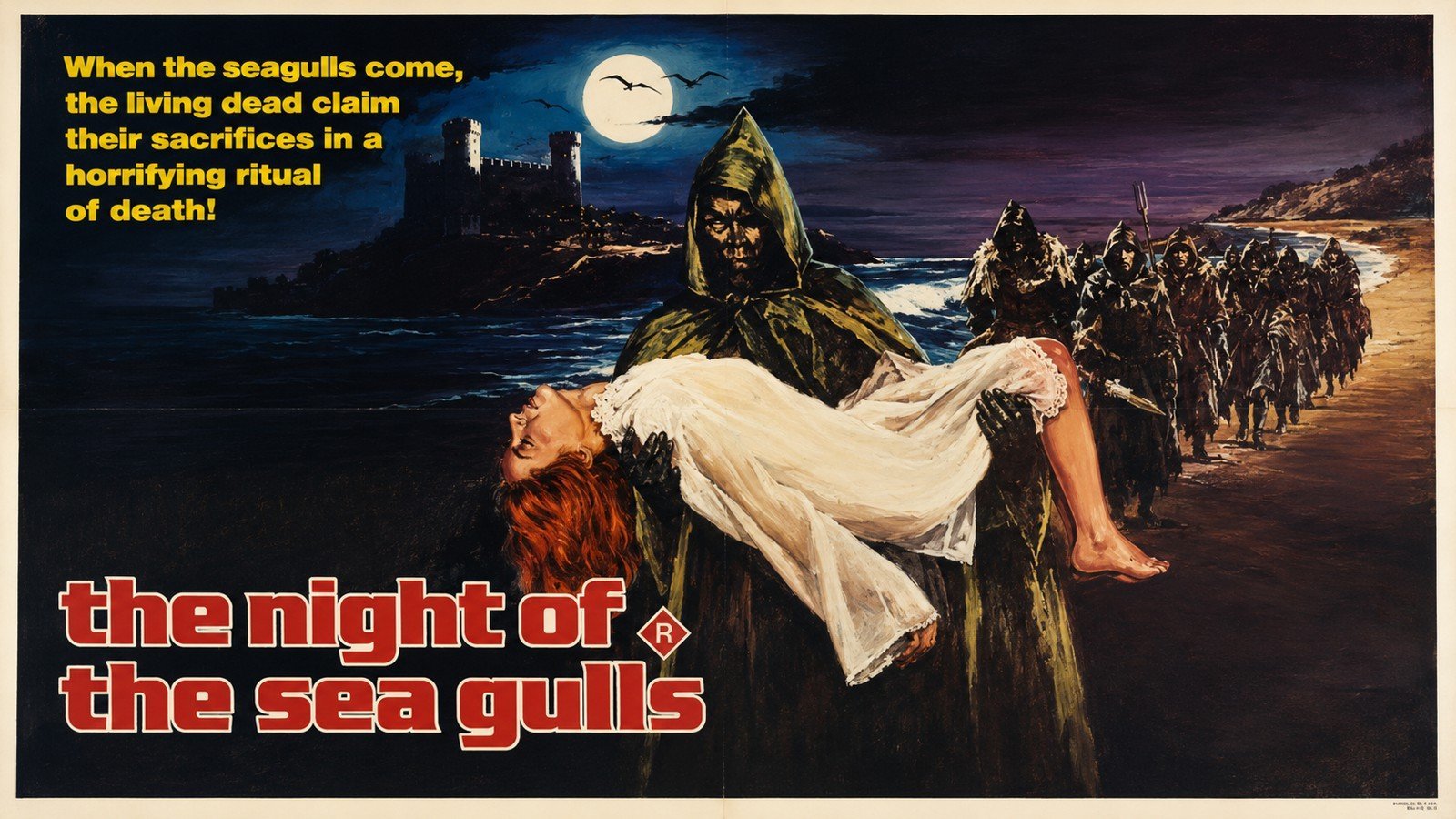
Night of the Seagulls (La Noche de las Gaviotas) (1975)
Starring: Victor Petit, Maria Kosti, Sandra Mozarosky, Julie James
Director: Amando De Ossorio
Synopsis: the fourth and final instalment of Ossorio's epic Blind Dead series
Reviewed by: Omar Khan
This was the fourth—and, alas, final—instalment in Amando de Ossorio's epic “Blind Dead” series, featuring those magnificently gruesome and murderous Knights Templar from the 16th century. In the previous film, “The Ghost Galleon” (“Horror of the Zombies”), the undead Templars were seen sailing their spectral galleon across the seven seas, leaving a grim trail of blood as their chilling signature. A pseudo-scientific holy man and his companions eventually managed to cast the Templars' coffins overboard, seemingly ridding the ghost ship of its cursed occupants. Yet, in one of the most memorable moments of the entire series, the Templars slowly emerge from the ocean floor to continue their murderous quest on land.
The stage is therefore set for “Night of the Seagulls”, which opens with a young couple lost in one of Ossorio's characteristically desolate, mist-shrouded landscapes. The husband heads off in search of help, leaving his busty young wife waiting alone in the middle of nowhere. As darkness falls, the ominous strains of Antón García Abril's haunting score begin to build, accompanied by the now-familiar sight of ancient coffins creaking open as shrivelled limbs slowly emerge from within.
By this stage, the imagery has become so familiar that one begins to wonder whether Ossorio has quietly recycled footage from “Tombs of the Blind Dead”. The Templars brutally savage the unfortunate husband before turning their attention to the helpless beauty waiting in the carriage. She is carried down into their underground cavern where, in one of the series' more memorable moments, her heart is cut from her chest and offered to a grotesque stone deity before the bloodthirsty Knights gleefully feast upon her remains.
Apparently, all of this took place many years ago.
Ossorio then rather cheekily informs us that the story we are about to witness is based on "true events."
The action shifts to the present as a young doctor and his attractive wife arrive in a remote seaside village, where they receive an unmistakably frosty welcome from the suspicious locals. Dr. Stein (mercifully not Frankenstein for a change) settles into his rustic new home while his increasingly uneasy wife begins to suspect that something is seriously amiss.
Close to midnight the couple are awakened by strange sounds. A distant church bell begins tolling across the darkness, followed by the cries of seagulls—which, we are repeatedly informed, is highly unnatural, as gulls are supposedly silent at night. Then come the eerie chants.
Venturing outside, the couple discover a procession of hooded figures leading a scantily clad young virgin towards the rocky shoreline.
Out of the darkness emerge the Templar Knights, riding in their trademark slow-motion style to claim the latest sacrifice offered by the village elders. The unfortunate girl is promptly torn apart, leaving only scattered remains strewn across the beach for the local crabs to enjoy.
Ossorio then proceeds to devote what feels like an eternity to watching these carnivorous crabs slowly edge towards the remains with murderous intent glistening from their already bloodstained claws. One almost pinches oneself to confirm that these scenes are really happening. Better still, they return for an encore later in the film.
The doctor eventually discovers the horrifying truth. The village has long been held hostage by the undead Templars, and the townsfolk have struck a dreadful bargain with their tormentors. Each year, they must sacrifice seven beautiful young women—one each night over the course of a week—in the hope that the Knights will spare the rest of the community.
Unfortunately, the doctor's attractive young assistant is next in line.
Racing to the beach, he finds her bound and awaiting her gruesome fate just as the Templars emerge from the darkness. The pair narrowly escape, pursued relentlessly by the undead horsemen. Together with the doctor's wife, they barricade themselves inside the house, but the Templars slowly lay siege to the building, smashing their way inside with grim determination.
Forced to flee once again, the survivors finally arrive at the underground cavern where the Templars perform their gruesome rituals.
There, the doctor makes a startling discovery.
Apparently, after four entire films, somebody has finally realised that these supposedly indestructible monsters can simply be set on fire with a burning torch.
Armed with little more than a flame, he keeps the advancing Knights at bay while he and his wife topple the grotesque stone deity, sending it crashing into a heap of rubble. As the idol collapses, the Templars appear to lose the mysterious force sustaining them. Like ancient mummies, they begin crumbling into dust, blood spurting from empty skulls before they finally collapse into lifeless heaps.
Have the Blind Dead finally been laid to rest?
One rather doubts it.
Like its predecessors, “Night of the Seagulls” unfolds at a deliberately slow, almost hypnotic pace. Certain scenes appear to have been photographed at a speed slower than real time itself. There is relatively little gore on display and, disappointingly for some, even the obligatory lesbian sequence has disappeared.
Ossorio clearly strives to recapture the eerie atmosphere that made “Tombs of the Blind Dead” such a memorable experience, and although he never quite reaches those remarkable heights again, he succeeds often enough to make this a worthy conclusion to the series.
The film's greatest strengths remain the unforgettable scenes of the Templars rising from their graves and emerging silently from the darkness, all accompanied by Antón García Abril's magnificently haunting score. Those moments still possess an almost dreamlike power.
And then there are the crabs.
The crab-feeding scenes have to be seen to be believed. One could quite happily put the kettle on, make a cup of tea, answer the telephone and return several minutes later to discover the crabs still methodically working their way through the remains. Such is Ossorio's extraordinary affection for prolonged crustacean dining.
For what it's worth, “Night of the Seagulls” is a considerable improvement over "Return of the Evil Dead", although it never quite matches the haunting brilliance of the original "Tombs of the Blind Dead". By the fourth instalment, however, even the magnificent spectacle of watching coffins slowly creak open while shrivelled limbs emerge from within begins to lose a little of its novelty.
Perhaps it really was time for the Templars to call it a day.
At least for the time being.
(Though, inevitably, they returned once more in Jesús Franco's “La Mansión de los Muertos Vivientes” in 1982.)

0 Comments
Leave a Comment