
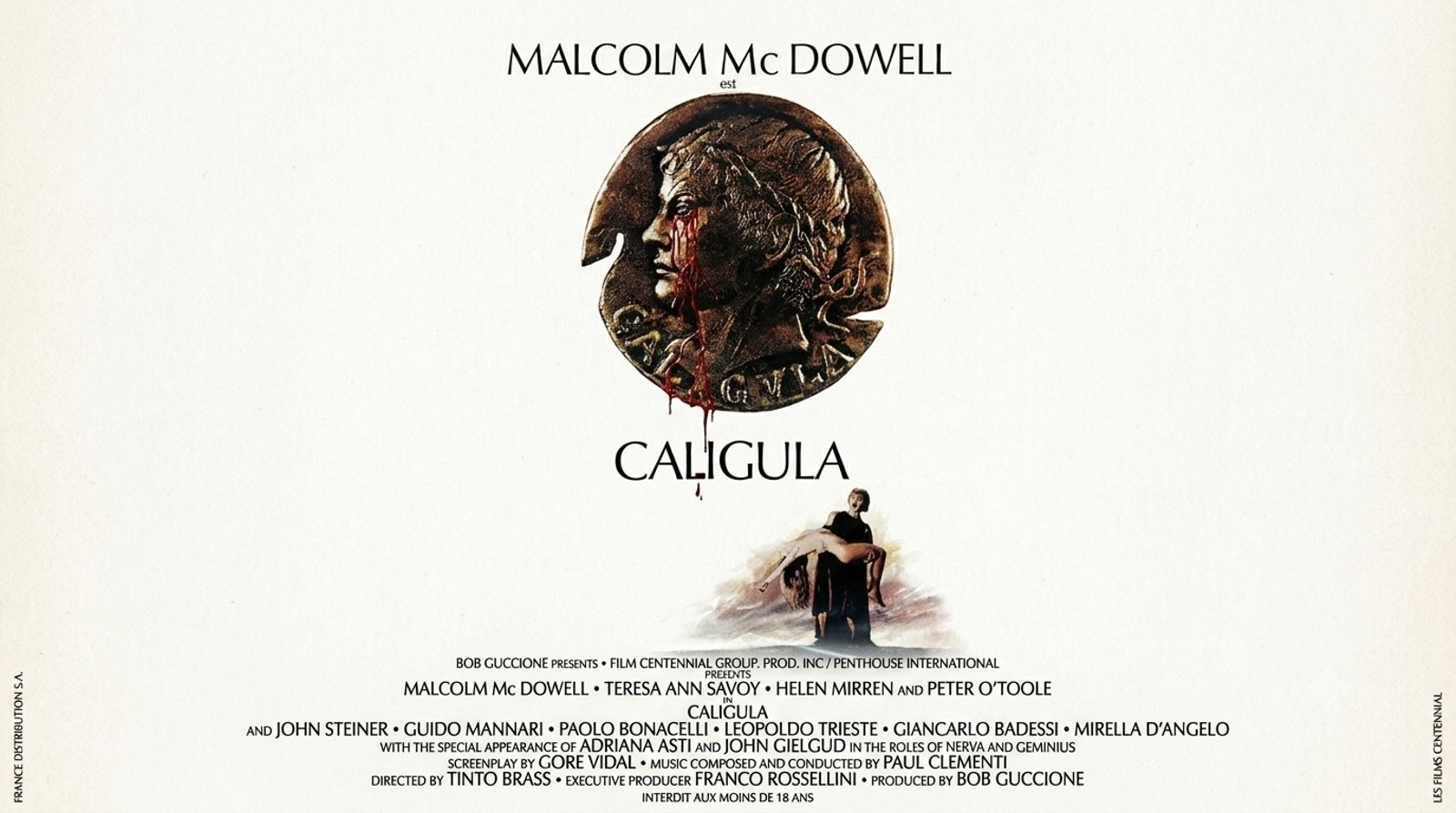
Caligula (1980)
Starring: Malcolm McDowell, Helen Mirren, John Gielgud, Peter O'Toole
Director: Bob Guccione
Synopsis: Shambolic rendition of Roman History served up by Penthouse in their inimitable style
Reviewed by: Omar Khan
"a dreary shamble" Time Out
"Most viewers will be rightfully repelled", Maltins
"talented cast wasted" Blockbuster Video
When Caligula first appeared more than two decades ago, it caused one of the fiercest controversies in modern cinema. Opinions became instantly polarised and, remarkably, many of those battle lines remain firmly drawn to this day.
Even before its release, rumours of chaos behind the scenes had begun to circulate. Several cast members publicly distanced themselves from the finished product, understandably wishing to disassociate themselves from what was rapidly becoming one of the most notorious productions in film history. Unfortunately for them, once their performances had been committed to celluloid, there was no turning back. Whatever their later regrets, they remain very much a part of the spectacle.
I first encountered Caligula during a trip from Britain's famously restrictive censorship climate to the United States, where the film was attracting enormous crowds despite being confined largely to cinemas specialising in adult fare.
The producers at Penthouse had famously decided to "improve" the picture by inserting substantial amounts of unsimulated sexual material after principal photography had been completed. Whether this was done because they lacked confidence in the film itself or simply because they recognised the enormous commercial appeal of controversy is open to debate. Whatever the motivation, the additional footage ensured that Caligula would become one of the most talked-about films of its era.
I still remember arriving at the packed cinema, surrounded almost entirely by middle-aged men who looked as though they had wandered in expecting something rather different from a historical epic.
What unfolded on screen was certainly memorable.
Shocking.
Repellent.
And, ultimately, rather depressing.
The irony is that if one strips away the notorious additions and judges Caligula purely as a piece of cinema, very little remains to recommend it. The film is a shambolic affair, almost completely devoid of narrative momentum or cinematic style. Scene follows scene with the apparent intention of shocking, provoking and titillating, yet after a while the relentless parade of excess simply becomes monotonous. Eventually even the film's most outrageous moments lose their power to surprise and become little more than repetitive exercises in bad taste.
Malcolm McDowell, forever destined to be remembered as Alex in A Clockwork Orange, attacks the title role with admirable commitment. He desperately tries to inject Caligula with the same unsettling madness that made Alex such an unforgettable creation, but the screenplay gives him precious little to work with. His wonderfully absurd dance sequence remains one of the few genuinely entertaining moments in the entire production.
The distinguished supporting cast fares little better. Sir John Gielgud makes a brief but rather unfortunate appearance, while Peter O'Toole, playing the decaying Emperor Tiberius, reportedly spent much of the production in an alcoholic haze. Whether entirely true or not, his exhausted, semi-conscious performance seems strangely appropriate given the chaos unfolding around him.
Historically, the film is little more than fantasy masquerading as biography. Genuine Roman history is bent, twisted and reshaped whenever necessary to accommodate Bob Guccione's lurid imagination, with little regard for historical accuracy or dramatic coherence.
The catalogue of sensationalism is almost endless. Graphic violence, grotesque excesses and increasingly bizarre acts are piled upon one another in an apparent attempt to outdo the previous outrage. Yet rather than becoming shocking, the cumulative effect is simply numbing.
Perhaps that is Caligula's greatest failing.
It mistakes excess for impact.
The film often invites comparison with the work of John Waters, another filmmaker who delighted in outrageous subject matter. The difference is that Waters approached bad taste with infectious humour, wit and an unmistakable sense of anarchic joy. However grotesque his films became, they always retained an irreverent energy that made them oddly entertaining.
Caligula, by contrast, possesses none of that mischievous spirit. It is grim, joyless and relentlessly unpleasant, resembling less a work of cinema than an overlong catalogue of decadence.
There is no wit.
No style.
No sense of fun.
Only endless excess.
For all its notoriety, Caligula ultimately survives not because it is a good film, but because it remains one of the most infamous curiosities ever produced. It is certainly unique, and its reputation has continued to grow over the years, but notoriety should never be mistaken for quality.
A fascinating historical oddity?
Certainly.
A good film?
Not for a single moment.
0 Comments
Leave a Comment