
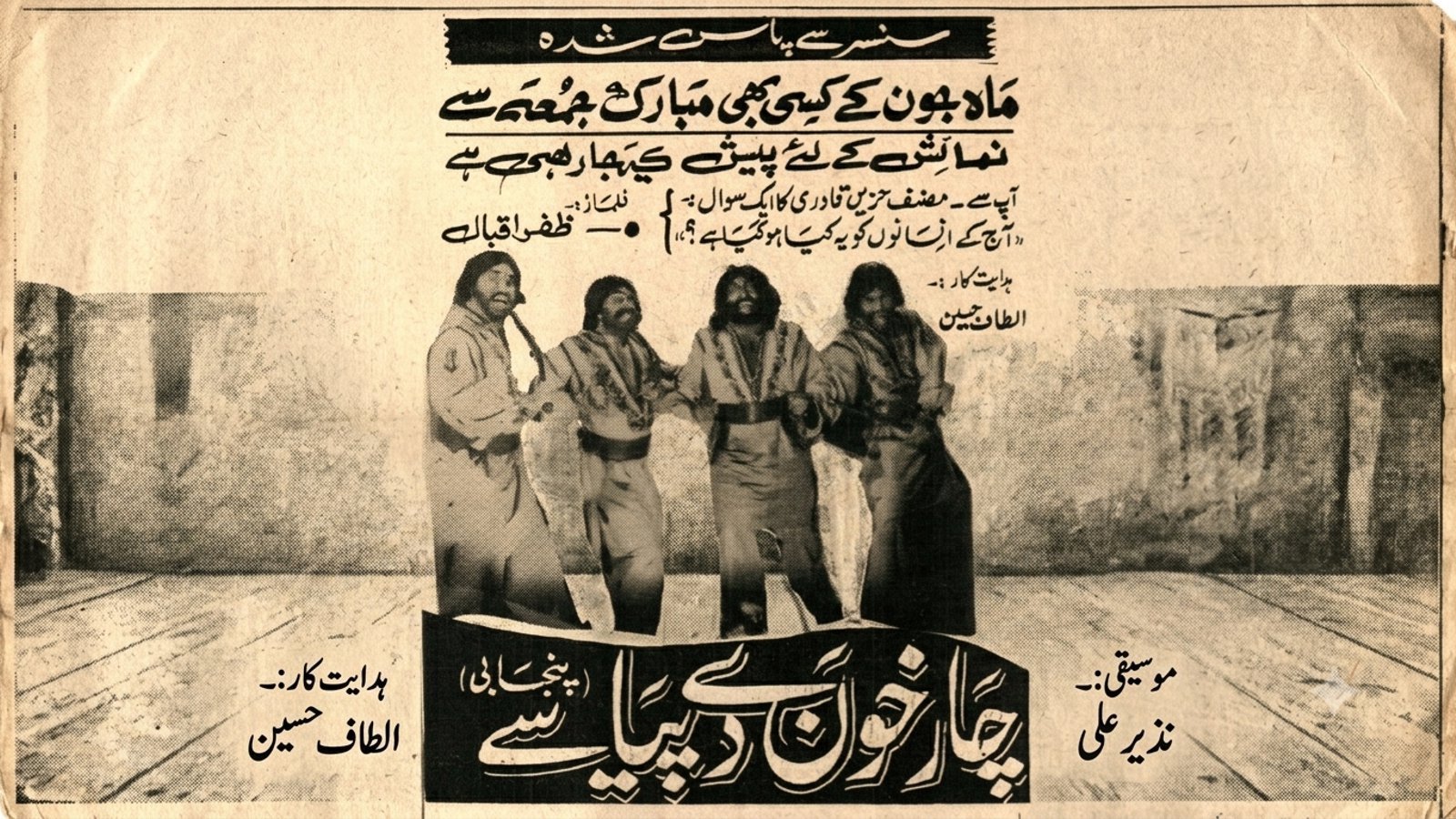
Chaar Khoon De Pyase (1973)
Cast: Naghma, Habib, Aasia, Asad Bukhari, Munawar Saeed, Mustafa Qureshi, Munawar Zareef, Nanha, Nasira, Sheikh Iqbal, Taya Barkat, Chun Chun, Neelofar, Farida, Nazo, Saajan, Ahmed Ali, Wasim, Khalid, Allauddin, Afzal Khan
Director: Altaf Hussain
Music: Nazir Ali
Synopsis: Ultra-Violent tale of a peaceful locality fending off brutal thugs similar to Gabbar Singh’s goons from Sholay.
Reviewed by: Omar Khan
A riasat headed by a benign Allauddin is under severe threat from a gang of four marauding Dacoits, who endanger the very existence of the peaceful village community. There are constant attacks by the Gang of Four as they plunder, loot, burn, murder and rape whenever they feel. Their ambush’s vicious ferocity and brutality make the villagers tremble in constant fear. They look to the hapless Jageerdar to protect them, and he agrees to take them on, but on the battlefield, his forces are no match for the barbarism of the Gang of Four, who reign supreme.
Mustafa Qureshi, the most demented of the Gang, takes a liking to Naghma, a pretty village belle, and in a dramatic moment, she begs her father to kill her rather than have her honour compromised by the brute Qureshi. The father plunges a spear into his daughter’s gut, frustrating the psychotic Qureshi for the time being, and the gang return having once again caused devastation.
The Jageerdar is at a loss as to how he can protect his villagers and is at the point of caving in, when his feisty daughter Aasia claims that she will attempt to neutralize the Gang by trying to appeal to their sense of morality. The old Jageerdar is sidelined, leaving the village’s defence to his daughter. One of the gang members is a disgruntled brother who has turned against his people and joined the criminal Gang—Aasia hopes to appeal to his sense of decency, though it seems a lost cause.
The Gang of Four soon come marauding as they regularly do and are met with the villagers offering all their wealth as a peace offering, but the criminals are in no mood for compromise. Aasia pleads with them, appealing to their “Ghairat”; miraculously, they take it as a challenge to their masculinity and repent momentarily.
At the outset of the film, the first thing to check is whether the film has been influenced by Bollywood’s iconic Gabbar Singh, and his marauding Gang of thugs. The film was released two years before Sholay arrived on the scene. The Gang of Four or Chaar Khoon De Pyase appears to be motivated by a socialist cause, fighting the Jageerdar system. However, it soon becomes apparent that their mayhem is inspired by greed and insatiable blood lust.
The Gang feeds upon the fear they cause with their carnage, and this sense of power drives them. The four are drunk on power and shout and cackle very loudly amongst themselves, as all Punjabi villains tend to. It was the style of the Punjabi film villain until Mustafa Qureshi turned things around with his memorable role six years on in Maula Jatt.
Chaar Khoon De Pyase
Aasia deftly tries to question their masculinity and refers to them as brothers, hoping to find some sense of morality. Her ploy manages to hold their attacks at bay momentarily. The village, however, exists at the mercy of the Gang of Four, whose sense of morality barely exists, and Aasia’s ploy is in danger of being undermined at any moment.
Enter two virtuous young men with superb weaves in the form of brothers Habib and Asad Bukhari. Habib is soon smitten with Naghma who didn’t die when her father speared her but has recovered to recapture her full glory. As the two virtuous brothers learn of the villagers’ plight, they team up to take on the Gang of Four, and an intense and highly violent series of confrontations ensue.
Flashing blades, whiplashing hunters, daggers, swords, and majestic weaves battle it out for the remainder of the movie. Aasia falls for Asad Bukhari in the interim, and they produce an heir to the jageer for the future.
Meanwhile, Aasia, who seems to possess more brains than the rest of the village combined, manages to sow the seeds of dissent among the Gang of Four, and one of them defects to side with her and the villagers. The defection triggers even more rage and vociferous cackling from Mustafa Qureshi and his cohorts, who up the ante in attacking the village. The vendetta now focuses on the two heroic brothers, who have stoically defended the region. Asad Bukhari falls, leaving Habib and Munawar Saeed, the defector won over by Aasia, to take the battle to the Gang of Three.
Film reaches its crescendo with a gruesome climax, Mustafa Qureshi cackling his way to the bitter end. The flickering hope of Asad Bukhari rising from the dead as Naghma had done is dashed. The only question remains if Habib will squash the Gang and extinguish their psychotic head honcho, thus liberating the village from tyranny.
The film is remarkable for depicting vast amounts of violence and the depravity of the film’s title characters. The acting is unimpressive and excessively loud, with only Aasia appearing as a normal human being. Mustafa Qureshi and his cohorts do justice to their roles as demented savages and cackle brilliantly. Munawar Zareef has plenty of screen time but doesn’t get a script allowing him to turn in a memorable performance.
The action is rough, and the camerawork is pretty uninspired. The template for loud, brash, ugly and violent Punjabi action films began in the early 1970s. The film’s producers could perhaps claim to have influenced Gabbar Singh from Sholay, even though it’s doubtful that anyone even remembers this cinematic aberration, then or now. The film managed to do average business at the box office, as Bloodlust and Violence remain good ticket sellers.
0 Comments
Leave a Comment