
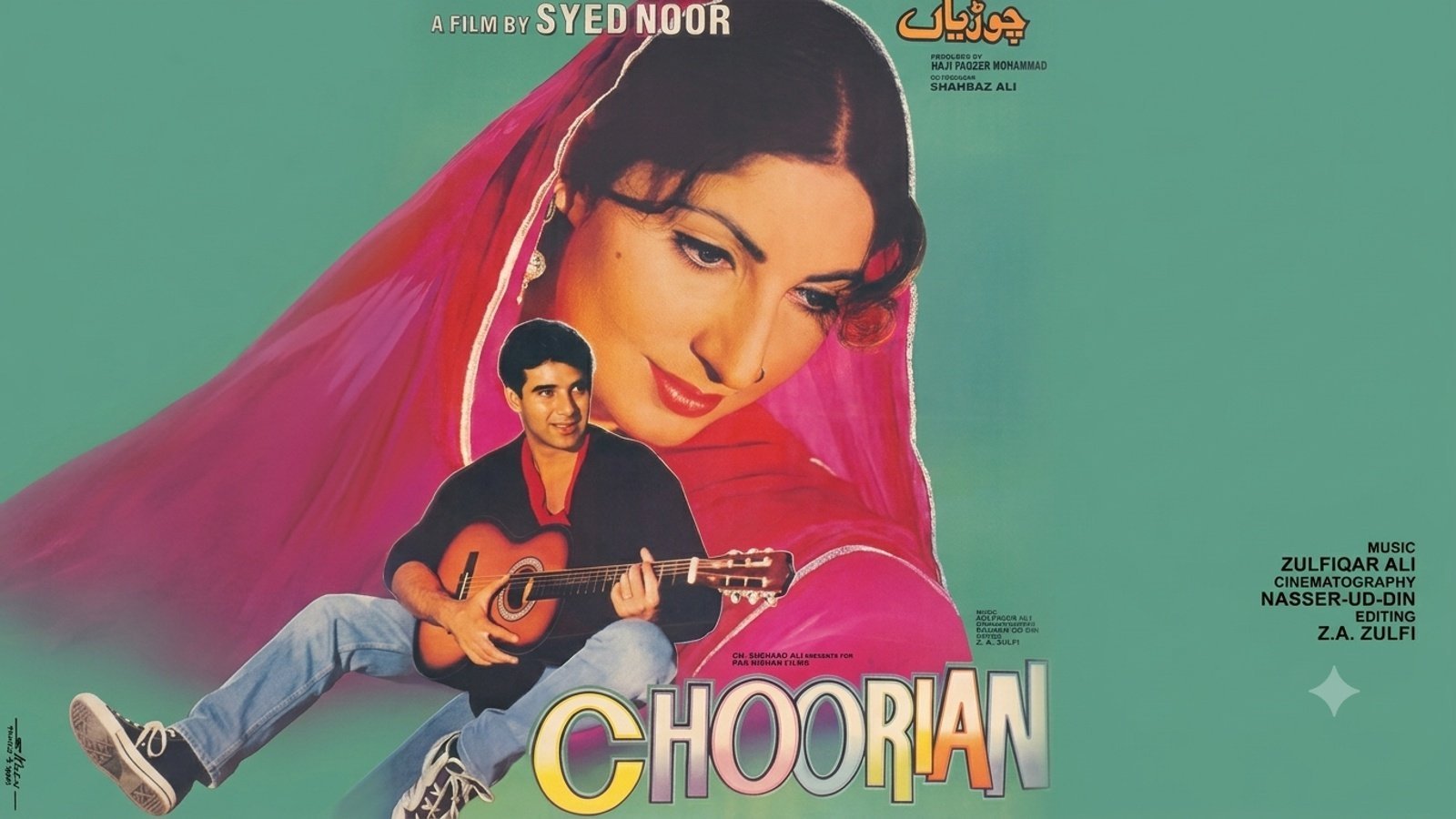
Choorian (1998)
Cast: Saima, Moammar Rana, Bahar Begum, Shafqat Cheema, Nargis
Director: Syed Noor
Synopsis: The Cinderella story that created a box office storm in Pakistan.
Reviewed by: Omar Khan
Known as the film that single-handedly revitalised the dying Punjabi film industry, Choorian’s exceptional commercial and critical success is virtually the stuff of legend.
A simple tale revolving around city boy Bakhtu (Moammar Rana), unwillingly dispatched to live at his uncle’s house in the village where he meets ditsy, unassuming and spectacularly well-endowed Billo (Saima), his uncle’s daughter from his first marriage. Her overbearing stepmother (Bahar) and stepsisters despise and terrorise her. Billo is a glorified servant in her home, more comfortable communicating with buffaloes and crows than her so-called family.
Won over by her sweet temperament and cheery simplicity, symbolising the purity of rural life, Bakhtu declares his love for her, which is shyly reciprocated. The lovers’ bliss is rudely interrupted by Bahar, who has other designs for Bakhtu, seeing him as a good catch for her spawn.
Nargis, Bahar’s lascivious elder daughter, attempts to win him over with a sizzling song and dance number in the rain but fails miserably, breeding more resentment towards Billo. Things come to a head when Bahar confronts the couple; the situation is ill-handled by the belligerent Bakhtu, who insults his aunt, calling her a “churail”, and is promptly thrown out of the house. This, however, does not quench their ardour. As punishment, arrangements are made for Billo to marry a local Chaudhary, which she grudgingly agrees to, emotionally blackmailed into it by her melodramatic father.
Of course, Bakhtu, like every good Punjabi hero, has a plan for this wedding, involving a gung-ho attitude and a machine gun.
Young love triumphs over evil, and after a mercifully short bloodbath, Billo and Bakhtu happily embark on their journey to Happily Ever After.
Saima gives a subdued performance as a village Cinderella. Moammar Rana seems to have a knack for comedy and comes across as relatively charming in his gormless way. Bahar excels even in her two-dimensional role of the wicked stepmother, acting her emasculated husband, Shafqat Cheema, off the screen.
The film contains some memorable songs. The toe-tapping Laiyan Laiyan is well-choreographed without wild camera angles and tasteless, exploitative moves.
Formulaic to the extreme, Choorian’s very ordinariness seems to be the secret to its extraordinary box-office success. Not quite shunning gratuitous violence or tedious mindless, comedic tangents (but keeping them to a minimum all the same), the director employs ageold techniques like a day at the mela, a romantic interlude in a vegetable patch and a bizarre romantic sequence involving a buffalo’s udder.
This quaint rustic tale relieves an audience weary of the vulgarity and violence of recent Pakistani cinema. The alarmingly prolific Syed Noor is aping Indian mega-hits Taal, Pardes and Hum Dil De Chuke Sanam, which mark Indian cinema’s trend towards the allure of simple village life rather than flash urbanity. Whilst on the right track, he
Choorian is not making the necessary effort to produce something of actual cinematic worth.
Choorian is hardly groundbreaking by way of script, characterization or plot. However, we have a way to go if this is the best of Pakistani cinema. I remember repeatedly hearing the phrase that “Chooriyan was a film that represented Punjab in the “correct” manner rather than the films laden with violence and “loudism”.



0 Comments
Leave a Comment