
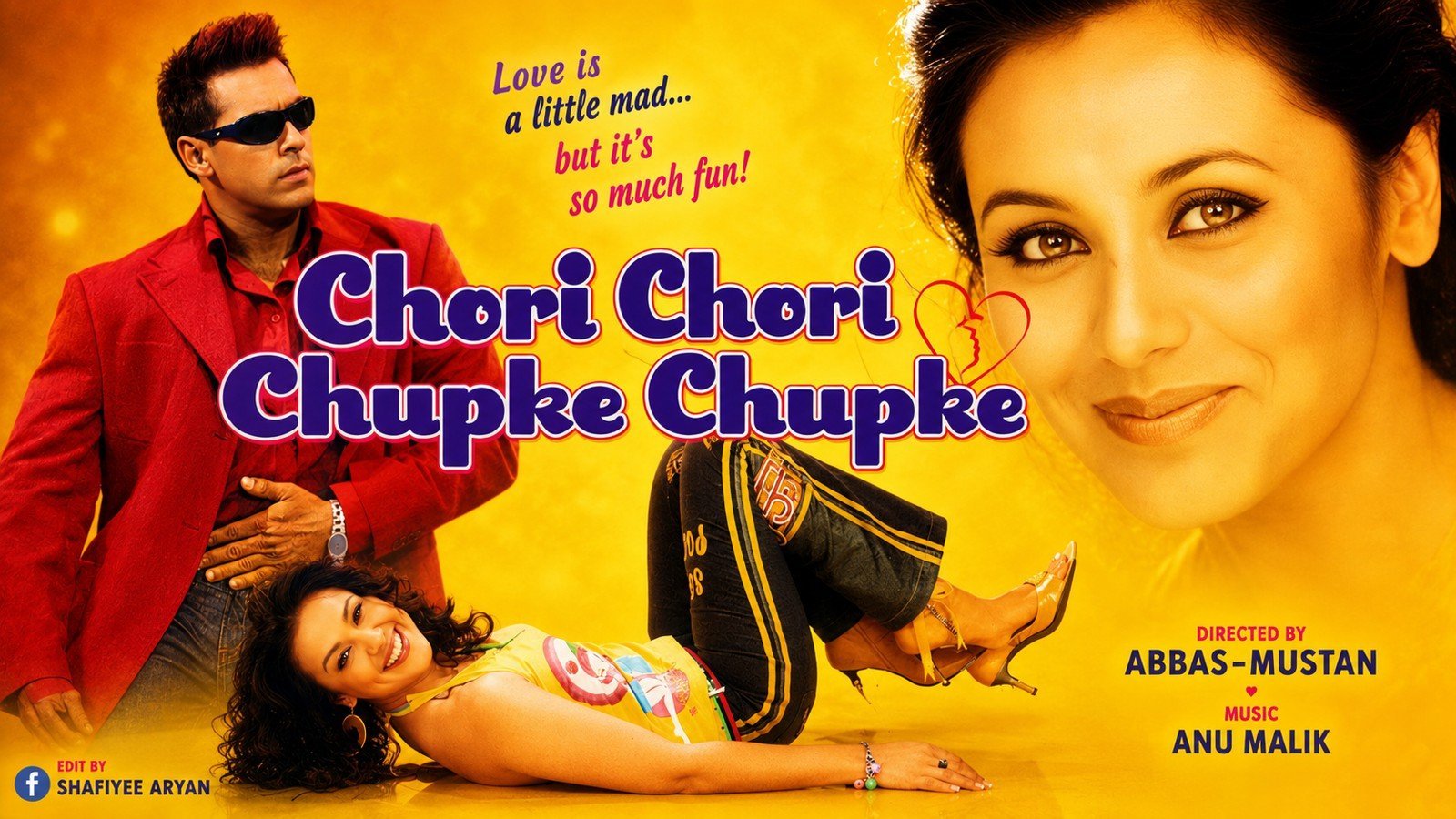
Chori Chori Chupke Chupke (2001)
Starring: Salman Khan, Rani Mukherji, Preity Zinta
Director: Abbas Mustan
Music Director: Anu Malik
Synopsis: Usual Bollywood triangle - but well performed and fairly engaging
Reviewed by: Faiz Khan
The film opens with the customary hara bhara sansar. Grandfather Kailashnath (Amrish Puri) longs to see his beloved grandson Raj (Salman Khan) married and, more importantly, to become a great-grandfather. Raj, however, is not the marrying kind—although this particular charade is mercifully short-lived, as he soon ties the knot with Priya (Rani Mukerji).
All appears well.
The newlyweds settle into marital bliss and Priya soon becomes pregnant.
We wait for the inevitable hitch because life is simply proving too perfect.
Tragedy strikes when Priya suffers a fall and miscarries. Not only does she lose the baby, but she is also told she will never be able to conceive again.
Devastated, the couple decide to keep the news from the rest of the family, knowing how desperately everyone longs for an heir. Raj suggests that they move to Switzerland for two years, adopt a child there and simply present the baby as their own.
Priya, however, has second thoughts.
She knows only too well that Grandfather wants a child who actually resembles his grandson—a true waris.
After reading an article about surrogate motherhood, Priya decides this offers a better solution than conventional fertility treatment.
The obvious question then becomes:
Who would agree to become their surrogate?
Raj throws himself into finding an answer and is eventually introduced to Madhubala (Preity Zinta), a no-holds-barred prostitute who agrees to bear the couple's child in exchange for several lakhs of rupees.
From this point onwards the film ventures into Pretty Woman territory.
Raj sets about transforming this brazen tart into a refined and respectable young woman—someone his wife will be comfortable living alongside. The plan is for the three of them to relocate to Switzerland until the child is born.
Initially everything proceeds remarkably smoothly.
Priya and Madhu gradually develop a genuine friendship, but complications inevitably arise when Madhu begins to fall in love with Raj and starts questioning whether she will really be able to surrender the baby once it is born.
The basic premise is hardly original. Similar territory was explored years earlier in Doosri Dulhan, where Shabana Azmi played the prostitute and Sharmila Tagore the wife.
What distinguishes Chori Chori Chupke Chupke, however, is the ease with which the story unfolds. The directors wisely make no attempt to disguise the fact that this is a mainstream Hindi film. They are not aiming for social realism or a detailed exploration of surrogate motherhood. Instead, they focus on the emotional relationships between the three principal characters.
To their credit, they avoid reducing the story to complete melodramatic nonsense.
One genuinely feels Priya's pain as she watches another woman carrying her husband's child. Her insecurity, hesitant glances and constant need for reassurance are all handled with surprising restraint. Thankfully, none of this is overplayed.
The difficulty lies not with the emotional triangle but with the film's central premise.
The entire situation exists because Grandfather has already suffered two heart attacks and supposedly cannot survive the shock of discovering the truth about Priya's condition. It is this rather absurd device that removes the story entirely from reality and plunges it headlong into the world of pure Bollywood melodrama.
It is utter bunkum.
One cannot help feeling slightly cheated that this is the film's principal motivation rather than a more believable desire for Raj and Priya simply to complete their family.
Then there is Madhu herself.
She is the archetypal commercial Hindi film prostitute—the tart with a heart and yet another affectionate tribute to the innate goodness of the Indian woman. She is rescued from her sordid surroundings, transformed into a sophisticated and graceful young lady and allowed to yearn for the love and respect that constantly surrounds her but can never truly be hers.
It is another familiar Bollywood cliché.
Even so, the film is assembled with considerable skill. It unfolds gently, avoids excessive melodrama and allows genuine emotion to emerge naturally.
The strongest scenes are undoubtedly those involving the three principal characters. Ironically, it is the supporting cast who drag the film back towards the more conventional Hindi movie formula.
This has to be Salman Khan's finest performance in several years. He underplays the role beautifully, bringing warmth and sincerity to Raj while handling the lighter comic moments with equal confidence.
Rani Mukerji has the more conventional part and, although her role is steeped in familiar clichés, she gives Priya a sensitivity that a lesser actress might easily have missed.
Preity Zinta, with the showier role, is also very good, although her prostitute owes considerably more to Julia Roberts in Pretty Woman than to the earthy, foul-mouthed Kajri from Mausam, who remains a far more convincing and realistic creation. There are occasions when Preity becomes slightly irritating but, as with so much else in the film, one simply has to accept that this is Bollywood storytelling rather than an exercise in realism.
Abbas-Mustan move away from the slick thrillers that made their reputation. Baazigar, Khiladi and Daraar all demonstrated their flair for suspense, and even here one senses their instinct for gradually building dramatic tension. They remain firmly in control throughout, steering the film confidently without ever allowing proceedings to drift.
Anu Malik's music, however, is something of a disappointment. One or two melodies are pleasant enough, although their appeal owes more to the picturisation than to the tunes themselves. Fortunately, the dreadful "Love You Love You Bolo" has been removed.
On the whole, Chori Chori Chupke Chupke is an agreeable, old-fashioned Hindi film—a decent story, decently told.
0 Comments
Leave a Comment