
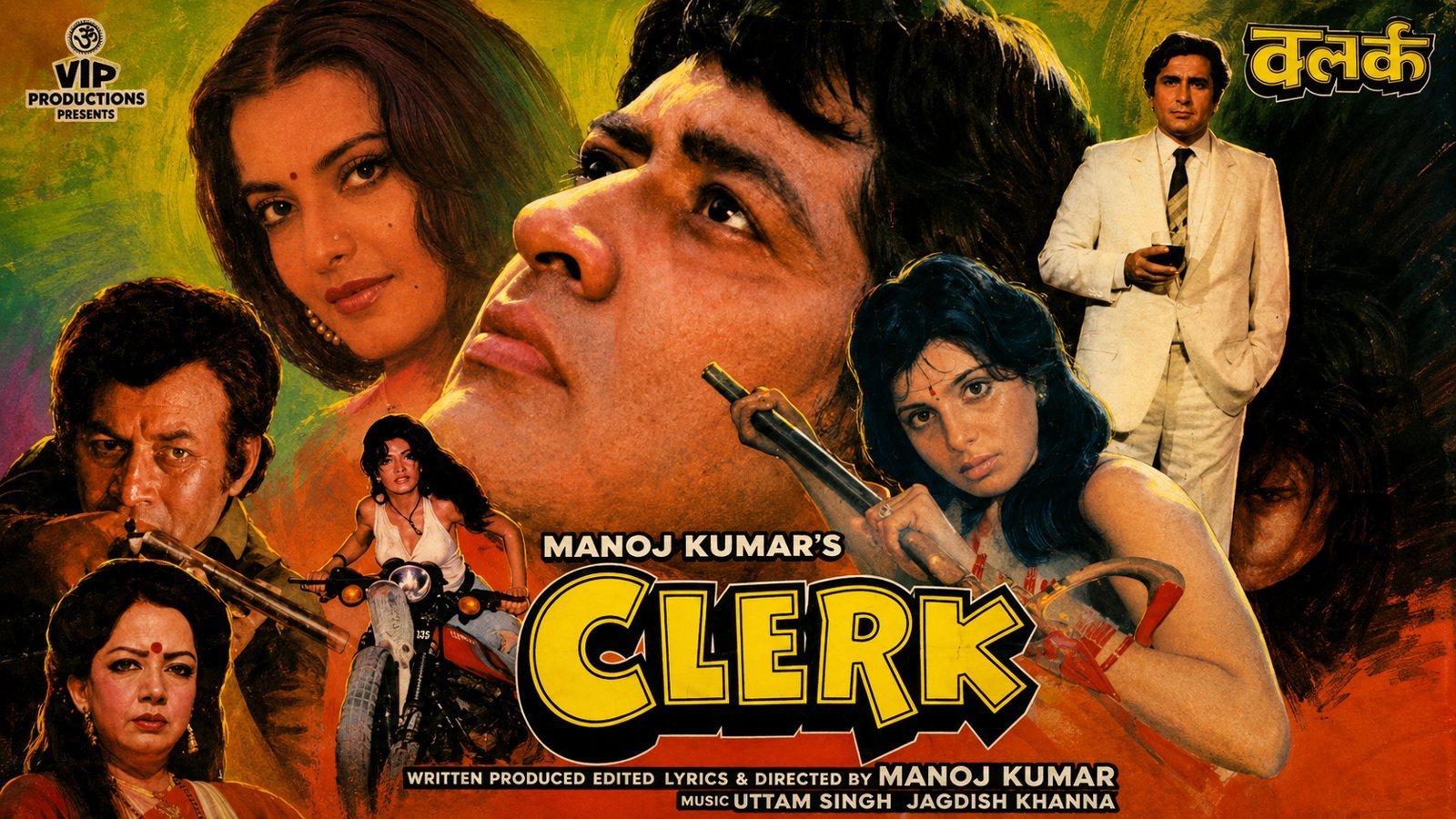
Clerk (1989)
Starring: Manoj Kumar, Mohammad Ali, Rajendra Kumar, Shashi Kapoor, Rekha, Zeba, Ashok Kumar, Anita Raaj, Prem Chopra
Director: Manoj Kumar
Synopsis: Upright clerk stands in the way of nefarious anti-state deeds ...stirring stuff!
Reviewed by: Omar Khan
Manoj Kumar once again continues his long-running series of "Bharat" films, in which he symbolises Mother India and all her virtues while battling wave after wave of corruption, greed and assorted evil threatening the nation from every conceivable direction. Upkar, Purab Aur Paschim, Shor, Roti Kapda Aur Makaan and Kranti all revolved around essentially the same Bharat character—downtrodden, misunderstood, frustrated, deceived, exploited and wronged at every turn, yet never defeated. Come the climax, Bharat inevitably rises above adversity, crushes evil and paves the way towards a brighter future for his grateful fellow countrymen.
It is, in essence, the same character every single time.
Only Manoj Kumar grows older.
With every new instalment, his girth seems to expand a little further while the chip on Bharat's shoulder becomes progressively larger. Never exactly blessed with matinee-idol looks to begin with, Manoj has, by this stage, acquired an appearance that rather suits the permanently aggrieved nature of his favourite screen creation.
Clerk was originally conceived during Manoj Kumar's glory days in the late 1970s and was made all the more ambitious by the inclusion of two of Pakistan's most respected stars, Mohammad Ali and Zeba—making it a genuinely unusual Indo-Pakistani collaboration during a period of considerable political hostility.
The project was announced amid tremendous fanfare.
Unfortunately, it took so long to complete that by the time it finally staggered into cinemas in 1989, the average age of the principal cast appeared to be somewhere north of fifty.
The whole enterprise already felt hopelessly stale.
Still, a filmmaker of Manoj Kumar's considerable talents should surely have been able to overcome such obstacles through the sheer strength of his subject matter.
The plot, after all, is positively scintillating.
Well...
...almost.
It actually revolves around Bharat, a humble government clerk who was once a brilliant student leader but, thanks to crushing poverty and a hopelessly corrupt system that denies honest men equal opportunity, has never fulfilled the greatness that is so obviously his destiny.
Poor Bharat also has an entire household of forgotten war veterans to support.
His father (Ashok Kumar) lies permanently on his deathbed until one particularly stirring patriotic military anthem miraculously restores him to full health. One minute the poor man is gasping for his final breath; two minutes later he is twitching enthusiastically and almost marching around the room to cries of "Kill! Kill! Kill! Glory! Glory! Glory!" with barely a trace of illness remaining.
It is quite an extraordinary recovery.
Bharat must also care for his crippled ex-Air Force pilot brother, played by Mohammad Ali, who spends much of the film wandering around lamenting both the loss of his leg while defending the nation from foreign invaders—slant-eyed ones this time—and the supposed infidelity of his long-suffering wife (Zeba). Add to this assorted siblings, wives and dependants and one is left wondering how an ordinary clerk's salary manages to sustain what appears to be half the population of Delhi.
Nevertheless, Bharat—usually accompanied by an invisible heavenly choir—soldiers on in his Ministry of Defence office under the supervision of an outrageously corrupt superior.
His moment of destiny finally arrives when he becomes custodian of a crucial file concerning a sinister husband-and-wife team by the name of Mr and Mrs Kapoor.
Oozing wealth, vulgarity and liberally sprinkling their conversations with English phrases at every opportunity, the Kapoors are determined to infiltrate the Ministry of Defence for their own nefarious purposes. Their greatest weapon is the devastatingly glamorous Mrs Kapoor, played by Rekha, a ruthless femme fatale who will stop at absolutely nothing to achieve her objective.
Flashbacks reveal that Bharat and Rekha were once college sweethearts hopelessly in love before she abandoned him in favour of the richer Mr Kapoor rather than become the wife of an impoverished clerk.
Or, more accurately...
...Mrs Bharat.
The rest of this labyrinthine plot concerns whether the Kapoors can persuade Bharat to approve their vital file, or whether our incorruptible clerk will not only save the nation but finally exact revenge upon the woman who discarded him like yesterday's cigarette lighter.
Proceedings could scarcely be duller.
The film's principal curiosity lies in watching Pakistani legends Mohammad Ali and Zeba performing alongside their Indian counterparts. They acquit themselves perfectly respectably—certainly no worse than anyone else on screen.
Rajendra Kumar is hopelessly underused, although everyone is ultimately reduced to supporting Manoj Kumar's one-man crusade. True to form, Manoj dominates every scene, patiently bludgeoning his audience into submission.
Even the music reflects his decline. Following Mukesh's death, the emotional heart seemed to disappear from Manoj Kumar's films. Mahendra Kapoor struggles manfully through songs such as the dreary lament "Gham Ke Pyale Aur Nahin", saddled with Manoj's increasingly ponderous lyrics.
Rekha injects a welcome spark into proceedings as the deliciously wicked Mrs Kapoor, while Sonu Walia provides occasional amusement with her trademark exclamation, "Tich!"
As a writer, Manoj Kumar's flair for symbolism is matched only by his famously mumbled dialogue delivery.
His favourite metaphor appears twice during the film.
At one point Bharat criticises Rekha for being such an important woman while using such a cheap cigarette lighter. She promptly replies that it is a disposable lighter—used once and then thrown away—a none-too-subtle reference to how she discarded Bharat after using him.
Subtlety was never Manoj Kumar's strongest suit.
Naturally, Bharat later uses precisely the same line to exact his revenge upon Mrs Kapoor.
One imagines Manoj congratulating himself for this masterstroke of symbolism.
Clerk is quite possibly one of the most tediously overblown films ever made. Unsurprisingly, a three-hour saga centred upon a plodding government clerk and an important file failed to ignite the public imagination. The film collapsed rapidly at the box office, and richly deserved to do so.
Mercifully, audiences were spared further Bharat adventures. While these films undoubtedly struck a chord during the socialist climate of the 1960s and 1970s, today they feel hopelessly ponderous—smothered beneath suffocating nationalism, endless self-glorification and an almost heroic commitment to wallowing in self-pity.
That said, Manoj Kumar built an enormously successful career upon precisely these films, so clearly they resonated with audiences of their time.
Like all fashions, however, their moment eventually passed.
After this final Bharat saga, it was surely the audience—not Bharat—who had every right to cry:
"Aur Nahin... Bas Aur Nahin!"
Clerk does, however, retain one undeniable attraction.
Its sheer, shameless, almost magnificent ineptitude has earned it a curious cult value all of its own.



0 Comments
Leave a Comment