
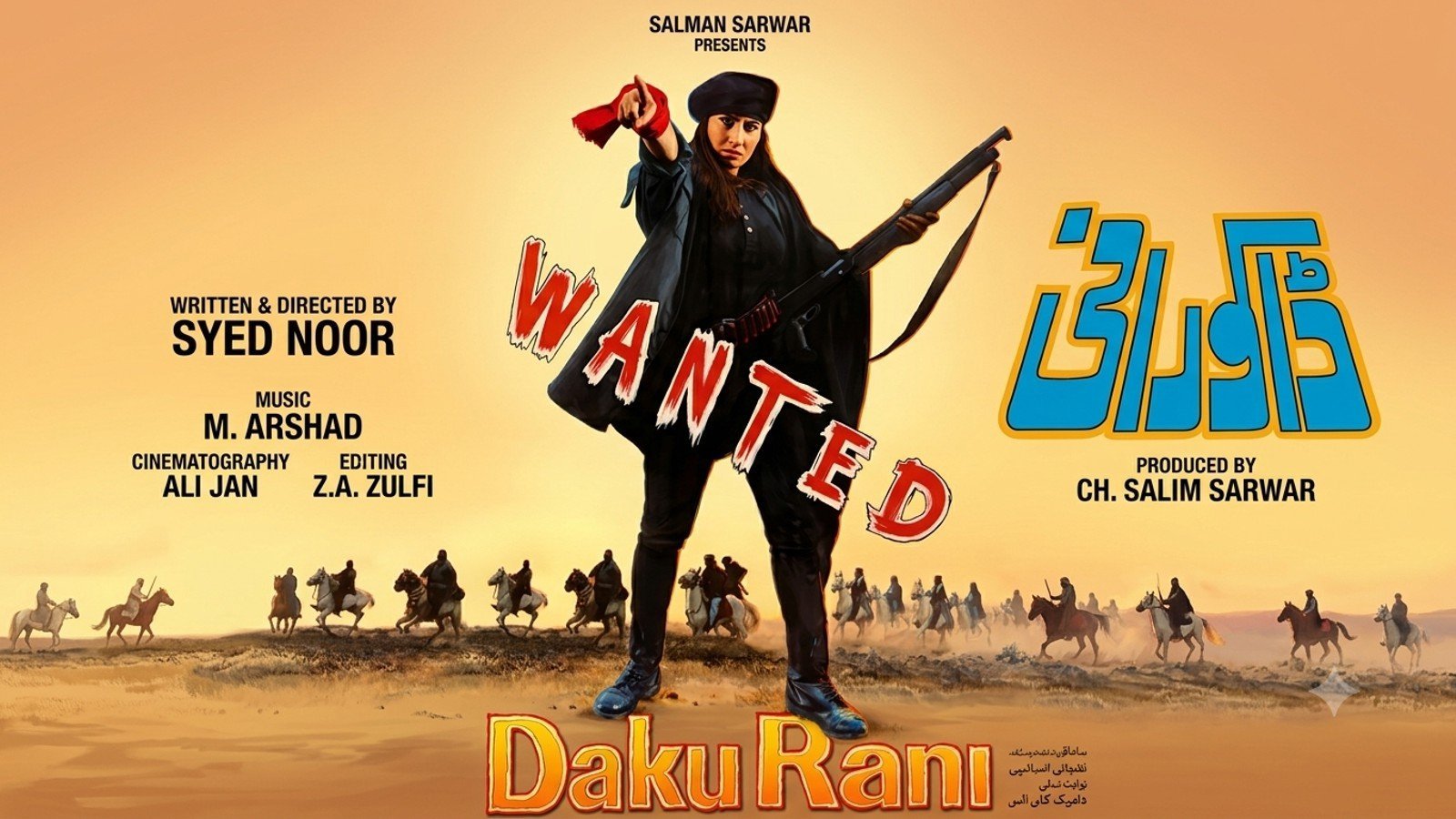
Daku Rani (1998)
Cast: Saima, Shaan, Moamar Rana, Meera. Arbaz Khan, Humayun Qureshi, Rashid Mehmood, Adeeb, Anwar Khan, Irfan Khoost, Altaf Khan, Afshan Qureshi
Director: Syed Noor
Synopsis: A Lollywood reworking of the Bandit Queen theme turns into a twisted form of feminism. This revenge hotchpotch regurgitates the Phoolan Devi Bandit Queen theme, given local treatment and adaptation.
Reviewed by: Omar Khan
There’s nothing new on display here though the film is a strange sort of closeted, almost schizophrenic feminist statement. Events on screen are dominated by the powerful central character of Daku Rani, acted with admirable gusto by tall, rangy Saima.
It is a female-dominated film, yet perversely it contains unprecedented scenes of the degradation of women. The film is replete with scores of lurid rape or attempted rape scenes, and at least half the population of men are depicted as morally bankrupt, sexually depraved animals to whom the only tangible law is one of the primitive jungle. It is hardly surprising that in this context, incidents of rape are, in fact, not even more commonplace than they are.
The rape scenes in which women are being brutalised far outnumber those where a young couple might be seen holding hands or embracing. It appears that hate and violence are far more acceptable and indeed regarded as normal, while any display of affection is not permissible.
There is one shocker of a scene where the evil Lords of the village sentence poor Saima and her father to have their faces blackened and then dragged through the village and left to die on top of a barren hill, manacled so that they cannot escape their death by dehydration and starvation.
It’s not uncommon for evil villains to be shown to be torturing their hapless subjects. Still, the real shocker is a scene where the group of Lords physically humiliate a defenseless girl in public—aiming their kicks viciously at her belly and abdomen without any semblance of remorse. It’s a contradiction where a supposedly feminist film depicts so much degradation against them. The film is simply an out-and-out exploitationer, merely trying to justify itself with its “correct moral” message.
The notorious I Spit on Your Grave appears to be a role model plotline for an entire genre of sub-continental filmmaking, which is a frightening indictment of the state of our society—violence, degradation, and more violence, particularly against women. Performancewise, Saima dominates proceedings, turning in a reasonably worthy effort.
Shaan has a sagely special appearance as a detached soul bearing the burden of a tortured past. Exaggerated mannerisms and stylised Filmi dialogue delivery undermine his performance.
Moammar Rana doesn’t have too much scope and doesn’t even get to remove his shirt even once. The songs are not worth mentioning, but the production values are a few cuts above the usual Lollywood fare without being polished. It’s yet another “ladies’ first choice” exploitation, revamping of the I Spit on Your Grave scenario. The rest of the film plays out with Saima doing the same old Phoolan Devi thing.

0 Comments
Leave a Comment