
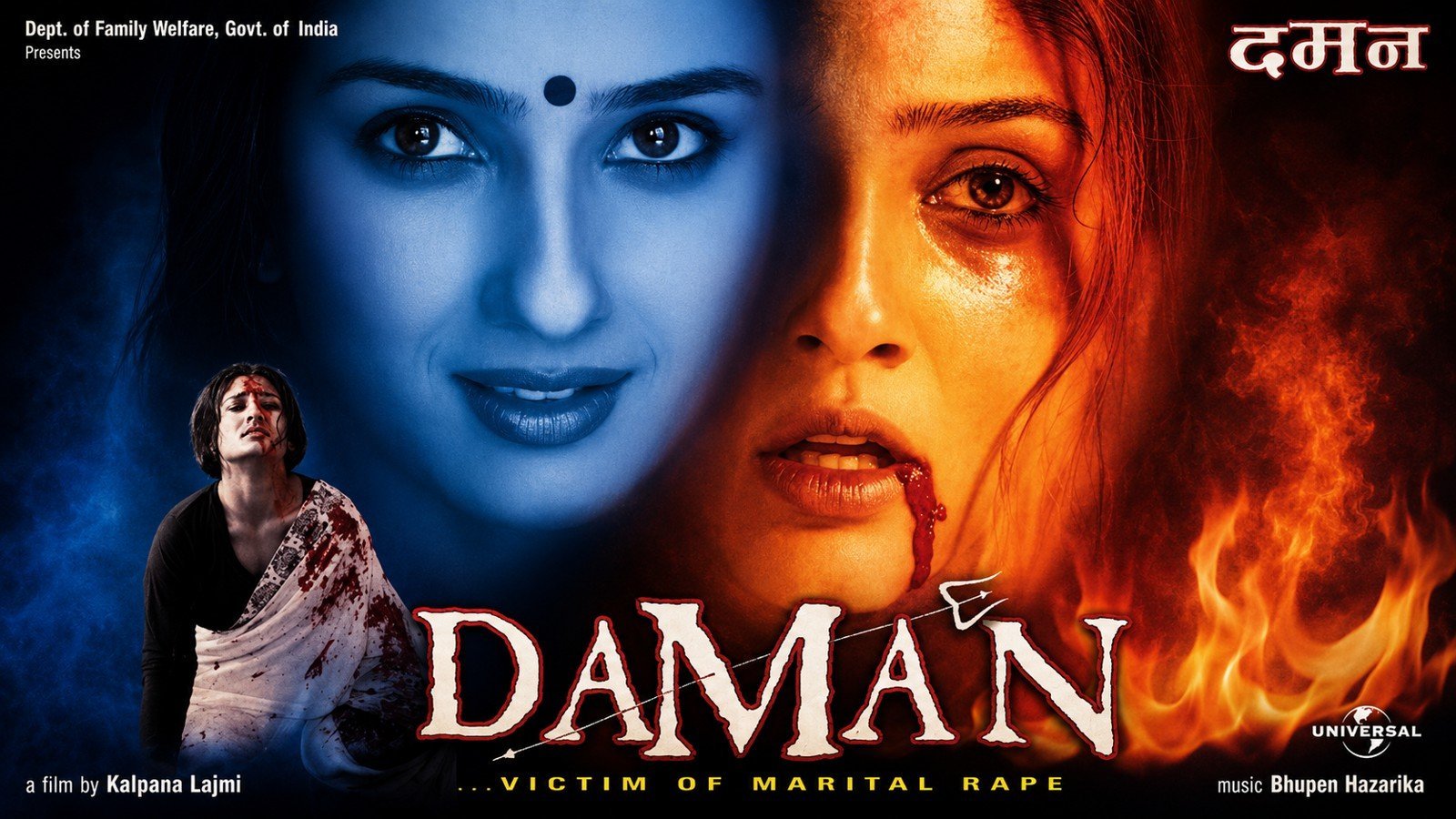
Daman (2001)
Starring: Raveena Tandon, Sayaji Shinde, Sanjay Suri, Raima Sen
Director: Kalpana Lajmi
Music Director: Bhupen Hazarika
Synopsis: Marital rape drama won the National Award for Raveena amidst huge uproar
Reviewed by: Faiz Khan
Kalpana Lajmi built her reputation as one of the few Indian filmmakers consistently prepared to tackle subjects that lay well outside mainstream commercial cinema. Her films frequently revolved around complex female protagonists and issues affecting women's lives, often sacrificing box-office appeal in favour of more challenging material.
My own exposure to her work has been limited. I missed Darmiyaan altogether and only ever saw half of Rudaali, but I still remember Ek Pal with considerable affection. Featuring superb performances by Shabana Azmi and Naseeruddin Shah, it examined an extramarital affair with sensitivity, visual flair and memorable music. It was an ambitious film—perhaps not an entirely successful one, either artistically or commercially—but it possessed intelligence and genuine conviction.
Daman promised something even more courageous.
Its publicity boldly proclaimed it to be India's first serious film about marital rape.
One could scarcely imagine a more important subject.
Marital rape remains one of the least discussed forms of violence against women, particularly in South Asia, where generations of women have been conditioned to believe that sexual consent within marriage simply does not exist. Until comparatively recently, even English law failed to recognise that a husband could rape his wife. The assumption was that marriage itself constituted permanent consent.
Thankfully, that legal fiction has long since disappeared in many countries.
Social attitudes, however, have often been much slower to change.
It is therefore enormously encouraging when filmmakers decide to confront such uncomfortable realities.
Unfortunately...
Daman squanders the opportunity almost completely.
The story follows Durga (Raveena Tandon), an uneducated but beautiful village girl married into a wealthy household headed by the violently unstable Sanjoy (Sayaji Shinde). His long-suffering mother hopes that marriage will somehow calm her tyrannical son and transform him into a responsible husband.
There is absolutely no evidence to support such optimism.
On the eve of his wedding he storms into the family home, smashing furniture, hurling ornaments across the room and behaving like a man who should probably be receiving psychiatric treatment rather than getting married. Only the threat of disinheritance persuades him to go through with the ceremony.
His behaviour scarcely improves afterwards.
He abandons Durga on their wedding night in favour of a prostitute, leaving his devastated bride to seek comfort from her sympathetic brother-in-law, Sunil (Sanjay Suri). A year later we are informed that the marriage remains unconsummated. Durga tearfully asks what she has done wrong and why her husband prefers "other women."
The answer comes during one of the film's key scenes.
While bizarrely painting Durga's face to resemble the goddess whose name she bears, Sanjoy forces himself upon her.
This, presumably, is the marital rape around which the entire film is supposed to revolve.
The problem is that the scene is so clumsily staged and so confusingly edited that it becomes surprisingly difficult to determine precisely what has occurred. Durga subsequently runs from the house, collapses in front of a police vehicle and declares that her husband has raped her.
The following day...
she withdraws the allegation.
Then the film simply moves on.
There are enormous narrative gaps throughout Daman. Characters disappear for months or years between scenes. We suddenly discover that Sanjoy has gone to Calcutta, Durga has been left behind, a child has been conceived and born, and before long twelve years have passed almost without explanation.
The fractured flashback structure does little to clarify events.
Instead, it creates confusion where clarity was desperately needed.
More importantly, it fatally undermines the film's central claim.
If Daman genuinely wishes to examine marital rape, then it needs to explore the psychological, emotional and social realities surrounding it. It needs to examine coercion, consent, power, silence and the devastating consequences of abuse within marriage.
Instead, the issue appears only fleetingly.
The rape itself seems confined to a single incident before Sanjoy disappears for an extended period. We never witness the sustained pattern of abuse that might have illuminated the wider reality faced by countless women trapped in violent marriages.
The film quickly abandons the very subject it claims to be about.
That is its greatest failure.
Strip away its veneer of "serious cinema" and Daman begins to resemble one of the female revenge dramas that flooded Indian cinema during the 1980s. It may not descend to the lurid excesses of films such as Zakhmi Aurat, but structurally it is not operating in a fundamentally different space.
Ironically, Ghar—a mainstream commercial film dealing with the aftermath of gang rape—proved considerably more honest and emotionally effective than this supposedly groundbreaking work.
Lajmi repeatedly claims to have opened a new chapter in Indian cinema.
I find that claim impossible to accept.
The screenplay undermines her ambitions at almost every turn.
Her greatest mistake lies in the characterisation of Sanjoy himself.
He is not merely unpleasant.
He is a grotesque caricature.
Violent.
Sadistic.
Almost clinically insane.
There is scarcely a moment when he resembles an ordinary human being.
By constructing him as such an extravagantly monstrous figure, Lajmi inadvertently weakens her own argument. The truly disturbing reality of marital rape is that it is not committed solely by obvious psychopaths or cartoon villains. It can occur within apparently respectable households, perpetrated by men whom society otherwise regards as perfectly ordinary.
That is the uncomfortable truth.
By making Sanjoy so outrageously evil, the film allows audiences to dismiss him as an isolated aberration rather than confront the far more disturbing possibility that such abuse may exist much closer to home.
Durga fares little better.
She remains an almost entirely passive figure for much of the narrative. Escaping from an abusive husband is unquestionably an act of courage, but the screenplay never allows her to evolve into the powerful symbol of resistance that it clearly intends. Even when opportunities arise for her to challenge the system more directly, she retreats into passivity before eventually arriving at a climax that feels disappointingly predictable.
The performances do little to rescue matters.
Much publicity surrounded Raveena Tandon's National Award-winning performance, and before seeing the film I almost felt obliged to defend her against the inevitable scepticism that accompanied the decision.
Having finally watched Daman, I confess I struggle to understand the award.
Raveena certainly performs competently enough, but competence is not the same as greatness. Much of her performance consists of pained expressions, tearful silences and prolonged suffering. It is effective in places, yet rarely feels spontaneous or deeply lived.
One never entirely forgets that one is watching an actress performing distress.
Comparisons with Tabu's extraordinary work in Astitva are unavoidable.
Tabu created a woman of astonishing emotional complexity.
Raveena creates a victim.
For me, there is simply no comparison.
Sayaji Shinde, meanwhile, is given little chance to develop beyond relentless hysteria, while Sanjay Suri provides perhaps the film's only genuinely natural performance before disappearing from the narrative so abruptly that one begins to wonder whether entire reels of film have gone missing.
Riya Sen and Shaan contribute almost nothing of value, their subplots feeling entirely unnecessary and doing little except extend an already uneven film.
Ultimately, the greatest disappointment lies with Kalpana Lajmi herself.
She has always spoken proudly of refusing to make compromised or superficial cinema.
Yet Daman is precisely that.
The flashback structure weakens rather than strengthens the drama, the screenplay is riddled with implausibilities and narrative gaps, and the film repeatedly substitutes melodrama for meaningful analysis.
Most frustrating of all, it takes an issue of enormous social importance and reduces it to a conventional revenge narrative.
Daman should have been an intelligent, courageous and desperately needed examination of marital rape and the silence surrounding it.
Instead, it becomes a confused melodrama that mistakes good intentions for genuine insight.
Few films have ever squandered a subject with greater potential.

0 Comments
Leave a Comment