
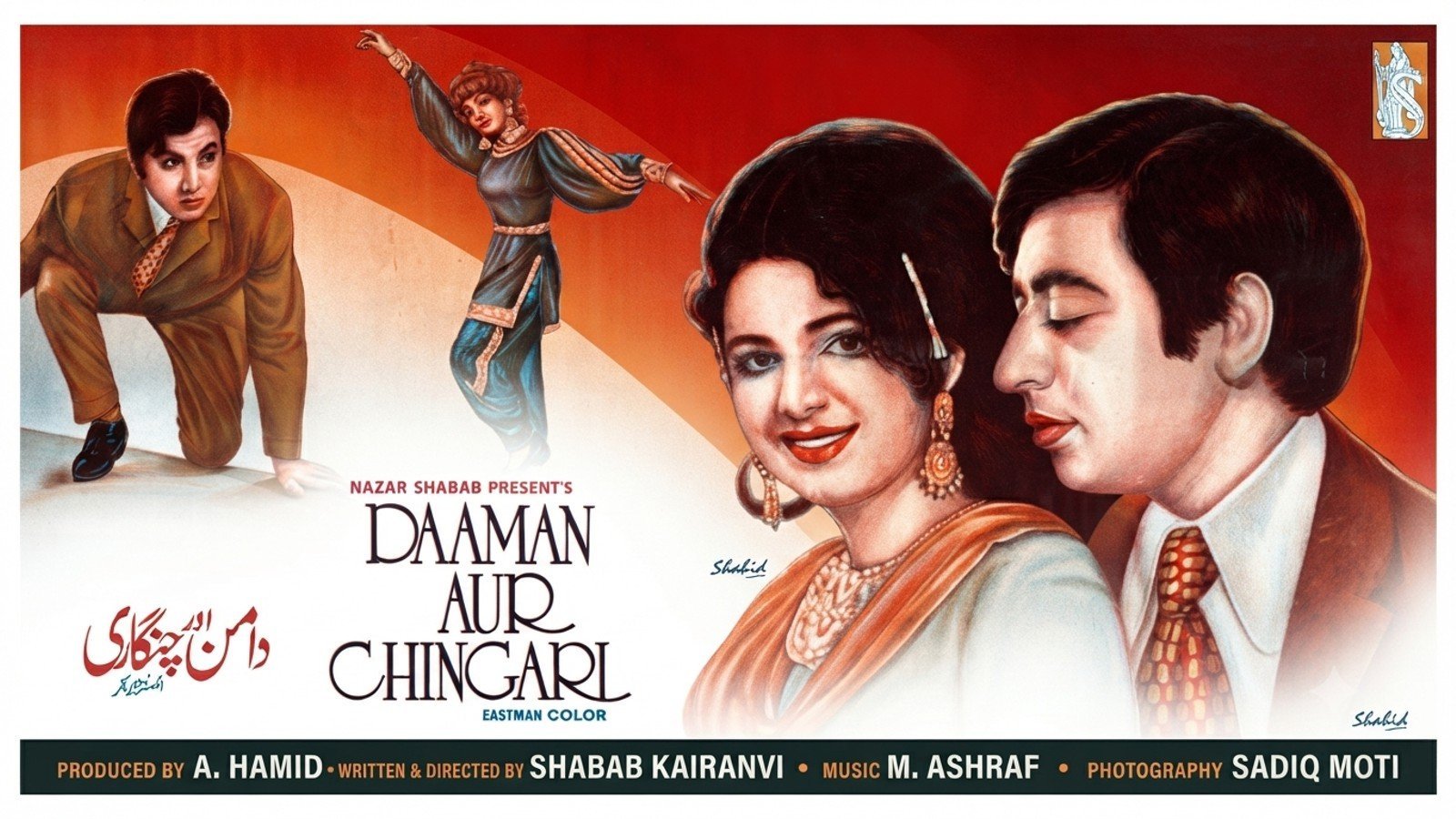
Daman Aur Chingari (1973)
Cast: Mohammad Ali, Zeba, Nadeem, Aalia, Aslam Parvez, Nayyar Sultana
Director: Shabab Kairanvi
Synopsis: Masala-laden melodramatic “family drama” manages to hit the spot.
Reviewed by: Omar Khan
Shabab Kairanvi, the director of this hit melodrama, was one of the powerhouse filmmakers of the ‘70s, with an enviable string of successes throughout the decade. Here he weaves together a potent, incredibly overwrought, and melodramatic plot tailor-made for local audiences who delight in such mega-dramatic fantasy.
The movie begins with its focus on the Allaudin household, which includes his two gorgeous daughters, Kauser (Zeba) and Kaiser (Aalia), and a good-natured Aaya (Seema), along with the mandatory moronic servant (Khalid Salim Mota). Zeba is in love with the thoroughly virtuous and decent Nadeem. At the same time, younger sister Aalia is involved with a man of a highly dubious character, played with his usual suave and debonair charm, by the supervillain Aslam Parvez.
Aalia’s father decides to get her married off to a highly eligible bachelor, Mohammad Ali. Still, when Ali visits, he mistakes Zeba for Aalia and is delighted at the prospect of marriage to the demure beauty—little does he know that his bride is supposed to be the wayward Aalia and not Zeba.
Meanwhile, it is also decided that Zeba shall wed her beau, Nadeem, when he returns from a stint abroad after attaining his law degree. The slimy Aslam Parvez is confronted, insulted, and humiliated by Allaudin and told to stay away from his daughter Aalia. However, this only makes the villainous creep more determined to destroy Allaudin’s clan. On Aalia’s wedding night, she is abducted by the dastardly Parvez, and Allaudin is faced with the prospect of telling the bridegroom’s family that the bride has ran away with her boyfriend.
Zeba sacrifices herself for the family, steps into Aalia’s shoes, and marries a delighted Mohammad Ali, who doesn’t realize how lucky he is. Meanwhile, Aalia is disgraced by Aslam and rescued by a Nightclub owning Madame, who persuades her to follow in her footsteps and wait for the day she can avenge Aslam.
Allaudin goes bonkers and sets his house on fire before going up in flames. Zeba tries to come to terms with losing her beloved Nadeem, who is devastated that he was ditched without any explanation. As is the case with typical Lollywood melodrama, a bitter Nadeem returns home from his studies and comes to stay with his best friend, none other than Mohammad Ali.
In another twist, Zeba finds Aaliya at the local nightclub, discovering what happened to her at the hands of Aslam. Meanwhile, Aslam tries to blackmail Zeba for keeping quiet about Aalia, the club dancer. At home, things are just as fraught with Nadeem and Zeba attacking each other through double-meaning dialogues, sending poor Mohammad Ali into a complete flap.
With several hit songs, all this dramatic mayhem resulted in a significant box-office success for the Kairanvi clan. The songs were toprated in their day, with Hamaare dil se mat khelo, Khilona toot jayega, by Mehdi Hasan being a big favourite. Madame Noor Jehan’s songs picturized on Aalia were also very popular, mainly Aina tod de, Asli Chehre Par, and Aik haath par Suraj rakh do.
Daman Aur Chingari
The acting is impressive, with Mohammad Ali outstanding in his dialogue delivery and devastatingly overwrought in the punch-drunk emotional scenes. He may not be the most handsome Lollywood hero (though some would argue against that), but he makes up for his lack of classical looks with his charisma and screen presence.
Nadeem does well as the jilted lover but fails to match Ali for charm. Zeba also performs efficiently, managing to keep her pouting in check. Realism may not be her forte, but she looks delectable and elegant and performs well enough in a role that hardly requires her to be a Shabana Azmi. Aalia has a rare, juicy role in an Urdu film and does justice to her part by being rewarded with at least three songs.
This film was a career-high for Aalia, who wasn’t as popular in Urdu movies as in the Punjabi scene. Perhaps the pick of the lot is Aslam Parvez, the lecherous predator waiting to pounce on a helpless victim whenever possible. It’s a role he waltzed through several times in his glittering career—oozing slime and menace through every pore of his body. A better villain has yet to grace the Urdu screen to this day.
Daman aur Chingari may not have an original bone in its entire structure, but that doesn’t stop it from being a perfect example of the ideal family-oriented melodrama, which is so much the hallmark of Lollywood cinema fantasy.
The one drawback is the inclusion of a comedy subplot featuring Munawar Zareef, which takes up a good half hour of the movie, including a parody song, which is insufferably tedious and nearly succeeds in slowing the movie to a virtual standstill on one or two occasions. The film is a good old-fashioned “family drama” that tugs sufficiently at the audience’s emotional levers to make it a worthwhile experience.



0 Comments
Leave a Comment