
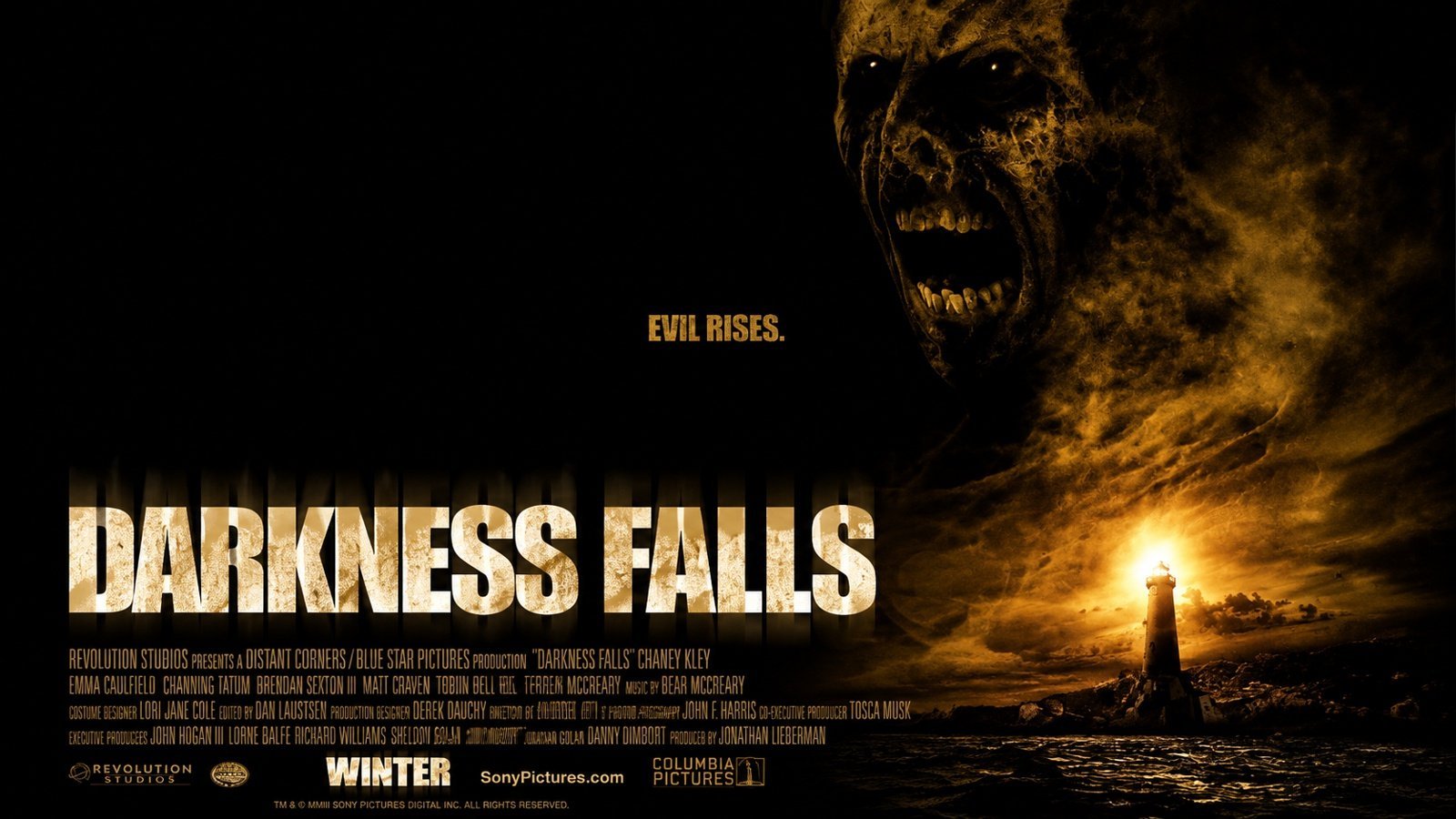
Darkness Falls (2003)
Cast: Chaney Kley, Emma Caulfield, Lee Cormie, Grant Piro, Sullivan Stapleton
Director: Jonathan Liebesman
Synopsis: dying hag curses sleepy town and returns later as the murderous Tooth Fairy
Reviewed by: Omar Khan
Hollywood horror appears to be going through a particularly anaemic period. The major studios seem to have exhausted not only genuinely original ideas but, increasingly, even half-decent ones. Every few months another slickly packaged exercise in noise and CGI arrives in cinemas, desperately attempting to convince audiences that louder somehow means scarier.
A perfect example is Darkness Falls, a film which performs the remarkable feat of transforming the Tooth Fairy into a homicidal supernatural killer.
One almost admires the sheer audacity of the idea.
Almost.
According to the film's ludicrous mythology, the small coastal town of Darkness Falls was once home to an elderly woman accused of abducting children for sinister black magic rituals. The frightened townsfolk promptly burn her alive, but not before she swears vengeance upon the entire community. In a deliciously ironic twist, the supposedly murdered children are discovered safe and well shortly afterwards, leaving the citizens to live with the burden of their guilt for generations.
So far, one can just about accept the fairy tale.
Then the film begins.
Years later we meet young Kyle, a little boy attempting to sleep after losing his final baby tooth. Disturbed by strange noises and convinced that someone—or something—is lurking in the darkness, he repeatedly pleads with his mother to believe him.
Naturally she doesn't.
A few moments later she is rewarded for her scepticism by being spectacularly shredded by a hideous apparition wearing an unnervingly cracked porcelain mask.
Years pass.
Kyle grows into a psychologically scarred adult, institutionalised and obsessively terrified of darkness, forever haunted by memories of his mother's grisly death at the hands of the marauding Tooth Fairy.
Then, because horror films demand such things, his childhood sweetheart telephones to explain that her younger brother is experiencing exactly the same terrifying symptoms.
Kyle immediately asks the obvious question.
"Has he lost a tooth recently?"
Quite understandably, nobody is especially receptive to the theory that a homicidal Tooth Fairy has been flying around the town lacerating innocent citizens in revenge for events that occurred decades earlier.
Kyle spends much of the film desperately urging everyone to carry flashlights and avoid the darkness at all costs, yet somehow repeatedly finds himself locked inside police cells where the light bulbs have an uncanny habit of failing at precisely the wrong moment.
In fact, the electrical wiring throughout Darkness Falls appears to have been installed by the same people responsible for the screenplay.
The entire town suffers endless power failures, culminating in a complete blackout that must surely have left the Tooth Fairy believing every Christmas had arrived simultaneously.
The creature itself refuses to enter the light because exposure reveals her horribly charred face. Worse still, anyone unfortunate enough to glimpse her is thereafter hunted down and violently dispatched for committing the unforgivable crime of...looking at her.
The mind boggles.
One cannot help wondering quite how Hollywood horror has descended to this level of creative bankruptcy.
Had it not been for the remarkable resurgence of Japanese and Far Eastern horror around this time, the genre would surely have been in an even more desperate state than it already was. While filmmakers in Japan were reinventing psychological horror through atmosphere, ambiguity and imagination, Hollywood studios seemed content to green-light increasingly infantile premises dressed up with expensive visual effects.
It is astonishing that a major studio looked at a screenplay about a murderous Tooth Fairy and concluded that this was the future of horror cinema.
Then again, Warner Bros. had recently enjoyed considerable commercial success recycling William Castle's films into glossy, made-for-morons horror attractions, so perhaps it was inevitable that other studios would eventually embrace the same brain-dead formula of loud noises, cheap CGI and wafer-thin scripts.
The most depressing aspect of modern studio horror is that the director frequently appears to play second fiddle to the sound designer.
Indeed, the real star of many contemporary horror films is no longer the monster.
It is the sound engineer.
Modern scares are meticulously orchestrated through sudden deafening bursts of noise designed solely to catapult audiences out of their seats. Such tactics require remarkably little imagination. Genuine suspense, atmosphere and craftsmanship have gradually been replaced by the cinematic equivalent of someone repeatedly shouting "Boo!" from behind the sofa.
Darkness Falls exemplifies this trend perfectly.
It mistakes startling the audience for frightening them.
There is a world of difference.
The film boasts a thoroughly preposterous screenplay, indifferent performances and visual effects that looked decidedly ropey even upon release. Any genuine sense of dread is continually undermined by the sheer absurdity of the central premise.
One begins to wonder where Hollywood can possibly go next.
Humpty Dumpty returning from the dead in Darkness Falls 2 perhaps?
Or maybe Little Miss Muffet, whose unfortunate spider has grown into a giant man-eating mutant after consuming BSE or SARS-infected curds and whey?
At this point, almost anything seems possible.
To describe Darkness Falls as a horror film is perhaps giving it rather more credit than it deserves.
A horrible film would be a considerably more accurate description.
As an amusing postscript, the DVD commentary track strongly suggests that the filmmakers genuinely believed they had created something genuinely terrifying. Listening to it merely reinforces the uncomfortable suspicion that the production was entrusted to a group of people blessed with far more money than ideas.
Darkness Falls is a preposterously dumb film with virtually no redeeming features.
It is not frightening.
It is not imaginative.
It is not even unintentionally funny often enough to become entertaining.
It merely serves as yet another depressing reminder of how creatively impoverished mainstream Hollywood horror had become at the beginning of the twenty-first century.

0 Comments
Leave a Comment