
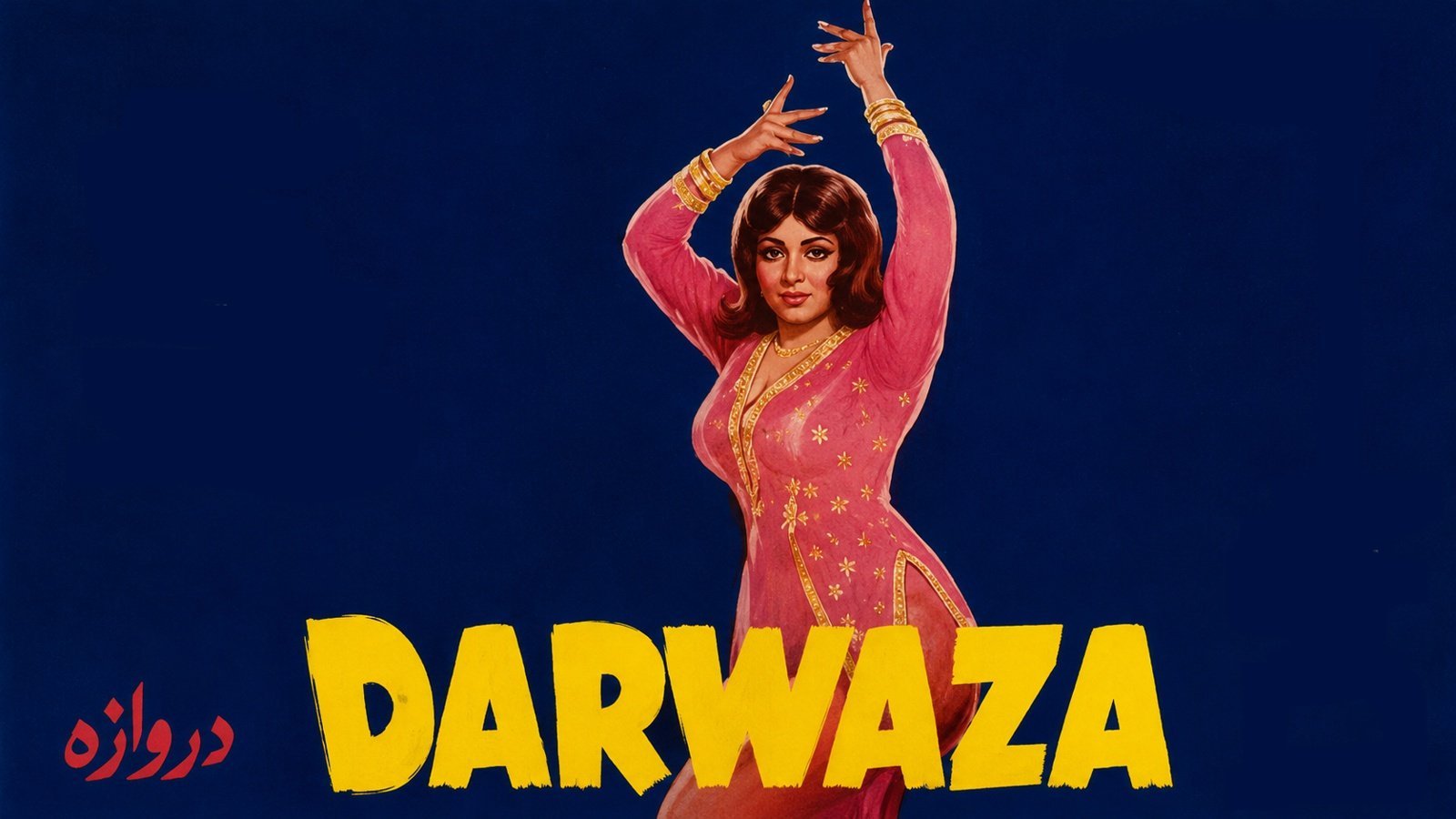
Darwaza (1962)
Cast: Neelo, Yousuf Khan, Talish, Nazar, Panna, Laila, Naeem Hashmi
Director: Saifuddin Saif
Synopsis: Musical melodrama, showcasing Neelo and an evil lecherous landlord destroying the hard but idyllic lives of the villagers with his devious, new Westernized values.
Reviewed by: Omar Khan
This old-fashioned melodrama was another perfect showcase for Neelo at the height of her popularity in 1962. She had enthralled audiences for a handful of years, in which she had already amassed over 40 films in both Urdu and Punjabi, and her popularity chart was higher than ever in the early 1960s. This time, she plays a spirited village belle madly in love with Yusuf Khan, an earnest peasant farmer; not a wealthy man in monetary terms, but everything that Neelo desires in a man and seemingly, it is a match made in heaven.
Complications arise when two different city rogues take a fancy to her and try to wrest her away from her happiness in the arms of her loved one. The first cad is the village landowner’s son, Dilbar Khan (Naeem Hashmi), upon whose acres the poor villagers toil to pay their dues and be allowed to subsist on the land. The second is Talish, a big-shot theatre star and producer from the city’s bright lights, who is smitten and infatuated by Neelo and is adamant to drag her to the city one way or another.
Even though Yousuf and Neelo have no riches, they are content. Alas, soon things change for the worse, as the Landlord who graciously and generously allowed their loans to be written off becomes gravely ill and passes away, leaving the estate in the hands of his evil, foreign- educated, and recently returned son, whose ethics and fangled business ideas clash with those of his ailing father, putting profit and personal gain above all other factors.
The dastardly Dilbar Khan orders the loans to be reinstated, which places an incredible burden on the toiling Yusuf, and especially on Neelo, whose family have no means by which they can cover the loans.
Dilbar Khan tries different conniving ways to get Salma (Neelo) to be his, but she stands firm until finally, a destitute father begs her to comply, as he cannot pay the loan back, and they have absolutely nothing to offer in exchange. The only ‘commodity’ he can offer is his daughter. Yusuf is crushed, but Neelo can’t destroy her life by marrying the Nawab, so she flees to the big bad city, hoping to be rid of the evil Nawab. Once in the city, she falls into the trap of Talish, who grooms her as the city’s top courtesan by teaching her classical singing and dancing. He falsely keeps her faith by telling her that he will write a letter to Yusuf, asking him to join her in the city but in reality, he has his designs on the beautiful and somewhat helpless Salma, captured in the city as she is.
Poor Yusuf falls into a deadly spiral of depression and illness as his will to live dissipates without his beloved, whose whereabouts he has no clue about. He lies in his bed, withering away, being cared for by his mother and Laila. He only insists that the door be left open just in case Salma ever decides to return, but eventually, Laila closes the door believing Salma has gone for good.
Eventually, matters come to a head when Talish moves on Salma, and his deception about writing the letter to Yusuf comes to the fore. At the same time, the scheming Dilbar Khan has arrived in the city and manages to find Salma, and continues his nefarious plans that her escape to the city had thwarted.
A tragic end for Salma and Yusuf looks likely, but timely intervention from an unexpected source gives them hope. Will they be able to rekindle their relationship, or will Salma be lost to the city forever, constantly hounded by randy, cunning, evil city dwellers?
The film is essentially a showcase for Neelo to display her range of talents, and she has plenty of scope to impress. The music is from another era and quite melodious, though the film could have done with fewer songs. Yusuf Khan is decent in support, while Talish shines once again, playing himself pretty much and playing it well. The villain, Naeem Hashmi, is impressive, and so is Laddan, his slimy sidekick. The film may not tread any new ground or make any breakthrough social or political statements, yet it is solidly entertaining throughout without being exceptional in any particular manner.


0 Comments
Leave a Comment