
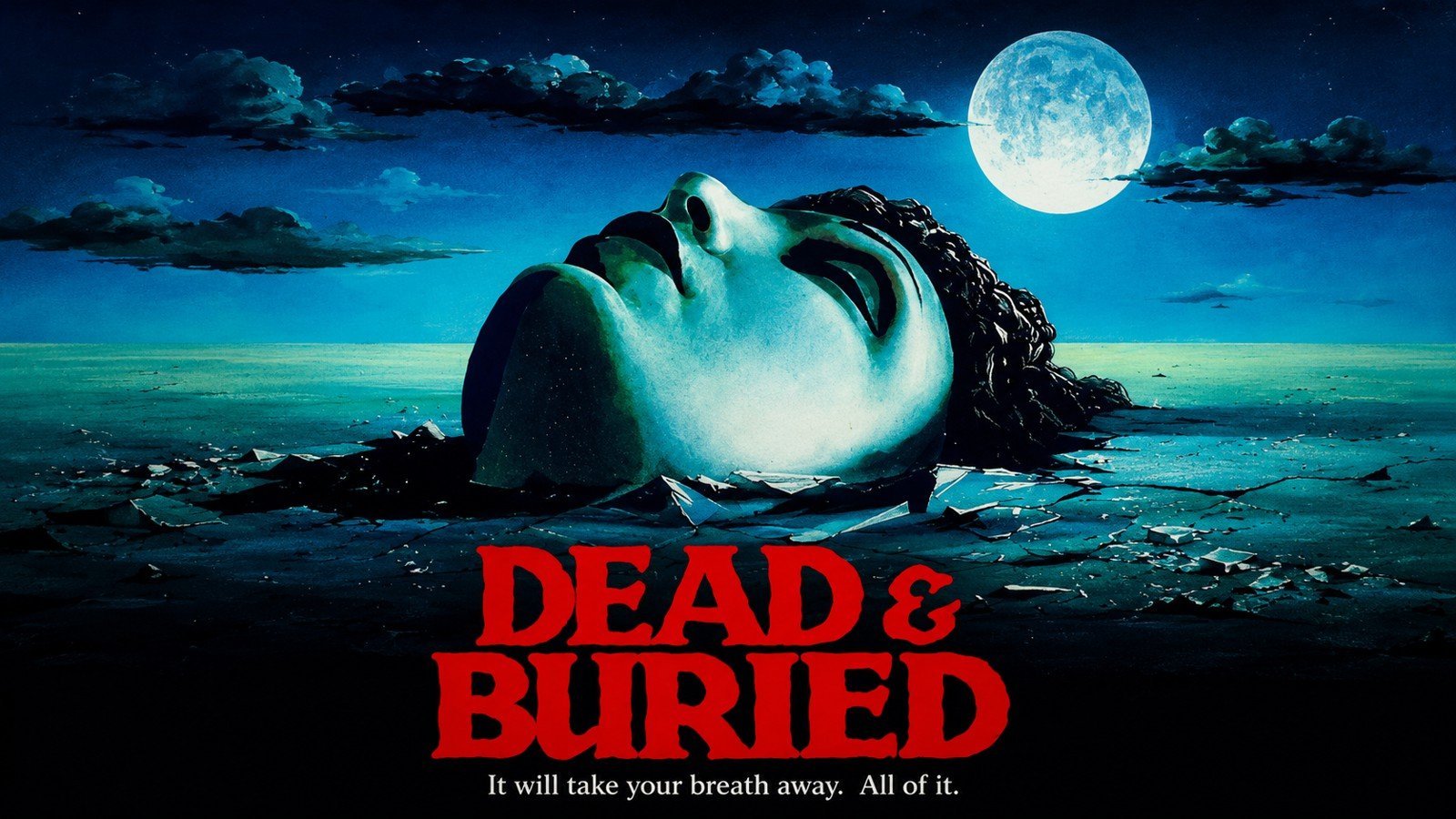
Dead & Buried (1981)
Starring: James Farentino, Melody Anderson, Jack Albertson, Robert Englund
Director: Gary A. Sherman
Synopsis: Sleepy fishing village has inhabitants who just wont stay dead!
Reviewed by: Omar Khan
"offbeat...builds to a suspenseful climax" Creature Features
"emerges as an efficient shocker" Time Out
"dumb, gory horror film" Blockbuster Video
"gory but well made chiller" Maltin
"grisly" Splatter Movies
"See this movie any way you can!" DVD Delirium
Dead & Buried arrived at the very dawn of the 1980s horror boom but disappeared almost without trace following its original theatrical release in 1981. Ironically, it was the subsequent video release—and more specifically the intervention of Britain's increasingly deranged censors—that eventually gave the film its cult reputation. The BBFC saw fit to place it on its infamous list of supposedly "obscene" films, effectively banning it for many years before finally relenting. The film also attracted considerable attention from genre fans because it reunited the writing team of Dan O'Bannon and Ron Shusett, whose previous collaboration had resulted in Alien.
In many respects, Dead & Buried came as a refreshing change during a period almost entirely dominated by masked, knife-wielding maniacs in the mould of Michael Myers and Jason Voorhees.
The film opens promisingly in the sleepy, gloomy coastal town of Potters Bluff, where a visiting photographer, busy capturing the town's picturesque decay, is lured towards an attractive blonde after she coyly beckons him over. What begins as an innocent flirtation rapidly descends into outright horror as the unfortunate photographer is brutally roasted alive by the seemingly deranged townsfolk.
James Farentino plays the local sheriff, a man left utterly flummoxed by a series of increasingly bizarre events. Visitors to Potters Bluff appear to suffer hideous accidents, only to recover with miraculous speed before inexplicably deciding to remain in town as perfectly contented members of the community. Adding further unease is the town's eccentric mortician-cum-coroner, a wonderfully bizarre old character who happily dances around his mortuary to the sounds of 1940s swing music while patching up his latest cadavers.
As Farentino struggles to make head or tail of the mounting mysteries, the audience gradually discovers that many of the townsfolk are directly involved in the murders, although their motives remain frustratingly elusive until a genuinely chilling finale finally reveals the horrifying truth.
The central idea is not a million miles removed from Invasion of the Body Snatchers or even The Stepford Wives, yet the filmmakers never seem entirely certain what sort of horror film they actually want to make. For much of the running time the emphasis falls squarely on Tom Savini's elaborate gore effects and make-up, while the mystery itself takes something of a back seat. Then, during the final third, the balance shifts dramatically as the mystery finally comes to the fore and the film suddenly becomes considerably more involving.
Ironically, the strongest part of Dead & Buried arrives when it stops trying so hard to shock us.
The opening half is rather muddled and often feels as though it is treading ground already covered by numerous horror classics before it. Consequently, many viewers will probably guess the film's central revelations well before they finally arrive. Even so, predictability does not rob the climax of its impact. The final scenes are genuinely unsettling and remarkably effective, almost rescuing the film from its earlier uncertainty.
Almost everything about Dead & Buried feels as though it is on the right track, yet there remains something curiously elusive that prevents it from joining the front rank of early-eighties horror classics. Perhaps its greatest weakness is that it often feels like an amalgam of several superior films rather than something entirely original in its own right.
Nevertheless, despite its obvious shortcomings, the film possesses considerably more imagination than much of the conveyor-belt slasher fodder that flooded cinemas during the early eighties. More importantly, it boasts a finale that lingers long after the closing credits have rolled, something many of its contemporaries failed to achieve.
The reason Dead & Buried incurred the wrath of the Mary Whitehouse-inspired lobby within the BBFC was almost certainly its handful of graphic gore sequences, particularly the notorious hypodermic needle through the eye and the admittedly rather unconvincing acid-injection death. Shocking they undoubtedly were in 1981, but hardly worthy of prohibition.
Looking back today, the decision to ban Dead & Buried seems positively absurd, especially when one considers the graphic violence routinely available in modern video games marketed directly at teenagers.
Under James Ferman, the British censor became infamous for policies that often bordered on the schizophrenic, and placing Dead & Buried alongside films such as The Funhouse, The Evil Dead, The Texas Chain Saw Massacre and even the ten-times Oscar-nominated The Exorcist remains one of the more farcical episodes in the history of British film censorship.
Dead & Buried may not quite deserve to stand alongside the greatest horror films of its era, but it is certainly a far more intelligent and rewarding experience than its original reputation—or indeed its former status as a so-called "Video Nasty"—might suggest.

0 Comments
Leave a Comment