
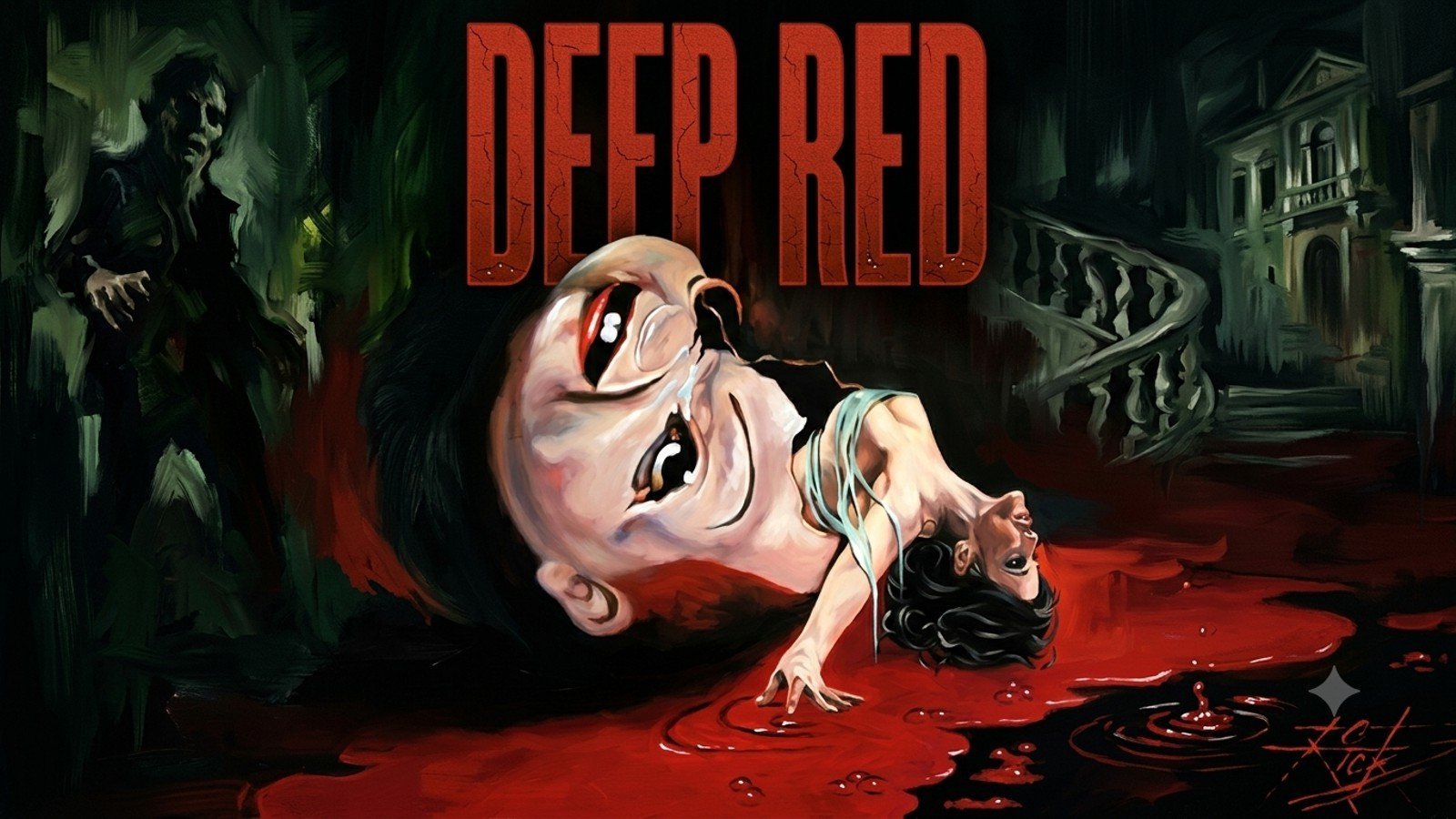
Deep Red (1975) AKA PROFONDO ROSSO, AKA THE HATCHET MURDERS
Starring: David Hemmings, Daria Nicolodi, Gabrielle Lavia, Macha Meril, Eros Pagni, Clara Calamai
Director: Dario Argento
Synopsis: Wonderfully stylish and grotesque psycho-slasher fare from Euro master Argento.
Reviewed by: Omar Khan
Legions of horror fans the world over regard Deep Red (Profondo Rosso) as Dario Argento's masterpiece, placing it even above the hugely acclaimed Suspiria. It was during this remarkable purple patch that Argento acquired such unofficial titles as "The Italian Hitchcock" and, somewhat less flatteringly, "the poor man's De Palma"—descriptions that could be interpreted as either compliments or criticisms depending upon one's point of view.
Deep Red opens with one of Argento's most striking visual flourishes. Set against a shimmering Christmas backdrop bathed in overexposed white light, the sequence unfolds like a garish dream. A sickly children's nursery rhyme plays incessantly in the background as we glimpse shadows, sharp edges, a knife, hear a scream and finally watch the weapon fall into a pool of blood redder than red itself. It is quintessential Argento, recalling the fragmented flashbacks employed in Tenebre, Phenomena (or Creepers, as it was known in some territories) and, of course, The Bird with the Crystal Plumage, the film that arguably laid the blueprint for much of what Deep Red would become.
Argento has always revelled in dreamlike imagery, and these surreal flashbacks recur throughout much of his work. The story then shifts to present-day Turin, where British expatriate Marcus Daly (David Hemmings) earns a living as a jazz pianist. Before he enters the narrative, however, Argento stages another wonderfully atmospheric sequence at a parapsychology conference. A celebrated psychic suddenly recoils in terror after sensing the presence of a murderer sitting among the audience. Dominated by vivid shades of crimson—a visual motif that had recently featured so memorably in Nicolas Roeg's Don't Look Now—the sequence ends with the psychic being stalked by a shadowy figure accompanied by that now thoroughly irritating children's tune before becoming the killer's next victim.
Marcus returns home through the deserted streets of Turin after pausing to exchange a few words with the local drunk, only to witness the horrifying climax of the murder. The killer's hatchet crashes repeatedly downwards before the unfortunate victim is left impaled upon the shattered glass of a window—another of Argento's favourite methods of dispatch. It is staged with his customary flair, combining balletic camera movement with moments of astonishing brutality. It is worth remembering that this is the complete uncut version, some twenty minutes longer than the theatrical release, which not only explains the greater level of gore but also accounts for some of the pacing issues that occasionally surface.
The film races out of the starting blocks, although the momentum slackens somewhat as Argento devotes considerable time to the playful relationship between Marcus and the inquisitive journalist Gianna Brezzi (Daria Nicolodi, who would later co-write Suspiria). Their humorous banter is charming enough, but it inevitably dissipates much of the tension that the opening reels establish so effectively, causing the narrative to meander at times.
Fortunately, Argento more than compensates with a succession of magnificent set pieces that elevate Deep Red far above the average Euro-slasher. The murders themselves, together with the prolonged build-up preceding each one, remain the director's greatest strength. There is an extraordinary confidence to the staging and it is fascinating to see just how influential the film has proved over the decades. One repeatedly experiences a sense of déjà vu, only to realise that Deep Red arrived years before the American slasher boom spearheaded by Halloween. The influence has travelled in one direction.
Equally inspired is the casting of David Hemmings. Having achieved international fame in Michelangelo Antonioni's Blow-Up as another man who inadvertently witnesses a possible murder and becomes obsessed with uncovering the truth, his appearance here carries an added layer of cinematic irony.
Hemmings gives a solid, dependable performance and, truth be told, looks positively Shakespearean beside some of the rather wooden supporting players. Goblin's famous synthesiser score, meanwhile, is full of energy, atmosphere and, it has to be said, an awful lot of noise. Like so many elements of Argento's cinema during this period, it is impossible to imagine the film without it.
There is little doubt that Deep Red contains some dazzling moments and it is easy to understand why so many horror aficionados consider it Argento's crowning achievement. Personally, however, I still find Suspiria to be the jewel in the director's crown. The finale here is enormously enjoyable and the visual inventiveness frequently breathtaking, but one is occasionally left wondering just how plausible the identity and behaviour of the killer really are.
Then again, perhaps that is entirely the wrong way to approach a Dario Argento film.
The moment one begins scrutinising his plots for logic, realism or consistency, the magic evaporates. Far better simply to surrender to the experience and enjoy them for what they are—lurid, stylish, gruesome (s)lashings of cinematic excess in which atmosphere triumphs over plausibility almost every single time.
I must confess, however, to suffering one rather unfortunate side effect after watching Deep Red once again...
I spent the rest of the evening wandering around the house humming that infernal children's nursery rhyme.
Latent murderous tendencies, no doubt.
I had the pleasure of spending a couple of days in the company of Dario Argento and Goblin AKA Claudio Simonetti at the Neuchatel Film Festival in 2004. We had dinner together at the old Suchard Factory that had been transformed into wonderful fusion restaurant. It was an opportunity to speak to Dario Argento about this and that and it was rather surprising to find that he was a very gentle sort of man who was quite squeamish about the horrors of real life. These were the days when the Taliban movement was gaining traction and the early waves of the movement that came to be known as ISIS was making its name globally. Argento mentioned that he was mortified at any prospect of travelling to Afghanistan or Pakistan after all he had heard about beheadings and so on being carried out on a regular basis. We talked not so much about horror movies but more about cuisine from around the world and our Filipino friend has us in spasms of delight and horror at some of the items he said were popular in his land. It was a memorable evening and I was honoured when both he and Simonetti purchased some of the hand painted posters I had exhibited at the festival. I remember he was particularly enamoured by the snake oriented "Naag Movies" and had bought a canvas of the Pakistani film Naag aur Nagin to take back home with him. Another huge honour to have been able to spend these very special moments with huge stars of their field and yet below all that success was a charming, warm and witty human being. No pomp, no prestige and no affections at all.

0 Comments
Leave a Comment