
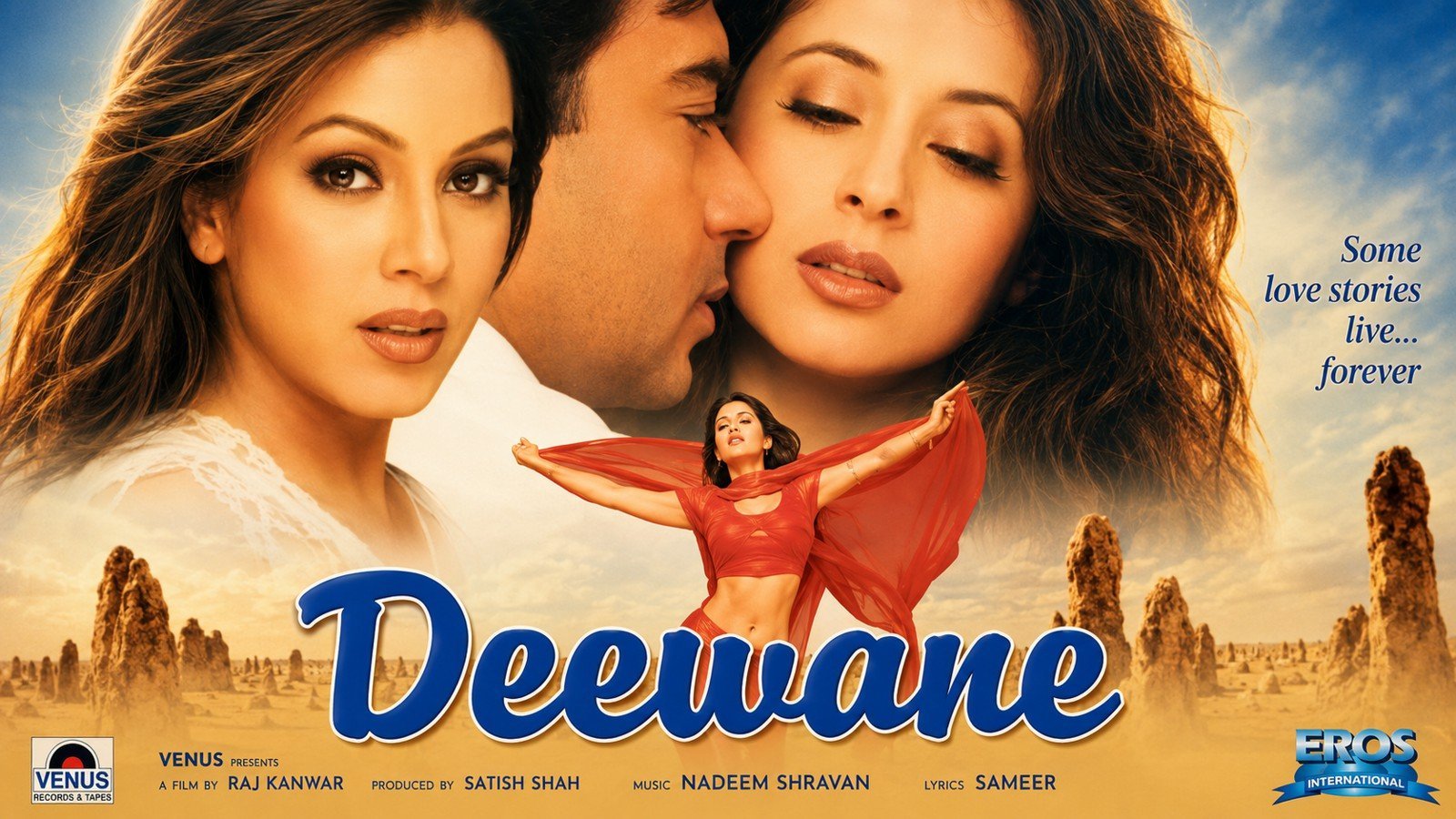
Deewane (2000)
Starring: Ajay Devgun, Urmila, Mahima Chaudhary
Director: Harry Baweja
Synopsis: a fantastical hotch potch which leaves you cold
Reviewed by: Faiz Khan
Deewane is a big film. Reputedly costing a whopping 14 crores, it is supposedly "an intense love story", according to Ajay Devgn. You would then wonder where 14 crores could have gone in a film which is, to quote Devgn again, "basically about love, emotions, jealousy and ecstasy."
Unfortunately, I do not subscribe to his point of view, and Deewane is really a fantastical hotchpotch which leaves you distinctly cold. If one takes the premise the film tries to portray, it could actually have been quite an interesting psychological experiment.
Here's how it stands.
Take two identical people, both in looks and manner. However, one places great importance on his job (he is a cop) and therefore has restrictions on his time; he doesn't like disco dancing and keeps his mobile switched on. The other (a thief) has no such restrictions, likes to boogie, recites the occasional sher and switches his mobile off. The lady in the middle has loved the cop since childhood and the two are about to be married. But because the obligatory villains fear being exposed by the cop, they attempt to bump him off. He doesn't die but ends up in a coma. Having previously arrested the thief—his humshakal—and this being known to the Police Commissioner, the Commissioner persuades the thief to impersonate the cop because crime has quadrupled since it was believed the officer had been killed. The thief agrees quite willingly because he is going to earn ten lakhs for his efforts.
Aha... but the crunch comes when he has to meet the cop's family and, more importantly, the cop's childhood sweetheart Sapna (Urmila), whom the cop is about to marry. Despite having the gorgeous Pooja (Mahima Chaudhry) hopelessly in love with him, the moment he sets eyes on Sapna, he is smitten. Soon afterwards, the cop recovers. By this time, however, Sapna has fallen in love with the thief for all the reasons mentioned earlier. When it is finally revealed that there are in fact two Devgns, the real trauma in Sapna's life begins. She simply cannot come to terms with the fact that she has developed genuine feelings for the thief, believing all along that he was the man she had loved since childhood.
Catastrophe.
Will she end up with the cop—a decent, honourable man whom she has loved all her life but who perhaps lacks the spark possessed by the thief? Or will she end up with the thief, who is now much like the cop except that he is more lively, spontaneous and romantic? Should that really make all the difference?
Will she throw aside the man she has known since childhood for someone she has known for barely three months—and that too while believing he was somebody else?
Sounds quite interesting...
Well, it's really just fantastic rubbish.
The film simply plods on and on and on. There is the inevitable track involving the garish villains, necessary only to establish the premise but so utterly tacky and over-the-top that there is never any conviction or hint of realism.
Which brings us back to the original question.
Where did the 14 crores go?
Locations, exploding helicopters, collapsing buildings, special effects and assorted stunts. All completely unrelated to the main thrust of the story.
The film really does plod.
I have to admit there was one point where I found myself genuinely intrigued as to which direction the story might eventually take. Then I realised that this probably had more to do with my senses having been numbed by the awful songs, the talking dogs (which, incidentally, raised more laughs than anything else, with Johnny Lever apparently doing Eddie Murphy doing Dr Dolittle), the permanently sobbing Mahima, the two bald villainous brothers...
Should I go on?
I like Ajay Devgn. As an actor, he has improved enormously over the years and always seems sincere about his work. He also strikes me as a refreshingly no-nonsense individual without the usual star attitude. He has a double role here which must have looked quite attractive on paper. It is not an especially demanding performance, and he carries it off with ease.
Urmila, on the other hand, is very much the same as she is in virtually every other film—midriff on display, trendy dance routines, endless hip-twitching and very much the glamour girl. During the dramatic scenes she remains as animated as ever, much as she has been in most of her recent films.
And God help Mahima Chaudhry.
She seems to have wandered straight off the set of Dhadkan and reprised the same role once again—the girl with one dance number who silently pines away for the man who does not love her.
She should really be developing a complex by now!!!
Funnily enough, both Dhadkan and Deewane were released on the very same day.
Harry Baweja previously made another plodding film, Dilwale, which nevertheless became a huge hit. Once again he attempts to include everything—action, romance, comedy and villainy—and once again ends up with a mixed pot containing not very much.
I went into the cinema telling myself that I would walk out if I found the film unbearable—the trailer certainly suggested as much.
So I was rather surprised that I actually stayed until the end.
Perhaps that is an indication in itself.
It's no classic, but it is certainly better than Govinda's last two efforts, if that is any yardstick by which to measure a film!

0 Comments
Leave a Comment