
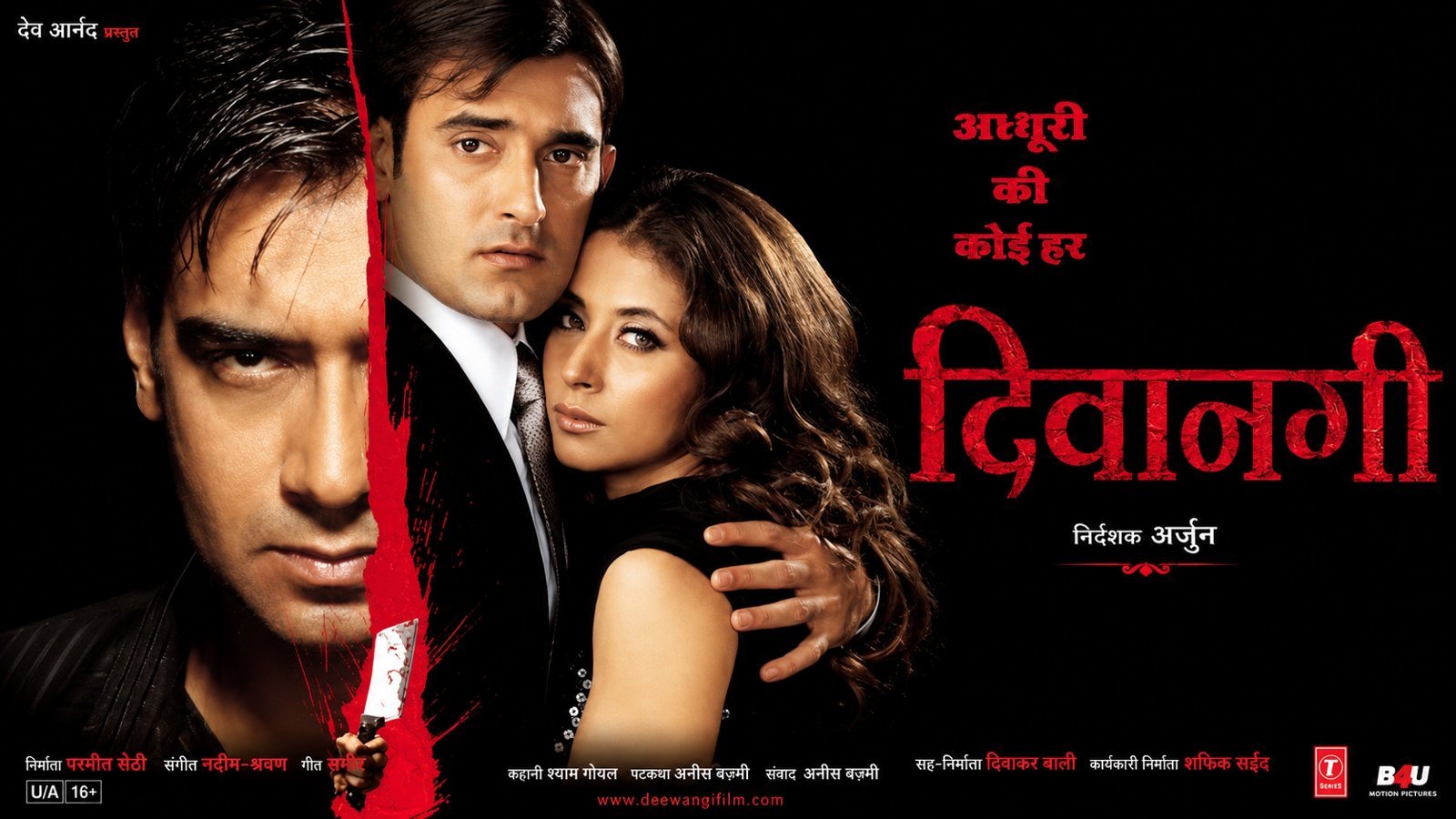
Deewangee (2002)
Cast: Ajay Devgan, Akshaye Khanna, Urmila Matondkar
Director: Anees Bazmee
Music Director: Ismail Darbar
Synopsis: Thriller inspired by Primal Fear turns out to be better than expected
Reviewed by: Faiz Khan
Every once in a while, a film jumps out and grabs you by the jugular—not because it is exceptionally good or groundbreaking, but because you go in with absolutely no expectations and come out pleasantly surprised.
Deewangee is one such film, even though it is heavily inspired by an English-language thriller whose title I shan't reveal.
Raj (Akshaye Khanna) is a brilliant lawyer with a reputation for fighting the right causes, whose path crosses that of Sargam (Urmila Matondkar). Now, what else would Ms Matondkar be but a pop artiste who dances more than she sings and is the latest sensation sweeping the nation? Well, inevitably, our legal beagle falls for the not-so-melodious tones of Sargam and all is hunky-dory until the brutal murder of music company boss Ashwin Mehta (Vijayendra Ghatge). A suspect is caught fleeing the scene and turns out to be a stuttering and withdrawn Tarang (Ajay Devgn), who also happens to be Sargam's childhood sweetheart. Sargam approaches Raj to defend Tarang and he agrees. Tarang has been found with blood on his hands but insists he is innocent, claiming that he merely stumbled across Ashwin's slashed body.
Tarang goes on trial. Raj presents a convincing defence but, the closer he gets to his client, the murkier the waters become. It transpires that Tarang suffers from schizophrenia and committed the murder during one of his violent episodes. His condition is inextricably linked to Sargam, whom he has loved since childhood and over whom he becomes fiercely protective. It was after Ashwin attempted to rape her that Tarang took a knife to him.
Raj succeeds in having Tarang committed to a psychiatric institution rather than prison, little realising what fate has in store for him because, by now, he and Sargam have become rather an item.
What sets this film apart is that, although it is by no means original, it genuinely attempts to do something a little different. We are presented with a story driven by characters rather than simply heroes, heroines and the usual cardboard cut-outs surrounding them. That has to be a good sign.
Anees Bazmee's previous film was Pyaar To Hona Hi Tha, itself a remake of French Kiss. This is a rather more curious choice for adaptation but, for the most part, it has been skilfully Indianised, even if the second half does become a little overlong. Bazmee sustains interest throughout and keeps a firm grip on the material, only loosening his hold somewhat towards the end.
Still, not a bad job at all.
Ajay Devgn tackles the schizophrenic Tarang with admirable conviction and one really has seen a marked improvement in the body of his work. This year alone he has appeared in The Legend of Bhagat Singh, Company and now Deewangee—three very different roles, all of them substantial.
Urmila, on the other hand, has little new to offer. It is the same dance routines, the same mannerisms and even the same fearful expressions we saw in Kaun. No, this one is unlikely to do very much for her.
Akshaye Khanna, meanwhile, has become a genuine pleasure to watch because he increasingly chooses roles for their characterisation rather than merely their screen time. Once again, his character is neither completely black nor white and he plays the lawyer superbly—a man caught in an impossible predicament who nevertheless uses every trick in the legal book to win the battle.
The film is let down somewhat by Ismail Darbar's rather mediocre score. The songs merely slow proceedings without offering much in the way of memorable melodies. Fortunately, almost everything else is up to speed and I, for one, would strongly recommend Deewangee as engrossing entertainment that dares to be a little different.

0 Comments
Leave a Comment