
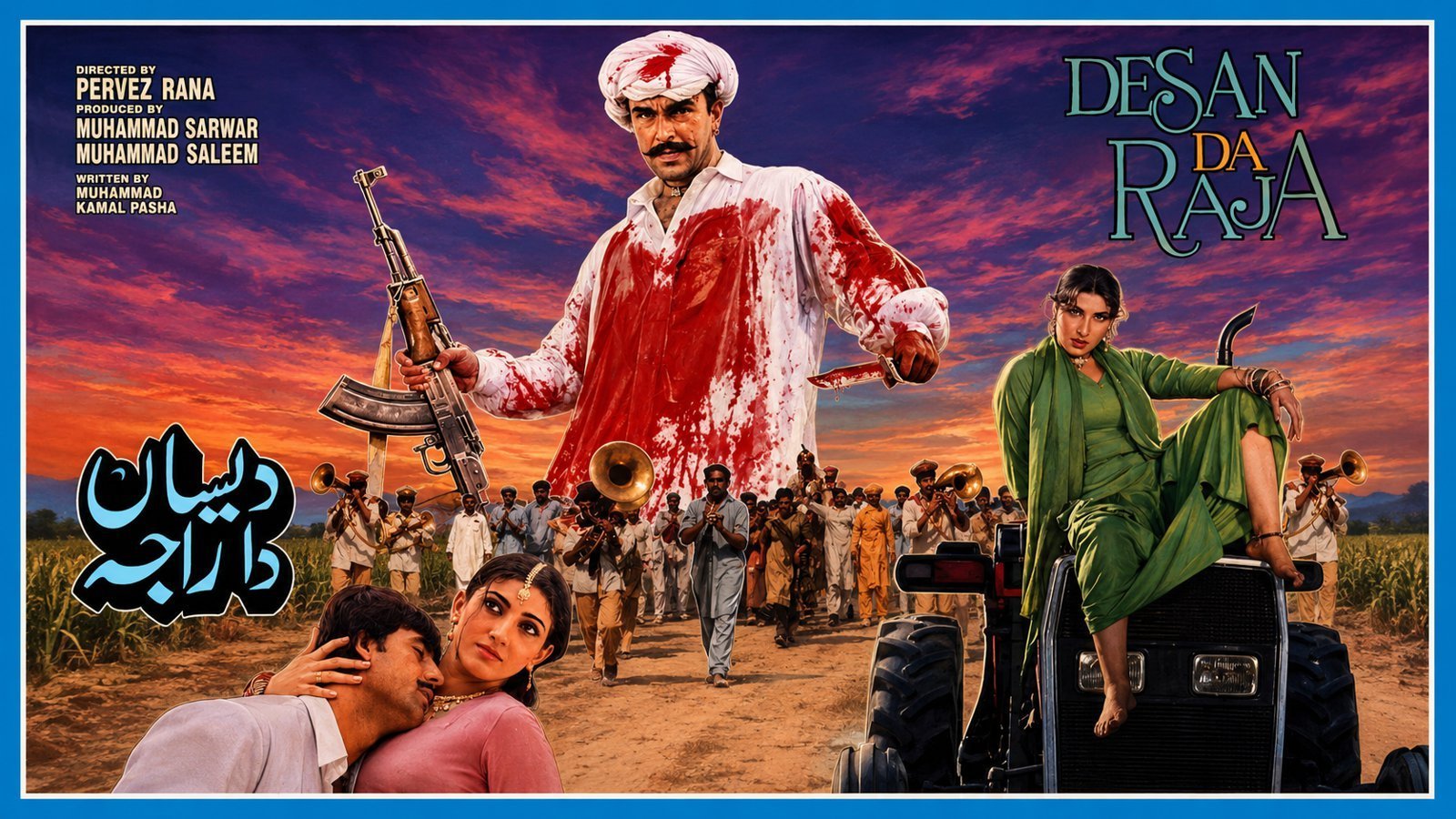
Desan Da Raja (1998)
Starring: Shaan, Saima, Bahar Begum , John Rambo, Sana, Shafqat Cheema
Director: Parvaiz Rana
Synopsis: The usual Chaudhry Vs Chaudhry mayhem. Revenge, mayhem amidst morons
Reviewed by: Omar Khan
More of the same - warring Chaudhrys at each other's throats with blood vows and doomsday threats. Much slanging, posturing, bellowing and grunting amidst the occasional pelvic thrust, accompanied by a spellbinding array of ill-fitting wigs, wonderfully outlandish costumes and spectacular moustaches. It's the usual pot-bellied, belligerent Chaudhry of one locality pitted against his arch-rival from a neighbouring village (yet again! Is this for real?), each flanked by a coterie of goons wearing the latest threads and sporting the most splendid sets of facial hair.
Here we have the buffoonish Chaudhry of Shikarpur village, strutting around his gardens surrounded by minions, one of whom is Zafri (Shaan), whose special responsibilities include filling the great Chaudhry's hookah while doubling up as bodyguard-cum-masseur. Saima stars as the village belle and milkwoman who has the hots for the studly Shaan and regularly intercepts him during his errands for the obligatory song-and-dance routine. Bahar Begum plays Shaan's mother, who repeatedly warns him of the dire consequences of meddling in the Chaudhrys' endless feuds and pleads with him to walk away from a life of blind devotion to his master. She reminds him that they are simple folk who mean nothing to these self-obsessed Chaudhrys. But it is all to no avail, as Shaan is clearly utterly enamoured of Chaudhry Alamgir and seems only too happy to massage him with increasing frequency - often in public!
There is also a tedious subplot involving Rambo, a simple village idiot employed by a wealthy dwarf to seduce a beauty upon whom he has set his sights. The beauty is a reformed (though not especially reformed) prostitute played by Sana, who turns in a remarkably convincing performance. She seems perfectly at home in the role and her two dance numbers rank among the film's high points, injecting proceedings with some desperately needed raunchy masala. Her introductory number is a revelation in cheapness, a glorious throwback to the ultra-cheap Punjabi cinema of the pre-military era during the 1970s. She sashays her way through the wonderfully tacky "Sexy Meri Shirt Sajan, Sexy Meri Pant!" Charming indeed!
Sana's second number is another gloriously over-the-top helping of raunch and masala in the finest old tradition. She gyrates, thrusts and cavorts all over the park to the irresistibly tacky Bukal De Vich Chor. Saima is also in peak "cheap mode" - one assumes director Parvaiz Rana has this effect on his leading ladies! She pulls out every jhatka imaginable during her equally racy numbers Kundi Na Kharka and Paa Jhappian. These songs were clearly conceived with the incomparable Madam Noor Jehan in mind and would almost certainly have become instant classics had she been well enough to record them. Sadly, ill health meant that other singers had to attempt the impossible task of filling the enormous void she left behind. To their credit, they do respectable jobs, though none can quite summon the sparkle, sizzle and sheer oomph that Madam Ji effortlessly brought to her raunchier numbers.
The plot thickens when Zafri is arrested for a murder committed on behalf of his beloved Chaudhry, only to discover that his master is rather less enthusiastic about helping him in his hour of need. Suddenly Bahar's warnings begin to ring true, and Zafri starts questioning his blind loyalty. The kindly dwarf posts Zafri's bail and sends him to deliver a message to Chaudhry Alamgir informing him that his own sister intends to marry a man from the rival Chaudhry's village, and requesting that, as leader of the locality, he give the couple his blessing. Naturally the Chaudhry responds with an almighty tantrum, but Shaan insists that the wishes of his mother are far more important than the dictates of any Chaudhry. Thus everything is set for the inevitable confrontation. Will the mighty Chaudhry and his army of goons allow one of "their" daughters to marry into enemy territory, or will Shaan prove that a mother's word carries greater weight than the empty pride of a meaningless Chaudhry? All is revealed after the customary bloodbath and an endless succession of fistfights, shootings and flying bodies.
The film remains interesting primarily because it sheds light on this curious Chaudhry phenomenon and the notion that a man's standing in society appears directly proportional to the amount of land he owns and the number of murders he has committed! The rampant lawlessness, broad daylight abductions, the fact that virtually every man appears permanently armed with a machine gun, the casual violence inflicted upon women and the open endorsement of honour killings all combine to paint a fascinating picture of the values prevalent within a particular society at a particular point in time. Desan Da Raja, incidentally, performed respectably at the box office, even if it ultimately fell short of becoming the blockbuster many had expected.
Desan Da Raja is about as predictable as Punjabi cinema can possibly get - almost a parody of this particular style of filmmaking (indeed, perhaps the only style?) - yet it moves along at a perfectly reasonable pace. Mindless nonsense, certainly, but oddly fascinating from a sociological point of view.

0 Comments
Leave a Comment