
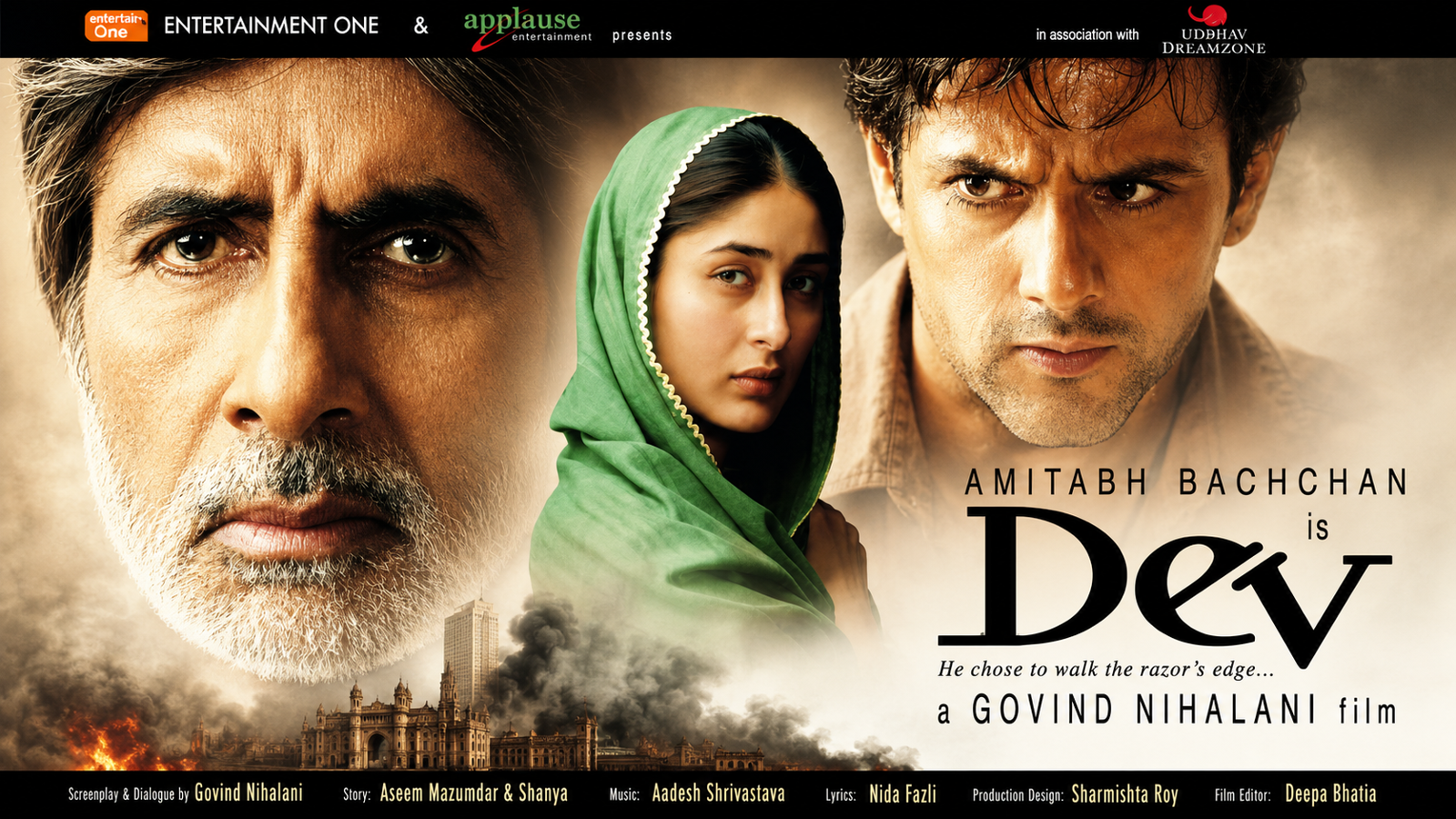
Dev (2004)
Cast: Amitabh Bachchan, Om Puri, Fardeen Khan Kareena Kapoor
Director: Govind Nihalani
Music Director: Aadesh Srivastva
Synopsis: Stunning film explores communal violence with a unique insight
Reviewed by: Faiz Khan
Dev is a film that treads familiar ground. Religion and politics resulting in communal violence, the inherently corrupt nature of government and the abuse of political power are hardly new subjects, nor have they been ignored in the past. However, Nihalani's film goes further by examining how politicians manipulate and indeed corrupt constitutional institutions such as the judiciary and the police, institutions that are supposed to remain independent and completely non-partisan. Therefore, even if Dev covers familiar territory, it does so by addressing deeply contemporary issues, and Nihalani emerges with a devastating critique of modern India that commands your attention and demands to be seen.
The protagonists are two senior police officers at the rank of Joint Commissioner. One is Joint Commissioner of Police Dev Pratap Singh, an upright officer who believes in duty above everything else. Through a series of almost black-and-white vignettes that flash before the titles, one initially gains the impression that Dev is less sympathetic towards India's Muslim minority. This perception is reinforced when he summons three eminent Muslim leaders to his office to discuss terrorism allegedly being fomented through certain madrasas. It is only natural that such remarks would cause offence, but the fact remains that, whether in India or Pakistan, this is an uncomfortable reality which the ordinary man is often unaware of and should not automatically be interpreted as anti-Muslim sentiment.
Nevertheless, Muslim politician Latif (Ehsaan Khan) views Dev's remarks as a grave insult and quietly threatens retaliation. Dev himself could easily have become a bitter man, having lost his eight-year-old son to terrorists almost twenty years earlier. Instead, both he and his wife Bharati (Rati Agnihotri) have allowed that tragedy to make them more compassionate, more forgiving and more understanding.
The other senior officer is Dev's closest friend of thirty years, Special Commissioner of Police Tej (Om Puri). His philosophy on life is almost diametrically opposed to Dev's, yet despite their differing outlooks the two men remain the closest of friends.
The story then shifts to Noor Manzil, a predominantly Muslim locality. Farhan Ali (Fardeen Khan) has just qualified as a lawyer and returns home to his father, a peace-loving Urdu professor who passionately believes in Gandhi's ideals and rejects the notion that India belongs only to Hindus. Yet Farhan's concerns that Muslims are increasingly being marginalised and persecuted are understandable, particularly in light of the atmosphere fostered by contemporary politics and organisations such as the Shiv Sena.
Farhan's father agrees to lead what he believes will be a peaceful demonstration. Unknown to him, however, Latif has carefully manipulated events to ensure that the protest descends into violence, provoking police firing that results in the professor's death. Disillusioned by both the police and the government, Farhan turns to Latif, convinced that JCP Dev is responsible for his father's death and believing that killing him will send a message that such atrocities against Muslims can never happen again. It is a simplistic argument and ultimately shown to be precisely that, as Farhan eventually finds protection from the very man he once regarded as his enemy. Nevertheless, Latif recognises an opportunity and begins moulding Farhan into the perfect assassin.
Also living in Noor Manzil is Aliyah (Kareena Kapoor), who loves Farhan but gradually witnesses his disturbing descent towards extremism. The assassination attempt ultimately fails and Farhan is arrested during a raid on Latif's hideout, though he refuses to divulge any information. Dev, recognising Farhan's intelligence and believing it has merely been manipulated by others, chooses to release him. In many ways, Dev begins to view Farhan almost as a surrogate son.
Latif now finds himself threatened by Farhan's continued survival and plots to eliminate him. In order to divert attention, he engineers the bombing of a Hindu temple, fully intending that Farhan should perish in the explosion as well. Farhan survives and begins to realise that Latif himself is responsible. Seizing upon the opportunity, the Chief Minister's political aide Rao (Milind Gunaji) sets about inflaming communal tensions, leading to devastating riots. Once the destruction is complete, Latif and Rao strike an unholy bargain whereby the Muslim community agrees to remain silent about the atrocities that have occurred. It is at this point that Aliyah courageously breaks ranks and files an official complaint, an act that leads to tragic consequences.
Stripped to its very core, Dev offers little that is entirely new in terms of subject matter, yet Nihalani's masterful direction transforms it into a riveting contemporary drama dealing with corruption, bigotry, betrayal and friendship. He has crafted a film that is intensely emotional without ever descending into melodrama. At times it is profoundly uncomfortable viewing and, on occasion, genuinely harrowing. Certain images remain with you long after leaving the cinema, not least because the incidents portrayed are drawn directly from events that remain fresh in public memory. The Gujarat riots were still very much part of contemporary history.
Religion inevitably appears to lie at the heart of these conflicts, yet what the film ultimately argues is that religious hatred alone does not produce such atrocities. Rather, it is the murky world of politics, power and corruption that fuels communalism and violence. The sight of policemen standing by while innocent people are burned alive, or asking victims their names only to discover they belong to the "wrong" religion before directing them towards certain death, is both horrifying and disturbingly believable. Tej's paralysis during the attack on Noor Manzil symbolises the gradual erosion of institutions that are supposedly founded upon the principle that no one stands above the law. The film leaves the audience with the deeply uncomfortable feeling that this principle has become little more than an illusion.
Initially, Dev leaves one with a profound sense of darkness, as though goodness itself has little chance of surviving. Yet it is also a film that offers a glimmer of hope, suggesting that there may still be a path forward. Nihalani, whose earlier work such as Ardh Satya established his reputation for uncompromising, socially conscious cinema, triumphs once again in every department.
Amitabh Bachchan proves yet again that he remains an actor without equal. Earlier this year he delivered a magnificent performance in Khakee, yet somehow surpasses even that here with another deeply affecting portrayal of a humane yet uncompromising police officer who lives entirely by his principles. Bachchan's Dev is simply mesmerising.
Om Puri, another actor of immense stature, commands the screen whenever he appears, and the scenes shared by these two veterans form the emotional backbone of the film. Fardeen Khan almost becomes the audience's guide through the narrative, the character through whom the story both begins and ultimately comes full circle. It is a demanding role but one he handles with remarkable restraint, never once succumbing to overstatement. After Yuva, Kareena Kapoor delivers yet another outstanding performance. Devoid of glamour or excessive make-up, she brings strength, dignity and conviction to Aliyah. Rati Agnihotri is equally impressive as Dev's quietly supportive wife. The music remains firmly in the background where it belongs, complementing the mood without ever intruding upon it.
This is a stunning film, and one that deserves to be seen.

0 Comments
Leave a Comment