
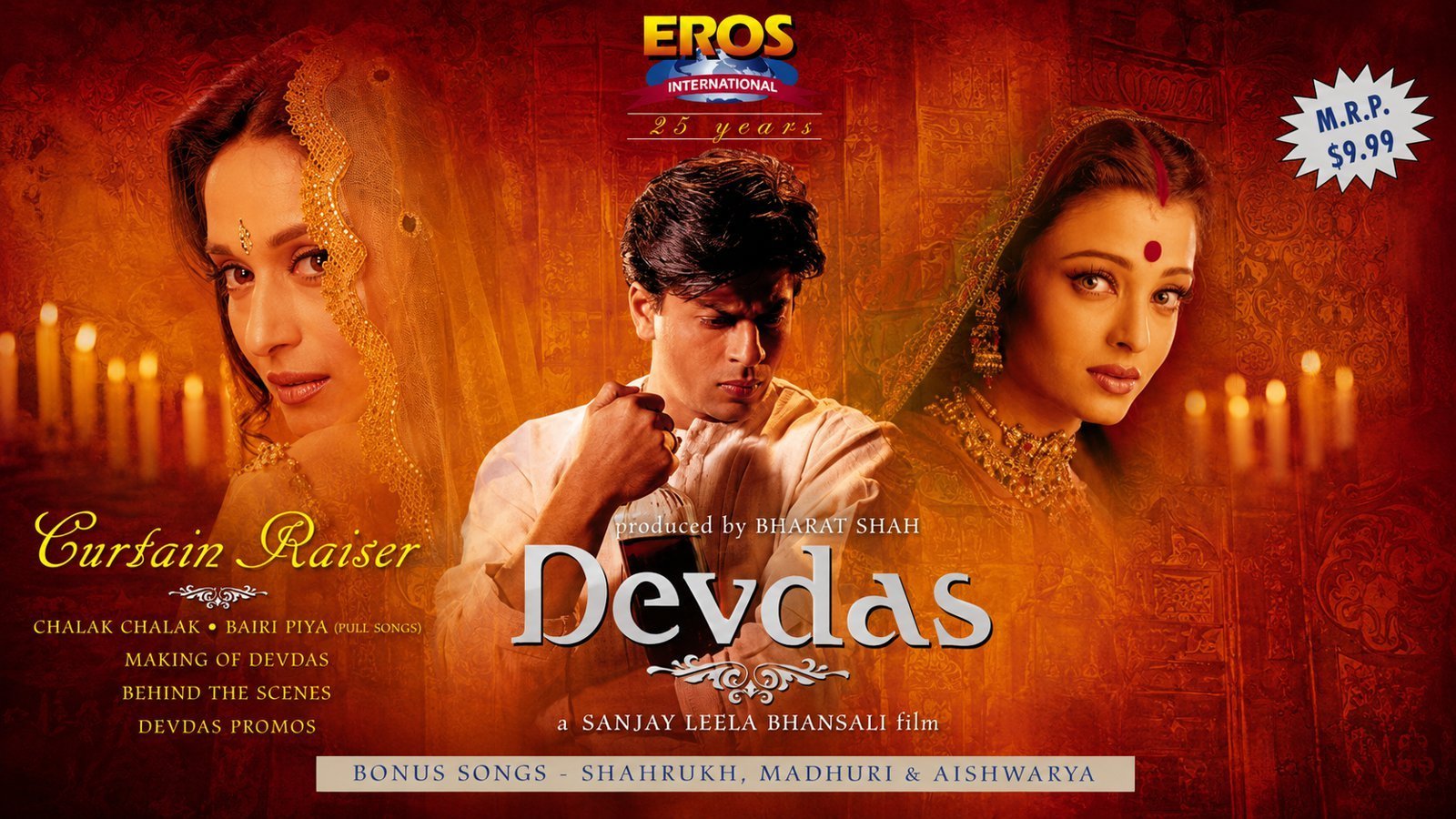
Devdas (2002)
Cast: Shahrukh Khan, Madhuri Dixi,t Aishwarya Rai, Jackie Shroff
Director: Sanjay Leela Bhansali
Music Director: Ismail Darbar
Synopsis: epic is hyped as being the most expensive film ever produced in Bollywood!
Reviewed by: Faiz Khan
A shock of muted crimson assaults the eye as the titles roll out, with exquisite background music setting the scene for what must be the most awaited film of the year. Devdas, made three times before, is the dark and tragic novel by Sarat Chandra Chattopadhyay, telling the story of a weak man, broken by love and ultimately consumed by alcohol. Perhaps the most famous and memorable version remains the one starring Dilip Kumar, Suchitra Sen and Vyjayanthimala, and comparisons with that earlier effort are inevitable. Having seen that version many moons ago, I was prepared to approach this film with a clean slate and no preconceived notions.
The film opens with the impending return of Devdas. His house, somewhat akin to Tara from Gone with the Wind, is lavish to the extreme, filled with garishly overdressed women, with his mother (Smita Jaykar), bursting with joy at her son's return from England, running amok through her haveli, resembling more a teenager in the first throes of love than a middle-aged mother awaiting her younger son's arrival. Into this fray walks Soumitra (Kiron Kher), her overtly garish neighbour, all towering hair and scarlet lipstick, the mother of Paro, Devdas's childhood friend. The conniving daughter-in-law (Ananya Khare) promptly sows the seeds of doubt in her mother-in-law's mind regarding her son's ultimately doomed friendship with Paro. Paro (Aishwarya Rai), now blossomed into a swan, keeps a diya burning for the ten years that Devdas has been away and dances with joy at the prospect of his return. The inevitable happens and Devdas, much to the chagrin of his over-exuberant mother, slips away to see "his" Paro before anyone else.
Romance blooms between the two but, of course, the England-returned Devdas is the son of a zamindar, belonging to a higher caste than Paro, whose mother Soumitra was once a nautanki performer. Plotting with her daughter-in-law, Devdas's mother publicly humiliates Soumitra during a social gathering, prompting the latter to vow that she will marry her daughter into a family far wealthier and more distinguished than Devdas's. Devdas fails to fight for Paro, the ultimate betrayal in her eyes, and she reluctantly agrees to marry a much older man.
Realising his folly, Devdas returns to Paro on the day of her wedding, but pride and hurt prevent her from accepting him and she goes through with the marriage. Thus begins Devdas's descent into self-destruction. Introduced by Chunnilal, a debauched yet congenial soul blessed with too much money and too little purpose, Devdas finds himself at the kotha of Chandramukhi (Madhuri Dixit). Though he initially despises her, she falls hopelessly in love with him and resolves to abandon her former life. Yet Chandramukhi knows all too well that Devdas lives only for Paro and that alcohol has become the crutch upon which his existence now depends.
Sanjay Leela Bhansali has brought to the screen a film of extraordinary visual splendour. Every frame is resplendent with magnificent colours, sumptuous costumes and breathtaking sets. Yet it is this very extravagance that sometimes robs the film of the credibility it strives so hard to attain. The settings are so overwhelmingly opulent that they rarely feel like anything other than a lavish Bollywood fantasy. Reality simply does not emanate from them. Indeed, the opening sequences are so theatrical and exaggerated that one is almost taken aback by the complete absence of subtlety, sacrificed in favour of overstatement and melodrama long before the story truly demands it. One seriously doubts whether havelis such as these ever existed in Bengal, whether Devdas's sprawling mansion or Paro's extraordinary blue glass-panelled home. If only Bhansali had created a world that felt more accessible, perhaps one might have shared more deeply in the pain of the story. For Devdas is, after all, a gargantuan tragedy, yet strangely one that leaves the viewer somewhat untouched, lacking the emotional depth that one so desperately hopes it will achieve.
Having said that, it was clearly Bhansali's intention to brighten what is essentially a stark and sombre novel, and his vision ought to be viewed in that light. He departs from the original by developing a friendship of sorts between Paro and Chandramukhi which, though rather far-fetched, nevertheless provides some of the film's most enjoyable moments. Their dance to "Dola Re Dola" is a supreme piece of audience manipulation, brilliantly executed by Bhansali and unapologetically designed to play to the gallery. Yet his greatest achievement lies in crafting a film as dark as Devdas while making it accessible to contemporary audiences without entirely sacrificing the essence of Sarat Chandra's story. This is not Sarat Chandra's Devdas so much as Bhansali's lavish interpretation of it.
Shah Rukh Khan delivers one of his better performances as Devdas. He is admirably restrained, though one never entirely feels that he has penetrated the very soul of this tortured man. He portrays Devdas as meek, gentle and impulsive, seemingly oblivious to the tragedy his own weaknesses are about to unleash. Whether his inability to stand up to his father stems from years of emotional repression or simply from an overwhelming devotion to his family is never made entirely clear, although the latter never quite comes across convincingly. Consequently, the agony of losing Paro and the depth of his emotional collapse lack some of the passion one expects from so monumental a tragedy.
Aishwarya Rai looks absolutely magnificent throughout much of the film and wisely underplays the role of Paro, producing a fine, if not truly remarkable, performance. Her earlier scenes with Shah Rukh Khan are particularly well handled and one only wishes there had been more of them.
The film truly catches fire with the arrival of Madhuri Dixit. Now in the twilight of her career, she sets the screen ablaze from the moment she first appears, quietly applying kajal to her eyes as Devdas stands silently at her door. Chandramukhi is perhaps the more conventional role, the tawaif who becomes a jogan, and could certainly have benefited from greater development. Nevertheless, Madhuri brings precisely the right nuances to the character within the limits of the script. To suggest that she becomes the soul of the film would hardly be an exaggeration, and one only wishes Bhansali had given her more screen time.
Special mention must also go to Jackie Shroff who takes the comparatively small role of Chunnilal and infuses it with that unmistakable Jackie charm.
The choreography, cinematography and production design are all stunning and combine to elevate the film still further. It is also refreshing to hear dialogue of such quality in a contemporary Hindi film. Ismail Darbar's score is exceptional and deserves to be regarded as a classic. Having said that, the songs themselves perhaps do not quite reach the timeless heights one might have hoped for. They are unlikely to be remembered in quite the same way as the great classics of Hindi cinema. Even so, the compositions are wonderfully unusual and, by today's standards, something to celebrate. Monty's background score is quite superb.

0 Comments
Leave a Comment