
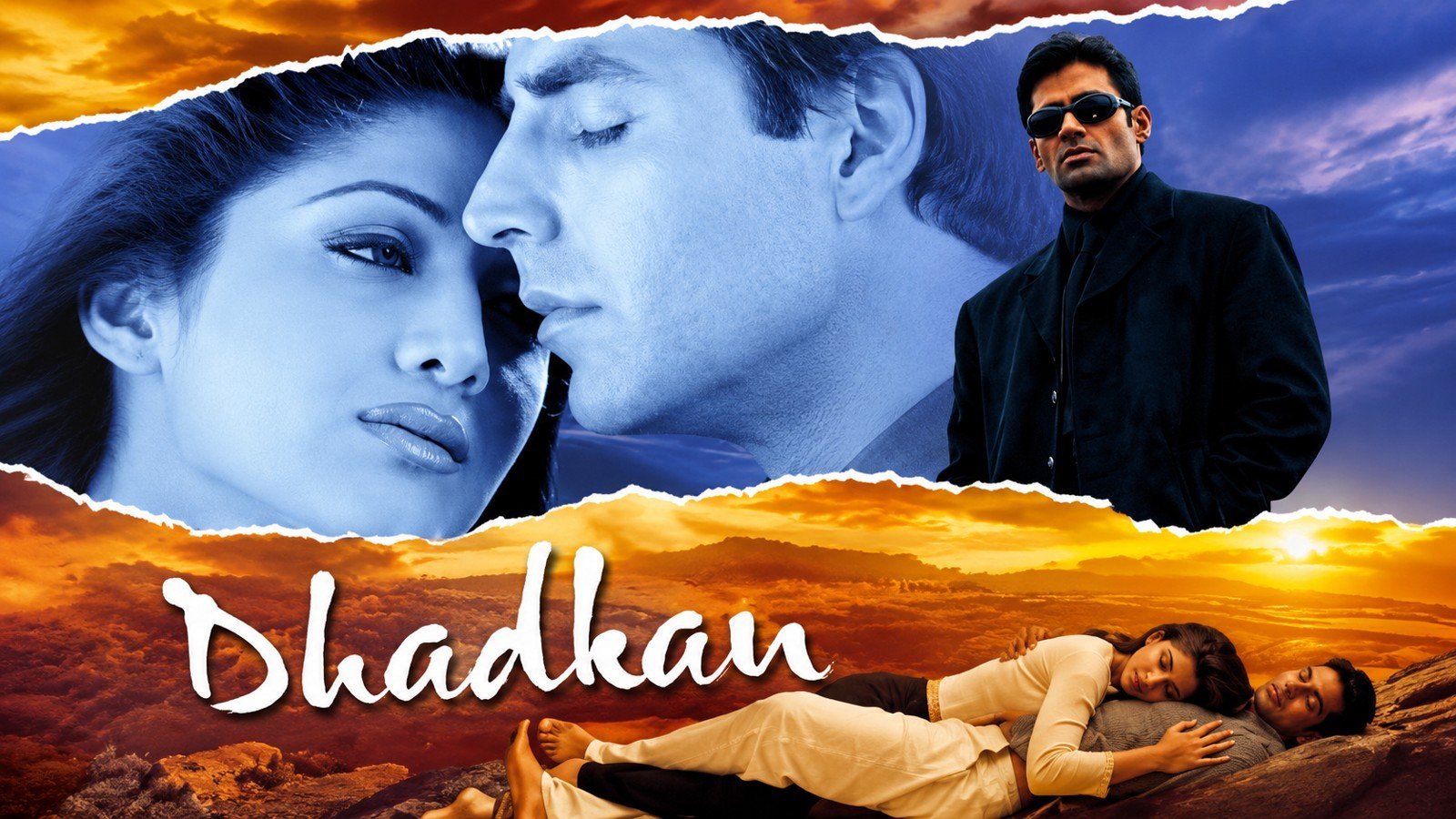
Dhadhkan (2000)
Starring: Akshay Kumar, Shilpa Shetty, Sunil Shetty, Mahima Chaudhary
Director: Dharmesh Darshan
Synopsis: an old fashioned triangle, well told and fairly well executed
Reviewed by: Faiz Khan
Dharmesh Darshan had a cropper on his hands with Mela and needs Dhadkan to succeed if he is to regain some of his credibility as one of the leading directors of our time. How he managed to earn that accolade in the first place was through the phenomenal success of Raja Hindustani, an old-fashioned yet refreshingly sincere film with interesting performances, good music and a fresh approach.
Dhadkan has much of the same flavour but is unlikely to follow Raja Hindustani down the same path, either in terms of box-office success or in bringing hosannas to its lead players.
Anjali (Shilpa Shetty) and Dev (Sunil Shetty) are in love. She is rich, he is poor, sporting permanent stubble, black clothing and a pair of broken chappals. Quite how the two ever met remains something of a mystery, but mercifully we are spared the details. Anjali insists on meeting Dev's mother, but Dev sends her alone. There she learns from his mother (Sharmila Tagore) that Dev is consumed by bitterness over the fact that he is illegitimate. Anjali promises never to leave him.
Returning home, however, she finds that her father (Kiran Kumar) has already arranged her marriage. She tells him about Dev and her father agrees to meet the young man. The meeting is a disaster, not merely because the rich are looking down on the poor, but because Dev carries such an enormous chip on his shoulder that he comes across as rude, arrogant and completely convinced that Anjali will abandon her parents for him without a second thought.
Decision time for Anjali: her parents or her lover. She chooses the former and breaks the news to Dev, leaving him shattered. When he tells his mother, she promptly dies on the spot. Anjali marries Ram (Akshay Kumar), but informs him on their wedding night that she wants nothing to do with him. Ram, saintly soul that he is, simply suggests they become good friends instead. Respect begins to flicker in Anjali's previously brattish eyes.
Ram, of course, is the very epitome of goodness. His stepmother and stepsiblings despise him, yet he remains convinced that love alone will eventually melt their hatred. Naturally they waste little time in being unpleasant to Anjali. She retaliates, only to find Ram siding with his elders because, after all, one must respect one's seniors. However, following yet another confrontation, Ram quietly tells the family that he believes his wife over them. At this point the brattish wife responds with suitably enormous tear-filled eyes and suddenly realises that this impossibly perfect husband may actually be worth loving after all. Cue the inevitable "Na Na Karte Pyaar..." in Switzerland and Venice.
Three years pass. On the couple's third wedding anniversary an unexpected guest arrives. No prizes for guessing who. Yes, Dev returns, having somehow amassed 500 crores in the space of three years—one dare not wonder how. Accompanying him is his beautiful business partner (Mahima Chaudhary), who is obviously hopelessly in love with him, while Dev himself remains completely obsessed with Anjali.
It is all rather predictable and thoroughly unbelievable, but then this is a Hindi film after all. For what it's worth, it remains extremely watchable. In fact, it almost plays like a Greek tragedy or an opera—melodrama served at full volume. Yet Dharmesh Darshan keeps remarkably firm control over proceedings, maintaining a steady narrative flow without too many unnecessary diversions.
The film concentrates almost exclusively on its central triangle, and wisely so. There is virtually no comedy, unless one counts Ram's absurd family, who are caricatures rather than characters. The script, however, leaves far too many loose ends unresolved and the climax is something of a let-down. After building itself towards an emotional crescendo, the film ultimately settles for a conclusion that is surprisingly tame. One comes away feeling that something far more dramatic should have emerged from all this carefully accumulated melodrama.
The film is supposed to propel Shilpa Shetty into the big league, but I doubt that it will. She is one actress who always seems to be trying just a little too hard. There is very little spontaneity or naturalness to her performances, although to be fair she has underplayed this role considerably, which is actually a blessing because she does have a tendency to overact. She gives a sincere enough performance but never really leaves much of an impression.
Akshay Kumar enjoys a welcome change of image. Gone are the action heroics, replaced by a quieter, more restrained performance. He is charming enough in what is essentially the role of Mr. Too Good To Be True—a sort of Ajay Devgn from Hum Dil De Chuke Sanam. Unfortunately the character is rather thinly written and evokes little real emotion. His climactic scene is simply too ridiculous. As in the Ramayan, this Ram can apparently do no wrong. In fact, he would probably embarrass the Pope with the sheer magnitude of his goodness.
Sunil Shetty has by far the strongest role and clearly gives it everything he has. Sadly, no matter how hard he tries, he simply fails to convince. His expressions remain stiff, his voice monotonous and almost devoid of emotion. Feeling, for Sunil Shetty, seems largely to consist of jerky hand movements and exaggerated gestures, especially during the songs. I actually found myself feeling rather sorry for him, though I suspect that had more to do with the effort he was making than with anything his performance actually conveyed.
Mahima Chaudhary is criminally wasted in what amounts to little more than a glorified guest appearance. It is a shame because she has shown before that she is a consummate performer and deserves far better than these one-song, few-lines roles. If only she would ease up on the pancake make-up she would look infinitely fresher. As for Sharmila Tagore, one is left wondering what on earth persuaded her to accept a five-minute role as Dev's broken-hearted mother, first seen clutching a radio with more than a hint of madness in her eyes.
The music is already proving popular, with "Dil Ne Yeh Kaha", "Na Na Karte Pyaar" and "Tum Dil Ki Dhadkan Ho" standing out as the best tracks. The background score is also excellent.
On the whole, Dhadkan is an old-fashioned love triangle, well told and reasonably well executed. Despite its predictability, its melodrama and its many gaping holes, I found it consistently engrossing.
But then, I quite enjoyed Mela as well—and look what happened to that!

0 Comments
Leave a Comment