
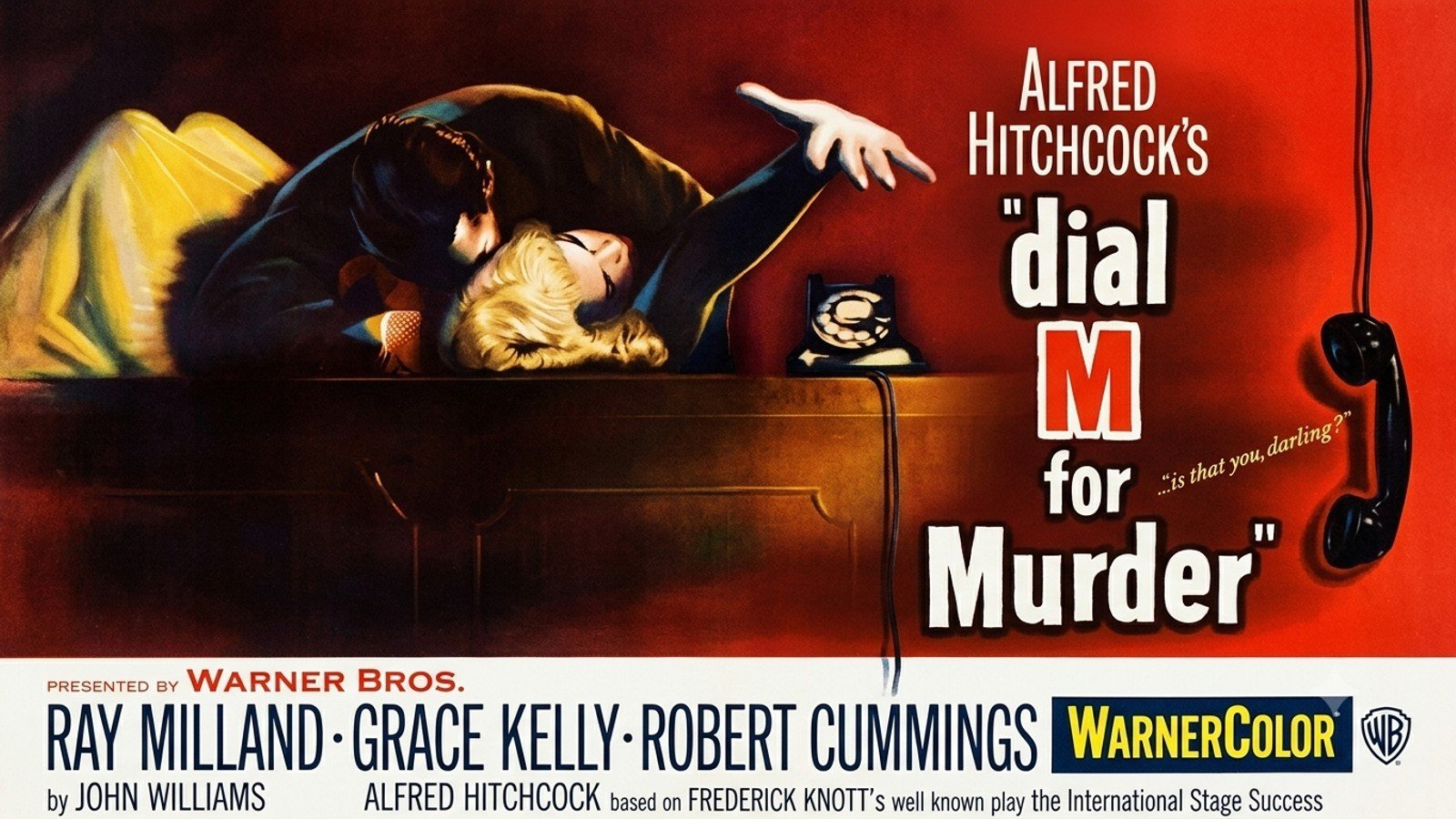
Dial "M" For Murder (1953)
Starring: Grace Kelly, Ray Milland, Robert Cummings, John Williams, Anthony Dawson
Director: Alfred Hitchcock
Synopsis: Hitchcock recreates a stage production with fair effect
Reviewed by: Shahryar Khan
Stagey, yet largely effective, Dial M for Murder is another superb Hitchcock thriller, featuring one of the Master's most astonishing murder sequences. Although not quite as taut as some of his greatest works, it still contains more than enough twists and turns to keep audiences thoroughly engrossed.
The alluring Grace Kelly delivers another wonderful performance opposite the ever-suave Ray Milland. Originally released in 3D, the process enhanced the famous murder scene even further. Dial M for Murder had already been an enormous theatrical success for playwright Frederick Knott, becoming one of the most talked-about stage thrillers in both London and New York.
Knott's play was skilfully crafted, entirely plausible and packed with suspense. Set almost entirely within a single room, it presented Hitchcock with an unusual challenge. At the time, he was under contract to Warner Bros. following the highly controversial I Confess, while already preparing what would become one of the undisputed classics of cinema, Rear Window.
In between these two highly charged productions, Hitchcock elected to play it relatively safe by adapting the theatrical hit into a motion picture that would almost certainly prove commercially successful. The film was indeed shot in 3D, although by the time it reached many cinemas the public's enthusiasm for the format had already begun to wane, and numerous prints were exhibited in the standard flat version.
Always the consummate craftsman, Hitchcock saw the challenge not as a limitation but as an opportunity. As he had done with Rope, he embraced the single-set concept, confining most of the action to the Wendices' apartment while carefully developing the personalities of the characters. The result is a thriller that engages not only because of its ingenious plot, but also because the audience becomes emotionally invested in those trapped within it.
Typically for Hitchcock, Ray Milland's polished villain proves considerably more fascinating than the conventional hero played by Robert Cummings, while Grace Kelly gives such a radiant performance that an adulterous wife appears almost as innocent as a nun. Hitchcock's extraordinary ability to draw memorable performances from even the smallest supporting roles also contributes enormously to the film's success. Anthony Dawson is particularly effective as the down-at-heel criminal blackmailed into committing murder by Milland's calculating schemer.
And has there ever been a more brilliantly portrayed detective in cinema than John Williams' meticulous Inspector Hubbard? The answer, perhaps, is yes—but only one: Martin Balsam's unforgettable Arbogast in Psycho.
The acting is first-rate, the camera angles are masterfully judged, and the suspense is maintained with effortless precision. Hitchcock even had a six-foot pit dug beneath the set so he could achieve the famous low-angle shot of the scissors during the murder sequence.
Consider, for example, the moment when Ray Milland, delayed at a sporting dinner, is several minutes late in making the crucial telephone call to the hired killer concealed behind the curtain. Will the killer wait or abandon the plan? Will Grace Kelly answer the phone? And when the call finally comes through—a sequence Hitchcock reportedly filmed using equipment at London's telephone exchange—the suspense becomes almost unbearable.
Those who enjoy searching for Hitchcock's trademark cameo appearance should keep an eye out for him, smiling from a photograph of an old boys' reunion dinner.

0 Comments
Leave a Comment