
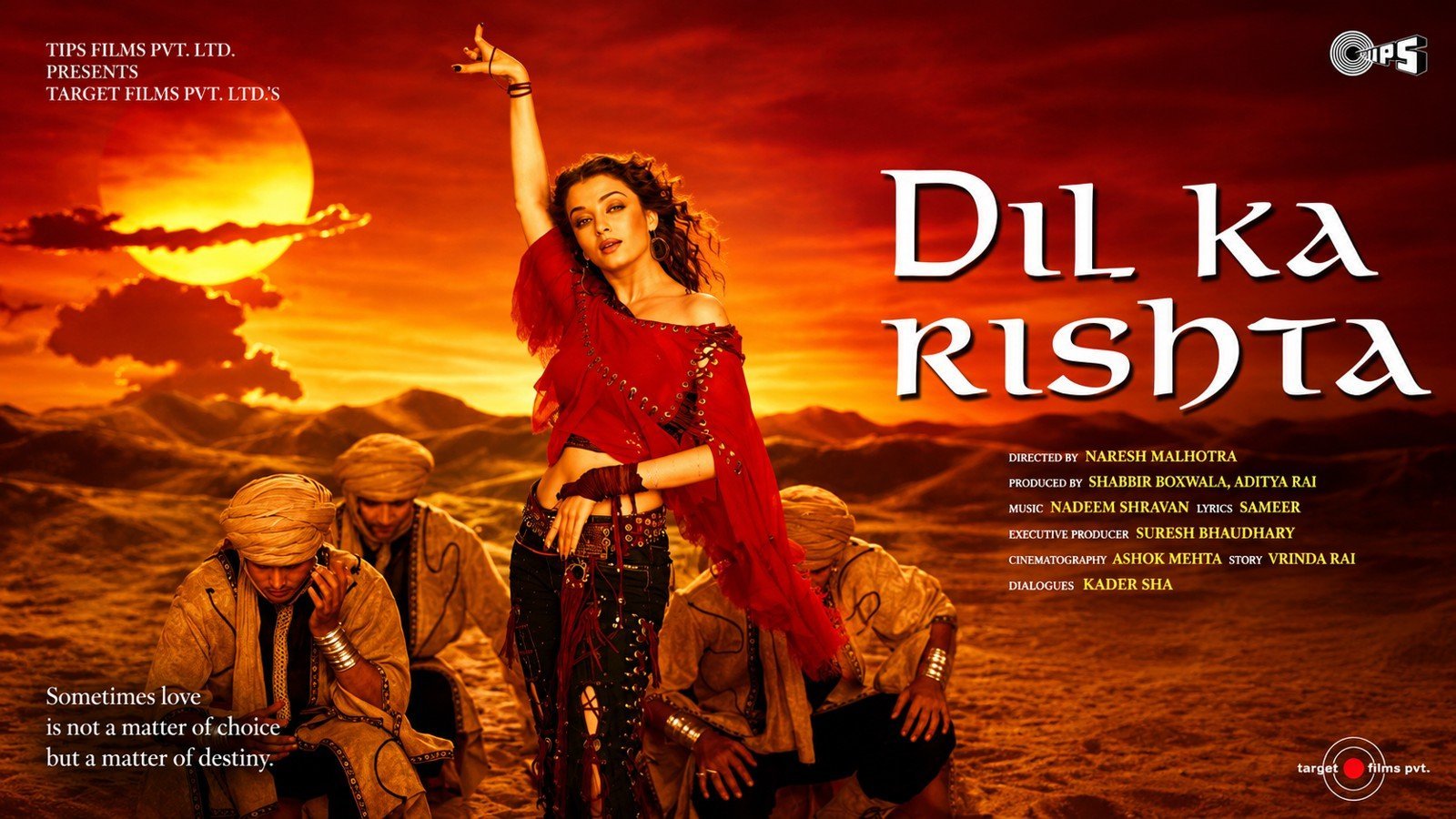
Dil Ka Rishta (2003)
Cast: Rakhee, Aishwarya Rai, Arjun Rampal, Ishaa Koppikar
Director: Naresh Malhotra
Music Director: Nadeem Shravan
Synopsis: Hideously contrived and utterly dated melodrama - unbelievable nonsense
Reviewed by: Faiz Khan
The nauseating nasal tones of Kumar Sanu crooning the title song over the opening credits immediately set the mood for this hideously outdated and vapid melodrama, a film that embraces virtually every cliché in the Bollywood handbook without missing a single one.
It is astonishing that, even in this day and age, somebody believed audiences would willingly embrace something this hopelessly old-fashioned.
Jai (Arjun Rampal) is a fabulously wealthy businessman living in Cape Town who returns to Mumbai every year to celebrate his late mother's birthday, seemingly convinced that one day she might rise from the grave and rejoin him and his father (Paresh Rawal).
His best friend Anita (Isha Koppikar) introduces him to a school for deaf children, where he catches sight of the beautiful Tia (Aishwarya Rai). Mistakenly believing she is deaf and mute, Jai instantly falls hopelessly in love.
Returning home, he proudly announces to his delighted father that he intends to marry "a deaf and dumb girl."
The next day he discovers that Tia is, in fact, perfectly capable of hearing and speaking—although there are moments later in the film when one begins to wonder.
Determined to win her heart, Jai throws himself into supporting the school's charity function, convinced that Tia secretly returns his affection.
Sadly, no conveniently placed dream sequence appears to support this remarkable conclusion.
Eventually he summons the courage to confess his love, only to watch Tia leap onto the back of a waiting motorcycle with her true love, Raj (Priyanshu Chatterjee).
Undeterred, Jai continues showering her with flowers, expensive cars and every other symbol of cinematic devotion.
None of it works.
Raj, meanwhile, is everything Jai isn't. Poor, noble and an orphan to boot, he earns further brownie points by informing Tia's family that, as dowry, he wants nothing more than their daughter herself.
Saint Raj.
Remarkably, he remains unfailingly pleasant even after discovering that Jai is hopelessly in love with his future wife.
Raj and Tia marry, domestic bliss follows and a child soon arrives.
Jai, naturally, turns to alcohol.
Fortunately, Anita convinces him to abandon the bottle and simply be happy for Tia.
Having apparently reformed within the space of a single scene, Jai immediately decides he is fit to drive home.
Stone drunk.
You already know exactly what is about to happen.
It does.
Jai crashes head-on into Raj and Tia's car, killing both Anita and Raj instantly.
Tia survives.
But, of course...
she develops amnesia.
Jai, desperate to atone for his actions, persuades Tia's mother (Rakhee) to allow him to care for the now memoryless Tia in Cape Town. To make matters even more preposterous, she is told that her own child actually belongs to Jai and Anita so that she will stay and help raise it until her memory returns.
One scarcely knows where to begin.
The story, written by Aishwarya Rai's mother, Vrinda Rai, belongs to another era altogether. This sort of melodrama may perhaps have worked during the 1960s, alongside separated twins at village fairs and the inevitable "uski yaadash chali gayi" routine, but today it simply provokes disbelief rather than emotion.
Ironically, Gulzar explored a broadly similar emotional premise years earlier in Kinara, but with infinitely greater intelligence, sensitivity and conviction.
Naresh Malhotra, who previously directed the breezy and entertaining Yeh Dillagi, somehow transforms this lavish production into a thoroughly lifeless affair. The film possesses all the gloss and expensive production values one would expect, yet not an ounce of genuine charm. Worse still, the dialogue is so relentlessly corny that there were moments when I genuinely feared collapsing under the weight of its sentimentality.
Aishwarya Rai, unsurprisingly, looks stunning throughout, but once again demonstrates that she requires a strong director to extract a convincing performance. Arjun Rampal fares even worse, substituting drooping eyelids and blank expressions for guilt, grief and emotional torment.
Perhaps the film should simply have been called Dumb and Dumbo.
Isha Koppikar is completely wasted, while Priyanshu Chatterjee injects the only faint spark of sincerity into an otherwise lifeless enterprise.
Nadeem-Shravan's music is every bit as uninspired as the film itself.
An expensive-looking relic that should have been left buried decades ago.

0 Comments
Leave a Comment