
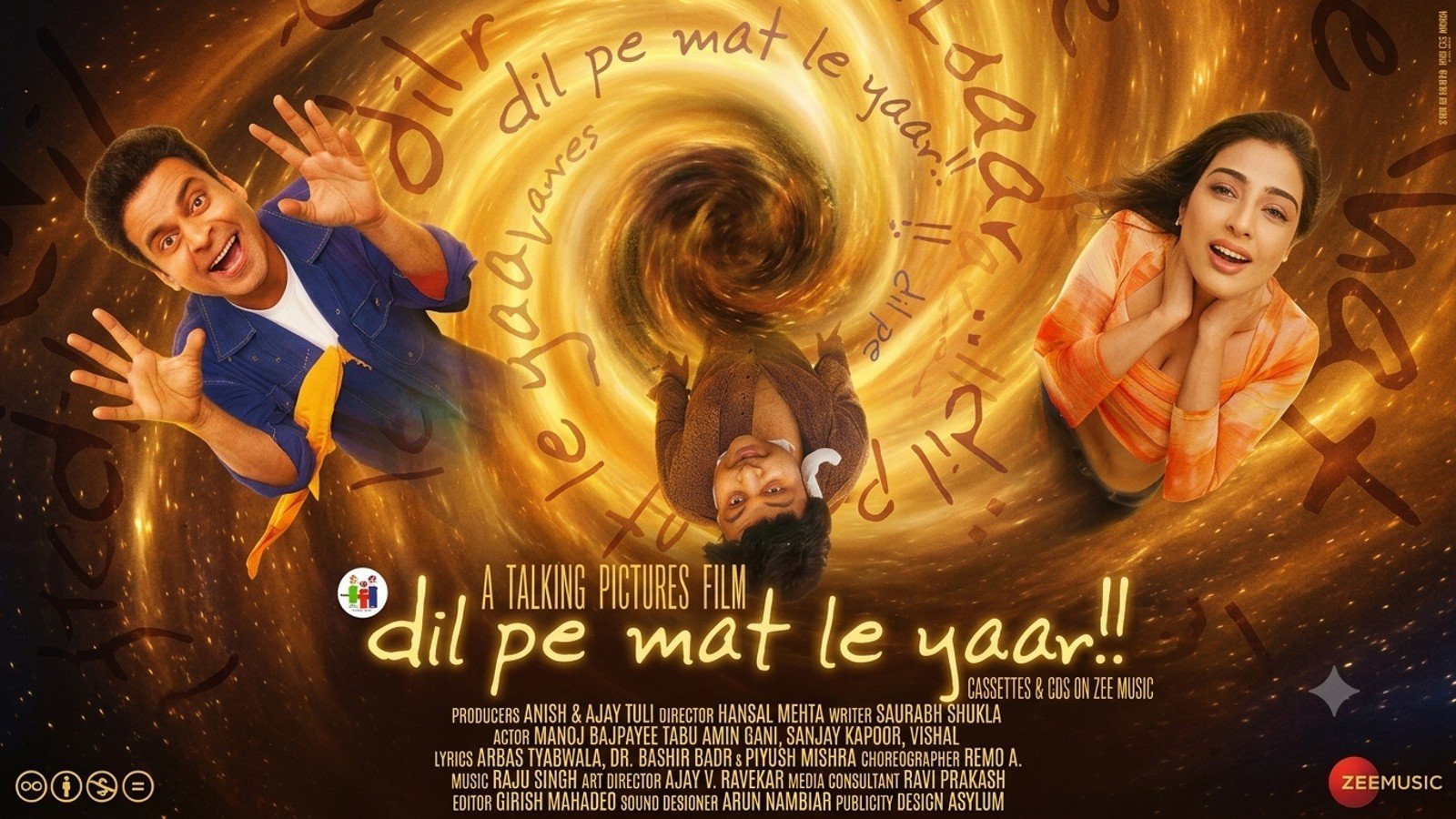
Dil Pe Mat le Yaar (2000)
Starring: Manoj Bajpai, Tabu
Director: Hansal Mehta
Music Director: Vishal
Synopsis: Botched attempt at fusing two genres starring
Reviewed by: Faiz Khan
Hansal Mehta's film is a curious catalogue of failures—not only those suffered by its characters, but also the director's own in constructing such a colossal muddle. Even the title raises expectations of a breezy comedy, and, for a while at least, the film appears determined to deliver exactly that.
Ram Saran (Manoj Bajpayee) is a simple village mechanic who arrives in the big city hoping to make something of his life. While working at a garage he meets Kaamya (Tabu), a journalist who is charmed by his honesty and innocence and decides to write an article about him. Ram Saran, however, mistakes her professional interest for something far more personal, and before long he is dreaming of a future together. The mechanics burst into song and dance, and one begins to assume that this is going to be a lightweight comedy built around the clash between an innocent country boy and a sophisticated city woman.
Then the film abruptly changes direction.
Those who failed to notice Kaamya's cigarette habit early on are about to discover its significance. In traditional Hindi cinema, smoking was often used as cinematic shorthand to distinguish the modern, independent woman—or, more often than not, the morally ambiguous one—from the conventional heroine. Mehta relies on exactly this device. Kaamya is ambitious, opportunistic and manipulative, and all of this is neatly conveyed by placing a cigarette between her fingers rather than allowing her character to develop naturally.
When Ram Saran loses his job, he turns to Kaamya for comfort. She is sympathetic, but only to a point. In a drunken, dishevelled state he blurts out his love for her, only to be firmly rejected.
Why shouldn't she?
He is a grease-covered mechanic who barely knows her, while she is an educated, independent professional living in an entirely different world.
Ram Saran, however, interprets the rejection as betrayal, and from that point the film descends into the criminal underworld as he gradually embraces a life of violence and corruption.
It is here that the film completely falls apart.
The central problem is that Mehta never convinces us why any of this should happen. The film begins as an offbeat romantic comedy before suddenly transforming into a bleak crime drama, and the transition is so abrupt that the two halves seem to belong to entirely different films.
Can two genres be successfully combined?
Certainly.
But Mehta never comes close.
The impression is that the director himself was unsure which film he wanted to make.
Tabu has described the film as a black comedy.
It is undoubtedly black.
It is occasionally comic.
It is most certainly not a black comedy.
The entire premise rests upon Kaamya's fascination with Ram Saran's innocence, yet there is never any convincing reason why she should become so intrigued by him in the first place. Presumably Mehta wishes to contrast Ram Saran's honesty with the cynicism and materialism of modern urban life, but if that is indeed his intention, it is handled with remarkable clumsiness.
Worse still, having established Ram Saran as someone whose decency sets him apart from everyone around him, Mehta promptly destroys his own argument by transforming him into exactly the sort of person the film initially condemns.
His descent into crime is equally unconvincing.
It is difficult to believe that Kaamya's rejection alone would drive him towards murder and organised crime, nor does the explanation that he wants to make enough money to prove himself to her ring true. Wealth was never what separated them in the first place.
For a brief moment, one begins to wonder whether Mehta intends to reveal that everything we have witnessed is merely a film within a film. Kaamya is shown receiving an award for her screenplay based on Ram Saran's life, suggesting that perhaps she has manipulated both his fate and the audience's perception of reality.
Sadly, even this intriguing possibility comes to nothing.
To Mehta's credit, the film does possess a certain gritty authenticity. He captures the flavour of its supporting characters remarkably well, but they seem to have wandered in from an entirely different and considerably better film.
What begins as an upbeat musical comedy eventually turns into a bleak and depressing commentary on modern life, but the journey from one to the other is neither convincing nor satisfying.
Manoj Bajpayee is well cast as Ram Saran and delivers a committed performance, but he lacks the screen presence needed to carry a film of this nature entirely on his own. Tabu, playing what is effectively the film's negative character, is excellent—completely believable and wonderfully restrained. Vishal's music is pleasant enough, although it often feels strangely at odds with the increasingly sombre narrative.
As I said earlier, one of the film's greatest weaknesses is its title. It promises one kind of film and delivers something entirely different.
That would not necessarily have mattered had what it ultimately offered been worthwhile.
Sadly, it isn't.
This is a muddle of gargantuan proportions with precious little to recommend it.
Personally, I rather wish Ram Saran had gone straight back to his village the moment he lost his job.

0 Comments
Leave a Comment