
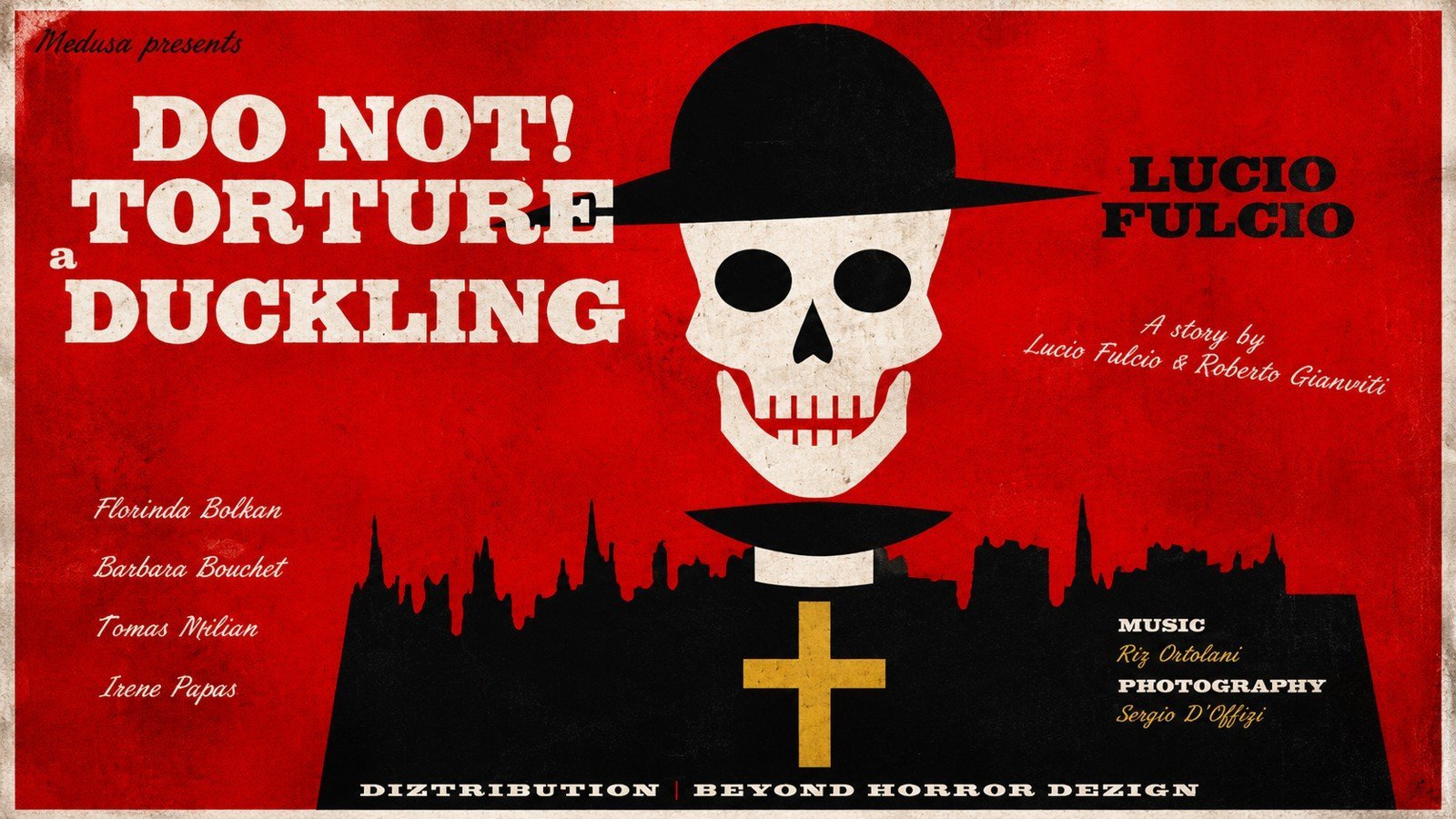
Don't Torture a Duckling (1972)
Starring: Florinda Bolkan, Barbara Bouchet, Tomas Milian, Irene Papas
Director: Lucio Fulci
Synopsis: Fairly stylish murder thriller from Lucio Fulci is fairly gore-free by his standards
Reviewed by: Omar Khan
Director Lucio Fulci burst to prominence in the late 1970s and early 1980s through a succession of outrageously gory horror films. He became the undisputed king of Italian splatter with classics such as Zombie and The House by the Cemetery. His fondness for maggots, intestines and every conceivable bodily fluid became legendary, particularly the unforgettable regurgitation sequence from The House by the Cemetery.
This film is one of Fulci's earlier efforts and comes as something of a surprise. It is comparatively restrained and, at times, remarkably stylish for a director who would later build his reputation on shocking audiences with bucket-loads of explicit gore.
The film qualifies as another Italian giallo—a violent murder mystery in which a series of brutal killings ultimately leads to a startling final revelation. Like so many films of its kind, the murders are eventually explained away as the consequence of childhood trauma, resulting in deep psychological scars. Torso, Deep Red and The Bird with the Crystal Plumage immediately spring to mind as employing similar themes and techniques.
Set in a small rural village, the story revolves around a silent killer who is brutally murdering young boys for no apparent reason or motive.
As the body count mounts, we are introduced to the usual assortment of potential suspects. There is the demented old man who fashions voodoo effigies and claims to receive messages from St. Benedict; his disturbed daughter, who has inherited both his knowledge of black magic and his instability; the mysterious widow; the priest's mother, forever carrying a small autistic child in her arms; the seductive red-haired beauty who delights in teasing young boys with her nudity while dabbling in the occult; and finally the kindly village priest who runs a refuge for homeless children and appears incapable of harming a soul.
Fulci directs the film with considerable assurance and style, thankfully reserving his more notorious excesses for one genuinely harrowing sequence in which a mob of villagers savagely beats the local witch. Here, his instinct for shocking an audience comes unmistakably to the fore. The scene is every bit as disturbing as the infamous maggot- and entrail-filled spectacles that would later become his trademark. One suspects this particular sequence would still struggle to escape the attention of modern censors.
Aside from this deeply unpleasant episode, the film holds together well as a murder mystery, although it never quite builds towards the kind of nerve-shredding climax one might expect. The performances are solid enough, particularly considering the film's modest budget.
Don't Torture a Duckling is neither especially frightening nor particularly exciting. Nevertheless, it remains essential viewing for anyone with a serious interest in horror cinema, and European horror in particular.
Perhaps the film's most intriguing feature, however, is its wonderfully bizarre title.

0 Comments
Leave a Comment