
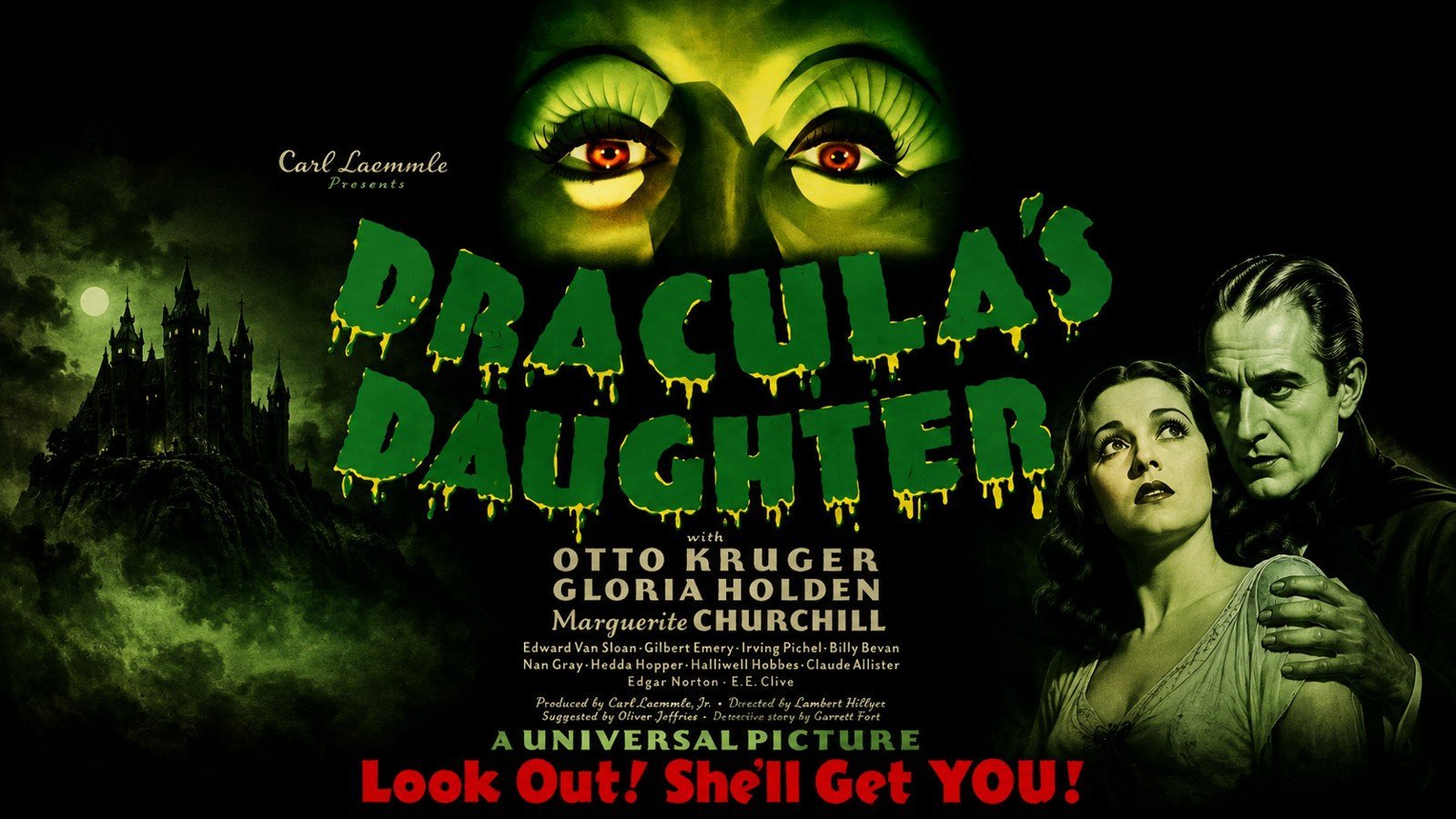
Dracula's Daughter (1936)
Cast: Gloria Holden, Otto Kruger, Irving Pichel, Marguerite Churchill, Hedda Hopper
Director: Lambert Hillyer
Synopsis: Dracula's daughter arrives on the scene to weave her own queer spell
Reviewed by: Omar Khan
"Haunting, low-key mood" Time Out
"satisfying...script crackles with pace and energy...excellent...essential watching" Vampire Films
"okay as a time killer" Creature Features
"provocative" Blockbuster
"chiller has a moody, subtly sensual quality" Maltin
"brooding...stylish...creates its own strange mood...compelling performances" Video Movies Guide
"director fails to bring any sparkle...remains only an interesting curio " Monster Movies
"suitably horrific bearer of the Dracula name" Horror Movies
"remarkable" Virgin
Universal followed up 1931's immensely successful Dracula with Dracula's Daughter five years later. The film picks up exactly where Dracula ended, with two typically upright yet bumbling British bobbies discovering two bodies one fog-bound London night. They also discover Professor Van Helsing, who calmly informs them that he has just slain Dracula by driving a wooden stake through his heart, whilst the other corpse, sporting a broken neck, belongs to Renfield, Dracula's demented servant. The policemen naturally conclude that Van Helsing is ready for the loony bin and the case is taken over by a bemused Scotland Yard. Although the Yard respects Van Helsing's credentials, how can they possibly subscribe to his rantings about Transylvanian vampires stalking the innocents of London?
"A British jury will never stand for that!" exclaims the Scotland Yard inspector to an increasingly desperate Van Helsing, who insists that the only man capable of clearing his name is noted psychiatrist Dr. Jeffrey Garth (Otto Kruger), once his student back in Vienna.
Whilst Van Helsing tries in vain to convince the sceptical Garth of his theories, strange deaths begin occurring across London, each bearing the symptoms so chillingly foretold by Van Helsing. Meanwhile, a mysterious Hungarian Countess by the name of Marya Zaleska arrives at the dungeon where Dracula's body is being held prior to its autopsy. Using her strangely magnetic eyes and a ring that appears almost hypnotic, she mesmerises the guard and escapes with her father's body. We soon learn that the Countess is distraught at having inherited her father's dreadful affliction and trembles with anticipation at the prospect of finally being freed from her "terrible condition." She believes that by performing the proper burial rites for her father and exorcising him of evil with the aid of a crucifix, she will break the curse of vampirism and once again become a normal mortal.
Her hulking, menacing accomplice Sandor (Irving Pichel), however, has serious doubts about his mistress's theory and openly mocks her growing conviction that burying Dracula will somehow free her from the curse. Sandor knows better.
As night falls, the Countess slowly succumbs once more to her evil urges and, despite desperate attempts to distract herself through painting and piano playing, she proves unable to resist. Sandor hands her the fashionable cloak she favours, along with her distinctive ring, as she slips into the fog-bound streets of London in search of sustenance in the form of a jugular vein or two. Having once again yielded to temptation she sinks deeper into despair, but resolves to continue fighting after being encouraged by the words of Dr. Garth, whom she met at a social gathering. Garth finds himself increasingly drawn towards the mysterious Countess, much to the disgust of his secretary and would-be love interest Janet, an irritating bimbo when compared with the elegant and enigmatic Marya.
Sadly, however determined she may be to overcome her ghastly condition and the murderous bloodlust that accompanies it, it is ultimately a losing battle. Eventually she accepts that Sandor was right all along and begins planning her future, not as a mortal but as one of the living dead. Naturally she intends taking Dr. Garth with her into eternity and sets in motion a suitably nefarious scheme involving treachery and kidnapping. Sandor, meanwhile, considers himself the obvious candidate upon whom immortality should be bestowed for services rendered. When he realises the Countess prefers Garth, he decides to take matters into his own hands, with dreadful consequences.
Dracula's Daughter had been simmering at Universal ever since Dracula made millions at the box office in 1931, becoming the studio's highest-grossing film to date. The studio executives were understandably eager to maintain horror's momentum. Initially, the sequel had been envisioned as a far more lavish production featuring an elaborate prologue with Bela Lugosi himself. James Whale was even attached to direct. It wasn't to be. The film ultimately went before the cameras on a far more modest budget and without any major box-office names. Instead, Universal relied upon the strength of the title and its obvious association with the original.
The studio also took a gamble by casting a relative newcomer in the title role. The raven-haired, unconventional beauty Gloria Holden was selected, no doubt because of her steely eyes and detached elegance. It proved an inspired choice. Holden is excellent as Countess Zaleska, effortlessly conveying charm, menace and quiet desperation in exactly the right proportions.
Holden's performance has since achieved an almost immortal status, largely because the film has remained a source of fascination for its alleged lesbian undertones. It is generally argued that the Countess appears more attracted to female victims than male ones and possesses a less conventionally feminine persona than audiences of the period might have expected. Whilst attempting to exorcise her father's body she speaks of her yearning to "live a normal life... think normal things." Many film historians have interpreted this as her desire to rid herself not merely of vampirism but of a hidden homosexuality. Her struggle against her father's curse has therefore been viewed as a metaphor for trying to "cure" herself of an uncontrollable sexual appetite, one that appears equally satisfied by female and male victims alike.
It has even been suggested that Sandor, the Countess's shadowy henchman, is himself somewhat affected and that together the pair represent cinema's first truly eccentric gay couple. Perhaps the first ever? It is certainly an intriguing theory.
The film did encounter censorship problems and the scene in which the Countess corners her frail blonde victim had to be rewritten several times to eliminate even the faintest suggestion of a sexual advance. At the same time, the British censors were becoming increasingly strict, another factor Universal had to bear in mind during production. Even so, much of the discussion surrounding the film's supposed lesbianism remains speculative and may simply be reading into material that was never consciously intended. The Countess's residence in Chelsea, for example, has been interpreted as symbolic of a bohemian lifestyle, drawing comparisons with New York's Greenwich Village. Yet it is worth remembering that when Dracula himself preyed upon male victims, few commentators suggested he was bisexual. When his daughter chooses a female victim, however, she is instantly labelled a lesbian. Nevertheless, it is precisely because of this reputation as a pseudo-lesbian horror film that Gloria Holden has become something of a gay icon, albeit hardly in the league of more flamboyant queer favourites such as Baby Jane Hudson.
The discussion of lesbian undertones aside, Dracula's Daughter succeeds as a worthy sequel, telling a story that feels like a logical continuation of the original film. Gloria Holden is excellent as Marya Zaleska and receives solid support from Otto Kruger and Marguerite Churchill, but it is Irving Pichel's wonderfully cynical Sandor who leaves the strongest impression. His fatalistic outlook, dry mockery of the Countess's aspirations and imposing physical presence make him one of the film's most memorable characters.
The film is beautifully photographed, with magnificent use of shadow, thick fog and swirling mists creating exactly the kind of nostalgic atmosphere one hopes for from a classic Universal horror picture. It may not quite rank amongst the studio's greatest achievements, but as a sequel it remains an intelligent, atmospheric and thoroughly satisfying follow-up.

0 Comments
Leave a Comment