
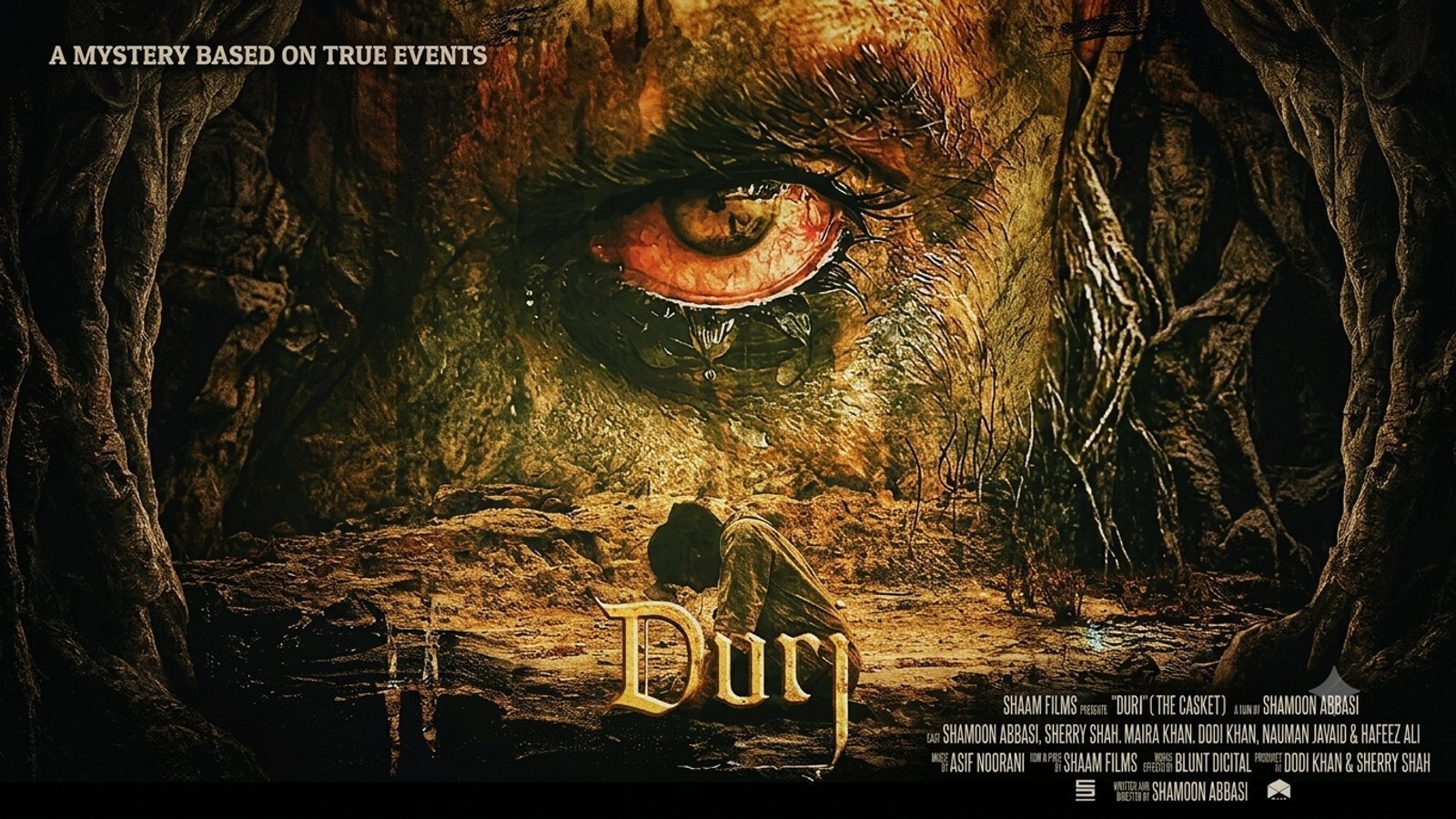
Durj (1964)
Cast: Shamoon Abbasi, Maira Khan, Dodi Khan, Sherry Shah, Nauman Javed
Director: Shamoon Abbasi
Synopsis: A film that commendably tries to break the dreadful cycle of endless Rom-coms and propaganda films but falls woefully short of expectations.
Reviewed by: Omar Khan
Durj is a Pakistani film marketed as a psychological horror-thriller but ultimately a frustrating one that never entirely builds to its potential. The best thing that could happen to any film is a ban from the censor board, as any publicity in show business is good publicity, and a ban is possibly the best of all.
The controversy over the short-lived ban created a sense of curiosity. People looking for something a little different than the run-ofthe-mill stuff showed up in reasonable numbers, with 50% or so of the cinema seats occupied on the second release day.
From the very outset, there was some ropy acting, clichéd music and a heavy moralising message that soon gets rather badly lost in a script that has the director struggling to tell a story with any coherence. The audience is shown numerous jumps back and forth in time; later, some plot twists are woven. An injection of some heavy-handed political and social commentary, each of which may have been noble intent but forgotten that the primary motivation for most people going to the cinema is for entertainment. Despite a sincere effort, the entertainment factor sadly fails to materialise.
The film follows an unlikely couple’s misfortunes and their subsequent slow dive into the horrors of murder and cannibalism. However, it never adequately explains their motivations other than poverty and despair. There are millions of poverty-stricken people in Pakistan, though, who are at least as despairing as these two. Still, unfortunately, the film never quite examines what made these two snap and drown in a world of spiralling evil and darkness to which they find themselves drawn.
It was a dour cinematic experience, relentlessly dark and with little relief. Even the abject Pari and the ghastly Hotal at least provided a bunch of laughs, even if unintentionally. Here, some of the audience did start to laugh because of the meandering nature of what unfurled on screen. Having watched the fun Baaji and the quite exceptional Zinda Bhaag, this movie came as a blow to the senses as a completely humourless and unrelenting experience.
It was a somewhat confused attempt at “deep cinema” and rather than offering much food for thought, it just came across as an exercise in what could have been. Unfortunately, the audience wasn’t engaged at any level nor invested in any of the characters, who all came across as undeveloped. Therefore, the audience couldn’t feel for them at any level. None of them was given any depth, nor were their motivations or insecurities, or fears fleshed out so that the audience might care about them at all.
Sherry Shah emerges with some credit among the actors, and Shamoon Abbasi scowls menacingly to good effect. Still, the audience never truly gets to feel or comprehend his inner demons and conflict. There is one memorable moment where his mind wanders into a brutal act of violence, perhaps the most effective in throwing any light onto his psychotic state, but sadly, little else that brings the audience any real insight.
Durj (The Casket)
By the time the movie reveals its climax and twists, most of the audience has been lost in translation. The background music tried hard to infuse a sense of dread but may have benefited from a little more restraint. However, a big plus point is the quite stunning locations, and some of the long drone shots are breathtaking, but even those fail to rescue the confused, stale narrative of Durj – which promises much but ends up missing its mark. The film meanders in its attempt to deliver its profound message and gets more than a little lost along the journey to its conclusion.
The censors cut a few scenes, which was a bit of an insult because at least there was a film that tried to go against the grain for which it should be lauded. The US and UK release has a running time of 109 minutes without any cuts, clearly showing that only 2 to 3 minutes were removed from the Pakistani version. (The suits at the Film Censor Board need to justify their existence somehow!)
Credit, however, to Shamoon Abbasi for attempting something other than the done-to-death Rom-com and at least to its credit, the film wasn’t produced and financed by the machine that currently rules the scene on film and TV.
Durj strives hard to present itself as artful but falls short of entertainment. Agreed that the film’s content doesn’t lend itself to a roller coaster popcorn ride, but it fails to grip and engage its audience as it might have. The bottom line for a movie-watching experience has to be entertainment, cerebral or light-hearted or even brainless fun, and in this regard, Durj doesn’t pass muster.
It is, however, a good attempt at breaking from the mundane and a brave attempt at expanding the scope of Pakistani cinema. Still, it doesn’t quite click with its wavering narrative and misses the jugular, no pun intended.
The Censor Board of Pakistan needs a lot of maturing and to give some credit to their viewers, who know that the world is more than a bed of roses. Nasty things happen; even here in “Soft Pakistan,” we have ghastly crimes, injustices, and atrocities like anywhere else. To pretend they do not exist by citing “it’s not our culture” is living in a delusional dreamland.
Secondly, it can be argued that there is nothing like a single “Pakistani Culture” as the nation comprises many distinctly different cultures, each with its traditions, music, art, cuisine, and history. Urdu, for example, is a language imposed on the nation. However, it is not indigenous to any nationalities or cultures that make up this country, as Pashto, Punjabi, Sindhi, Balochi, and Seraiki are. Urdu is the language of those who largely migrated from India.
Then there is the “ostrich with its head in the sand syndrome,” as not so long ago and extensively covered by the media, mass murderer Javed Iqbal killed, sodomised, and tortured 100 children in Lahore. The entire world knows about those despicable acts. Recent events in Kasur with children being afflicted, raped and videotaped for the dark web is also a horrendous fact everyone knows well. Not to suggest that films should glorify such atrocities, but these horrors exist, and to pretend that life is just a bed of roses and a series of rom-coms is an insult to the intellect of Pakistani viewers.
Such admittedly ugly subjects may not make huge profits at the box office or even be remotely entertaining. Still, our cinema will never mature if the dark side is never discussed and banned for “not being our culture.” For this reason alone, Durj is a brave attempt and an important landmark in the evolution of Pakistani cinema.
Durj (The Casket) The world is nasty, and Pakistan is as hostile as anywhere else – no better but certainly no worse. We try to hide behind our horrors by claiming rates of rape are much higher in the USA, which may be statistically accurate. Still, rape and honour killing murders are a routine part of life in Pakistan too. By hiding all adult issues under the carpet and pretending they don’t exist, we are left with a public fed a diet of meaningless piffle and fantasy, treated almost like children. Though the truth sometimes hurts, it needs to be stared at in the face and discussed. Not every film should be meant for children or flagwaving warmongers alone. In Pakistan, honest and relevant subjects are seldom allowed despite hundreds of blood-soaked and semi-pornographic Punjabi and Pashto films passed by the censor board over the years. The result is a stunted, intellectually bankrupting cinema that insults every thinking and knowledgeable adult. Durj at least attempts to set the cat among the pigeons and is credited for that despite its less-than-perfect execution.
0 Comments
Leave a Comment