
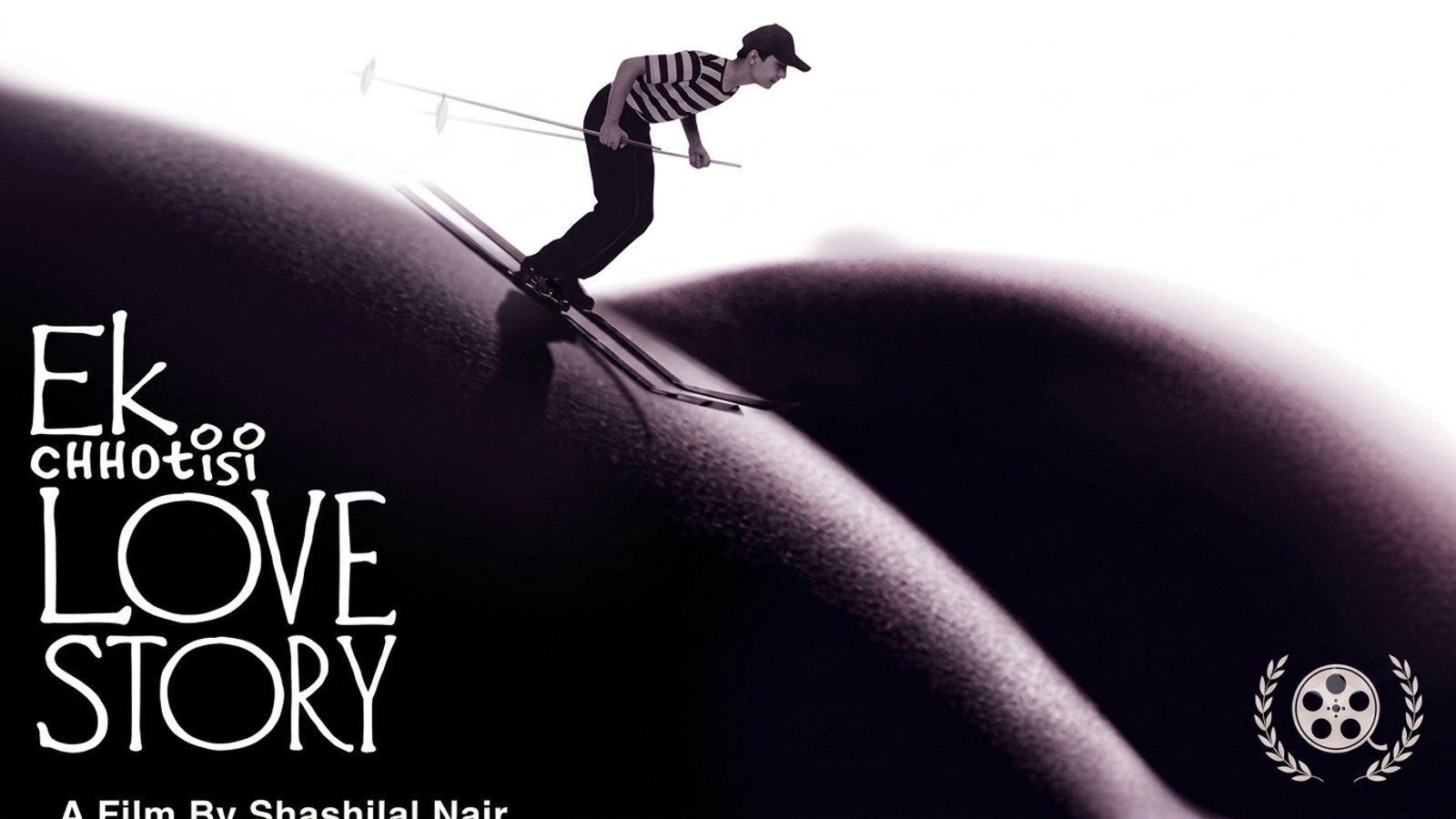
Ek Chhoti Si Love Story (2002)
Cast: Manisha Koirala, Ranvir Shore, Aditya Seal
Director: Shashilaal Nair
Synopsis: Cheap and crude exploitation fare has no redeeming features
Reviewed by: Faiz Khan
This is the film that everyone is talking about, and you may well ask whether it is worth all the hue and cry surrounding it. I would say that this worthless film certainly requires debate, not only with regard to the ethics of filmmaking but also concerning its content and what exactly is being passed by the censors.
Ek Chhotisi Love Story is undoubtedly a controversial film. Whether it would have become quite so controversial had Manisha Koirala, its heroine and only real star, not moved heaven and earth—and even Bal Thackeray—to prevent it from seeing the light of day is another question. Given its subject matter, however, the film was always likely to shock if released substantially in the version now being seen by audiences.
The first and most important issue must be director Shashilal Nair’s reprehensible conduct in inserting scenes involving a body double which Manisha had retained the right to approve or reject. She objected to those scenes, yet found they had not been removed from the final cut and that the film was being released despite her objections. Nair had apparently given Manisha a letter confirming that the scenes would only be retained subject to her approval.
It is beside the point that everyone now knows Manisha did not perform those scenes herself. Had the controversy not erupted in the media, the audience would naturally have assumed that it was she appearing on screen. In my opinion, Manisha had every right to object.
The second question is whether the scenes themselves are genuinely so objectionable. Having first seen the censored version, I rather unkindly imagined that Manisha’s crusade might have more to do with the fact that the film presents her in an extremely unsympathetic light—large, unflatteringly photographed and dressed in hot pants and skimpy clothes in what is, after all, a fairly worthless production. Having now seen the uncut version, however, I take back those views entirely.
The film left me reeling on two counts. Firstly, there is the cheap and salacious use of the body double in scenes that add virtually nothing to the narrative and seem to have been inserted purely to titillate the audience. How can Nair justify the camera panning across the lead character’s underwear at the beginning of the film, with it half slipping from her body? And what possible need is there for the boyfriend’s hand to wander inside that underwear later? It is a thoroughly repulsive sight.
Possibly the most objectionable sequence is the love-making scene on the bed. How is it possible that the censors passed this with merely an adult certificate, and that a judge apparently found nothing objectionable in it? Surely this represents a grotesque abuse of the censor’s rules. Meanwhile, the actress at the centre of the controversy is left bruised and humiliated, with her reputation being torn to shreds.
No, sir. Whatever the film’s supposed merits, Manisha did not deserve this.
Ek Chhotisi Love Story begins almost as though the story is being projected backwards. A hand reaches across to touch a young boy’s bandaged arm but is pushed away. In the next scene glass is shattered and the boy escapes from a hospital, sneaking back into his house. Light then falls upon what is perhaps the film’s most important character—the telescope. Cut to Manisha playing cards in the flat opposite.
It makes no sense whatsoever.
This is Nair attempting to be at his pretentious best and failing miserably.
An ample Manisha lives in the flat opposite Aditya, a fourteen-year-old boy who becomes obsessed with her. He lives with his elderly grandmother, who is not exactly averse to taking the occasional peek through the telescope herself and who later even attempts to justify her grandson’s behaviour by saying that he watched Manisha “religiously”. Granny apparently sees nothing unhealthy in this increasingly obsessive voyeurism.
Aditya follows Manisha to work and one day actually tells her that he watches her from his flat. Quite apart from the unlikelihood of anyone confessing to such behaviour, Manisha is understandably horrified, although it is perfectly obvious that Aditya remains essentially a child with an enormous crush. Hard, independent and ultimately vicious, her astonishingly immature response is to provide him with a “real show”. Without informing her boyfriend, she deliberately makes out with him in full view of the boy, knowing perfectly well that Aditya will be watching.
When the boyfriend discovers what the boy has been doing, he knocks him violently to the ground. Contrary to expectation, however, Aditya remains undeterred and continues his pursuit, leading eventually to the film’s crushing climax.
The film is undoubtedly lifted from Krzysztof Kieślowski’s Polish film A Short Film About Love. One must at least give Nair credit for borrowing not only the idea but virtually the title as well.
None of the characters inspires sympathy and none is particularly easy to identify with. At the centre of the film is a pervasive nastiness, with Manisha perhaps playing the nastiest character of all. Selfish, unsympathetic and almost completely unfeeling, her final humiliation of the boy leaves a grotesque impression—that of a harsh, lined face caked in make-up, morally bankrupt and utterly alone. No, this is certainly not a humane character, nor one who represents women’s emancipation or sexual freedom.
Barely more believable is the young boy himself, completely friendless and implausibly obsessed, although Aditya Seal manages to bring a certain childlike vulnerability to the performance. None of the remaining cast deserves much mention.
Manisha Koirala presumably believed she was making a film for the art-house circuit. It certainly possesses all the familiar trappings—no songs, minimal sets, the mundane watering of plants to suggest “realism”. The result, however, is worthless. Nair has not even managed to copy his source effectively, and there is very little Manisha can do with such a vile and one-dimensional character.
This is no Summer of ’42.
Presumably intended as a commentary on the loss of innocence, the film is nothing of the sort. Like its characters, it is one-dimensional, openly sensationalist and emotionally bankrupt.
My final words go to Manisha.
This has been a grotesque mistake, not only because of the film itself but because of the humiliation she has suffered as a result. There is little that can now be done. The film has been released, has become a hit and is already available on DVD. However, if the law allows it, she should sue the director and producer for breach of contract, defamation and anything else that applies—and ensure that he never works in this industry again.

0 Comments
Leave a Comment