
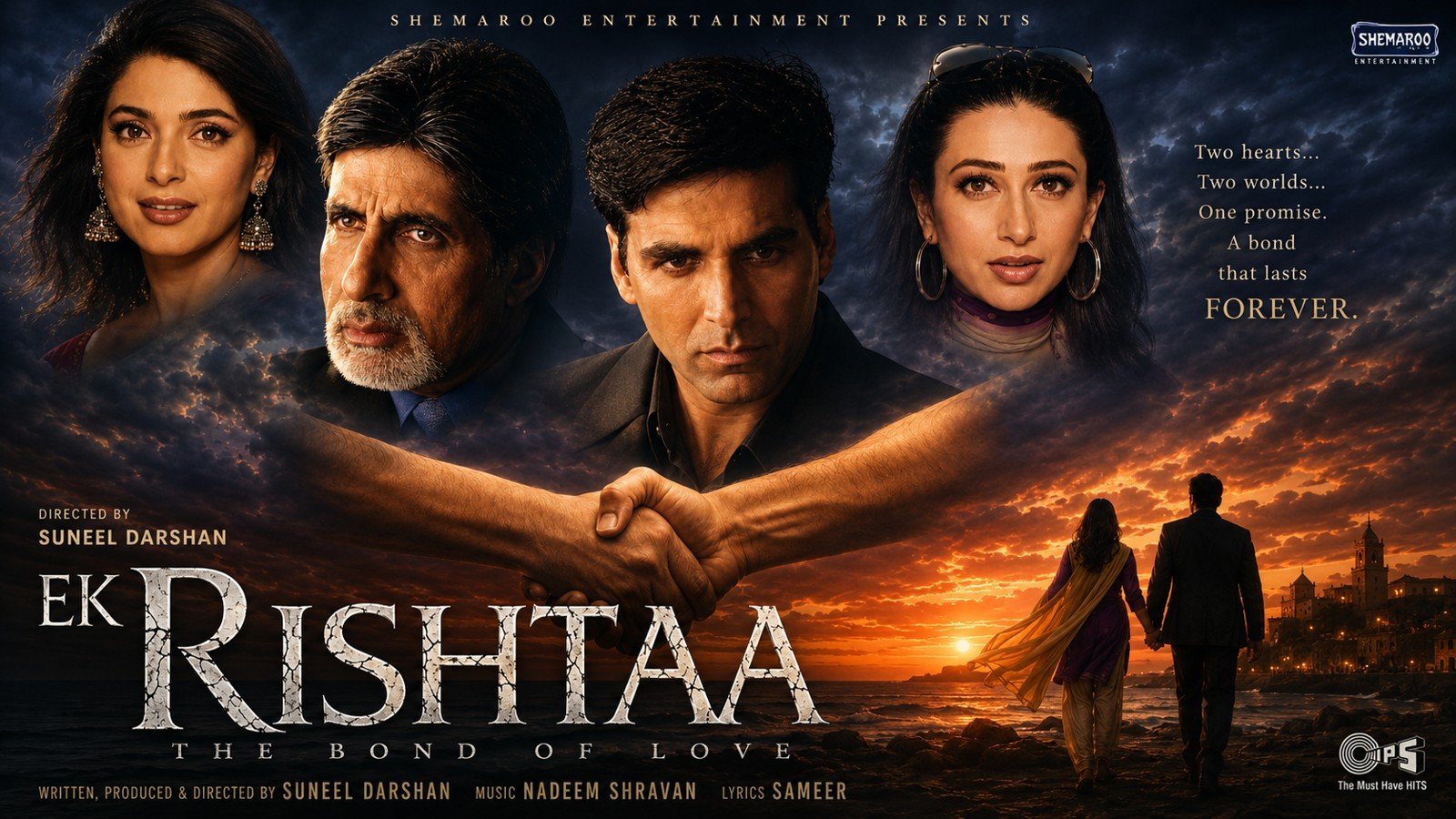
Ek Rishtaa - THE BOND OF LOVE (2001)
Starring: Amitabh Bachchan, Raakhee, Akshay Kumar, Karisma Kapoor, Juhi & Mohnish
Director: Sunil Dharshan
Music Director: Nadeem Shravan
Synopsis: Old-fashioned yarn about never, never trusting a book by its cover!
Reviewed by: Faiz Khan
An ailing patriarch, Vijay Kapoor (Amitabh Bachchan), lies in bed, broken by those closest to him. Beside him is his dutiful wife Pratima (Raakhee), while a young daughter sits playing the piano downstairs. The house is otherwise silent and is about to be auctioned. Almost immediately, we enter the world of flashbacks and see a supposedly young Vijay Kapoor and his wife, both with heavily dyed hair and eyebrows, singing about their hara bhara parivaar while looking ridiculously like two sixty-year-olds trying to pass themselves off as being in their thirties. By the time the song is over, the children have grown into three daughters and a son.
At a business awards ceremony, Vijay Kapoor is practically stalked by a twitchy and overawed admirer, Rajesh (Mohnish Bahl). Rajesh begs for Vijay Kapoor’s autograph, sings endless praises of what a wonderful man he is and explains how he has idolised him for years, even carrying newspaper cuttings and articles about him wherever he goes. Impressed by this adoring young man, Vijay gives him a job and, in time, Rajesh marries one of his daughters, played by Juhi Chawla, who remains heavily pregnant throughout almost the entire film. Naturally, Rajesh is so revoltingly decent and good that it comes as no surprise when the worm eventually turns.
Meanwhile, Ajay (Akshay Kumar) returns from holiday and joins his father’s business, beginning at the bottom rung of the ladder. During his stint at the factory, he comes across a gambling union boss (Ashish Vidyarthi), with whom he has a confrontation. His father reprimands him and orders him to apologise to the union leader. Ajay does so, but promptly resigns from his job. Here lies the real conflict. The father firmly believes that success in life can only come through experience, whereas the son believes that his education is enough to help him establish an IT business and make a success of it. Matters, fuelled by misunderstandings, eventually come to a head and Ajay is thrown out of the family home. At this point Karisma comes to his aid and the two marry.
Soon, however, the tables are turned upon Vijay Kapoor when, in typically outlandish Hindi film fashion, the scheming son-in-law quietly makes off with the family fortune and leaves them completely destitute. Apparently, this has all been part of the sinister master plan of a resentful middle-class boy who has spent years plotting to take the family to the cleaners.
It is all pure Bollywood bunkum.
We now return from the land of the flashback to find the dutiful son returning to the family fold, only to discover that his father remains distant and refuses to accept charity. Before Ajay can return, however, his pregnant and hysterical wife insists that he choose between her and his parents. He chooses his parents, and she goes back to her own home. Slowly but surely, the film winds towards its conclusion, mercifully without any elaborate death scenes, although Juhi Chawla performs something of a disappearing act, presumably having finally made her way to the delivery room.
Ek Rishtaa is a disappointment and let there be no doubt about that. It has been mounted on an enormous scale and boasts an extremely impressive cast. The film was advertised as a drama revolving around the clash between father and son and, had it remained concentrated upon this central relationship, it might have developed into a genuinely interesting and involving film. Unfortunately, this is precisely where it falls apart.
While the conflict between father and son is developing, there is certainly some fire in the proceedings. Here are two men from different generations, bound together by love but separated by their very different ideas about ambition, experience and the changing world around them. Darshan, however, shows little interest in exploring this. Instead, he abandons the more compelling story in favour of the ancient and thoroughly unconvincing track of a conniving son-in-law secretly swindling his trusting father-in-law out of millions.
This is Pran territory, not a film of the twenty-first century!!!
The film then degenerates further into the level of the average commercial potboiler, complete with Nagma dancing while the four villains slurp and leer around her. The direction is flat, with one scene simply falling into the next without any real depth. At times, the film feels almost episodic. One is never sufficiently moved, or at least not for very long, because the story is told in such a superficial and uninvolving manner.
In fact, this is a fairly simple story, simply narrated, but saddled with a premise that ultimately lets it down. It never delivers the strong emotional punch it spends so long promising.
Having said that, the film is not a complete washout. It remains watchable for much of its running time, largely because the constant expectation that something more substantial might emerge keeps one interested, even though that promise is never really fulfilled.
Amitabh Bachchan is by far the most accomplished member of the cast and is now making considerably better choices in terms of roles. This is a controlled and impressive performance. Raakhee is somewhat wasted. Akshay Kumar gives an understated and perfectly decent, if unexceptional, account of himself, although one feels he is capable of much more. Karisma Kapoor looks rather off-colour, and her performance is equally off-key. This is certainly not one of her better efforts. Juhi Chawla is so heavily pregnant throughout the film that even basic mobility appears to be something of a problem, and none of her customary sparkle is evident. Mohnish Bahl badly overplays what is already an extremely clichéd role. Not a single person in the audience could believe that this grotesquely virtuous Mr Goody Two-Shoes was not really a snake preparing to reveal his poisonous fangs.
Nadeem-Shravan’s music offers one or two pleasant tunes but nothing remotely exceptional. There are far too many songs, several of them entirely unnecessary and apparently inserted wherever the director felt the film required a little further padding. The tracks that stand out are “Ek Dil Hai” and “Aap Ke Aane Se”, although a couple of the other songs have also become popular.
The dialogue is quite good and, indeed, often provides the film with its only real sense of drama. It is a shame, therefore, that with such an impressive cast and the potential to create something of genuine merit, the director chose such a pathetically dated and clichéd storyline and ended up with a distinctly half-baked effort.
Still, after Jaanwar, this is at least one step in the right direction.

0 Comments
Leave a Comment