
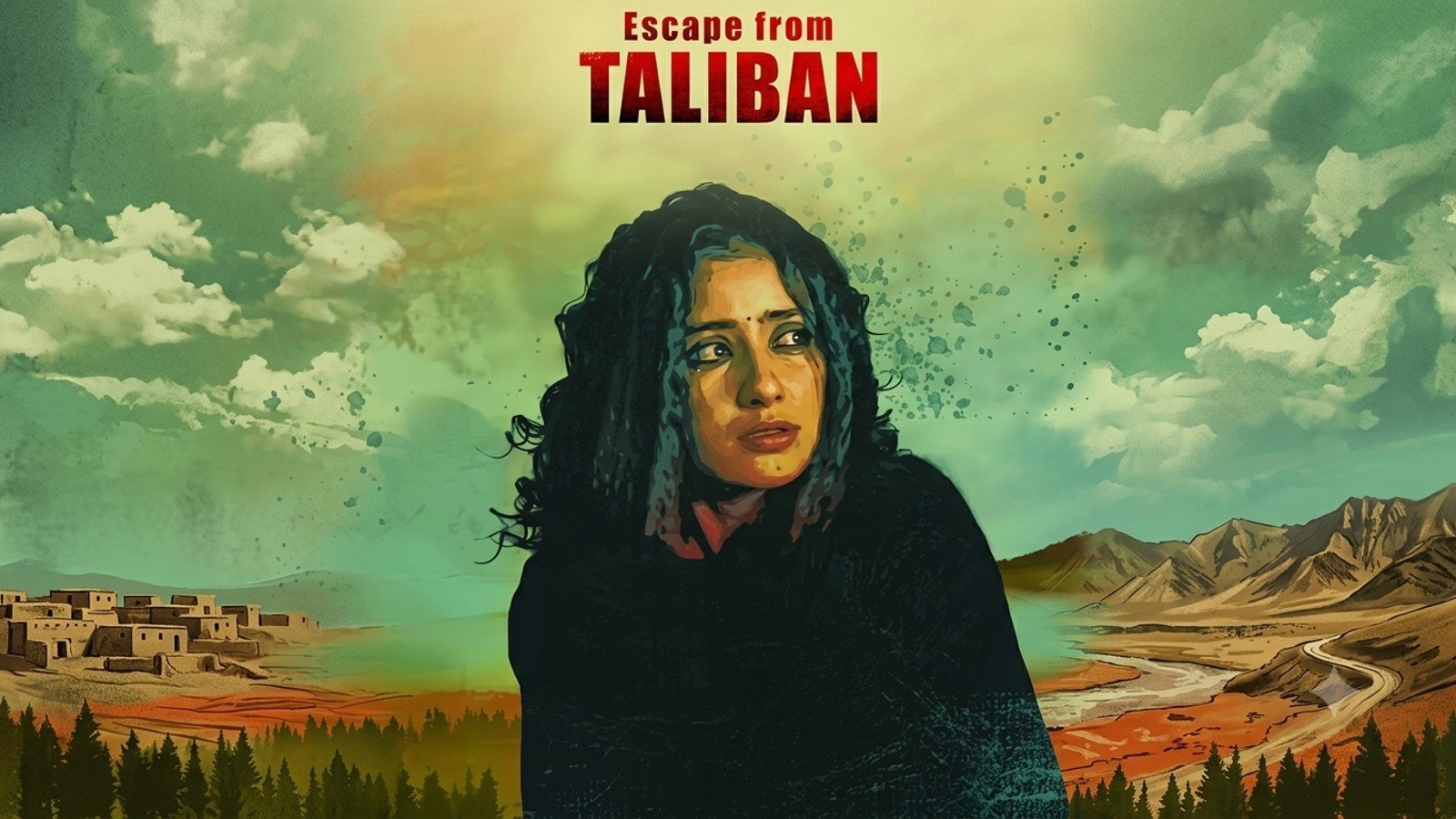
Escape From Taliban (2003)
Cast: Manisha Koirala, Nawab Khan
Directors: Vijay Nopany, Ujjal Chatterjee
Synopsis: Supposed true story about a woman caught up in the horrors of Taliban rule
Reviewed by: Omar Khan
According to the filmmakers, Escape from Taliban is based on fact. The movie begins with images of a burning, war-torn landscape while a voice-over song laments how a country that was once paradise, a heaven on earth, could have been reduced to such horror, darkness and inhumanity, especially towards women. Scriptwriter Sushmita Banerjee recounts her own horrific struggle to escape from Afghanistan in the mid-1990s, when life had become unbearable under the barbaric rule of the pre-Jurassic Taliban regime. We see Sushmita writing her memoirs and slipping into flashback as she recalls how her journey to paradise turned hideously sour.
Sushmita, a strong-willed young woman, defies her parents, who warn her that “a Hindu girl could never be happy married to a Muslim” and that her dreams of building a life with a Muslim moneylender from Afghanistan are pure fantasy. Despite their pleas for sanity, she elopes with her Afghan boyfriend in 1988 after he promises that they will be able to build a comfortable life together in his homeland. Apparently, Sushmita exists in something of a vacuum, as she seems to have very little idea of conditions in Afghanistan at the end of the 1980s. The country had already been devastated by years of war and Soviet occupation and, following the withdrawal of the Soviets, the debris that remained would eventually help give rise to the Taliban extremists, aided and abetted by the Pakistani ISI, who appeared to regard Afghanistan as their own private playground.
Anyway, Sushmita, who seems reasonably well informed in every other respect, appears oblivious to the fact that perhaps the most spectacularly foolish thing she could do with her life would be to pack up and settle in war-ravaged Afghanistan. Yet the charms of her rather unattractive boyfriend—by Afghan standards, at least—prove impossible to resist, and she abandons her comfortable existence in Calcutta for what she imagines will be paradise. The moment she arrives, with missiles flying and bodies scattered along dusty, crater-pocked roads, she realises that the tourist brochures may have misled her and that Afghanistan is not quite the Butlin’s holiday camp she had imagined. Worse follows when she is introduced to her husband’s decidedly peculiar clan. The women are portrayed as giggling, submissive simpletons, while the men grunt and spout misogynistic prehistoric babble at every opportunity.
The first sign of serious trouble appears when the marauding Taliban vice squad, apparently searching for someone to bully, spots smoke rising from a chimney during Ramadan and immediately scents a victim. They race to the house and discover Sushmita preparing supper for her child. When questioned in the most animalistic manner, she protests that she is not a Muslim. This is not good enough for the Taliban, who threaten rivers of blood should such a transgression ever occur again, but not before beating Sushmita to a pulp and smashing everything in sight. They then roar away in their Indian-made Tata jeeps, kicking up a swirl of angry dust as they disappear temporarily into oblivion.
And so the film continues in much the same vein, attempting to shock and outrage viewers by demonstrating just how animalistic the Taliban are and how bestial almost every Afghan man appears to be, particularly when dealing with women. Time and again, we are shown scenes of women being tortured and humiliated by their menfolk during the course of this cheap, sensationalist and exploitative film.
The problem is not that the film’s basic argument is entirely wrong. The treatment of women under the Taliban was undoubtedly barbaric. However, its depiction of Afghans, their culture and their religious practices is so grotesquely distorted that the film ultimately comes across as little more than a cheap attempt to malign not only Afghanistan but Islam itself as something belonging to the Dark Ages. Everyone is entitled to a point of view, but this film does not possess a shred of objectivity. Its entire approach is designed simply to shock and repel. Not for a moment does it attempt to explain why these conditions might exist or to place them within any social, historical or cultural context.
The film reeks of being a cheap cash-in on the infamy and notoriety surrounding the Taliban and a rather smug attempt to exploit contemporary interest in the subject. Anyone familiar with Afghan culture and customs will probably be rolling on the floor in uncontrollable fits of laughter, because the people portrayed here resemble almost anything except Afghans. If one Afghan greeted another with an “adaab”, as happens in the film, he would probably be knocked senseless!
Yet this is only one of the many glaringly absurd errors made by the filmmakers, along with the Tata jeeps and the astonishing accents, in their haste to complete the film before the Taliban ceased to be the flavour of the season. One particularly hysterical piece of subtitling occurs when the opening line of the Quran is recited and translated as “exorcism chants”, a clear attempt to be both blasé and witty at the expense of a fifth of the world’s population. Every religion may appear inexplicably strange to an outsider, but that does not give anyone the right to judge and mock the beliefs and customs of others.
Quite apart from the moral objections to a film of such blatantly propagandist intent, it is a disaster in almost every other respect as well. Not only is its depiction of Afghan life hopelessly inaccurate, but the film is riddled with glaring inconsistencies from beginning to end. In all honesty, it tells us nothing new, and the increasingly stale message it seems determined to deliver is that the world would be a better place without Muslims. What it ought to be saying is that the world would be a better place without extremists of any kind, and that films which spread misconception, prejudice and hatred are not doing anyone a favour.
It is a pity to see Manisha Koirala’s career sink to such depths that she has to accept material as pathetic as this, although, to be fair, her role is reasonably substantial, and she does it some justice. Clearly, she has seen better days and this film surely represents her nearing the end of the road.
The man they have unearthed for the male lead is monstrous and amphibious and should perhaps have been left beneath the slimy rock from which he was discovered. What a loser—but then, exactly what a film of this tawdry nature deserves.
Escape from Taliban may be recommended to curiosity seekers or anyone with an interest in naked, exploitative propaganda. However, if you are looking for an accurate and trustworthy portrait of life in Afghanistan between 1988 and 1994, I suggest you look elsewhere.
True story or not.

0 Comments
Leave a Comment