
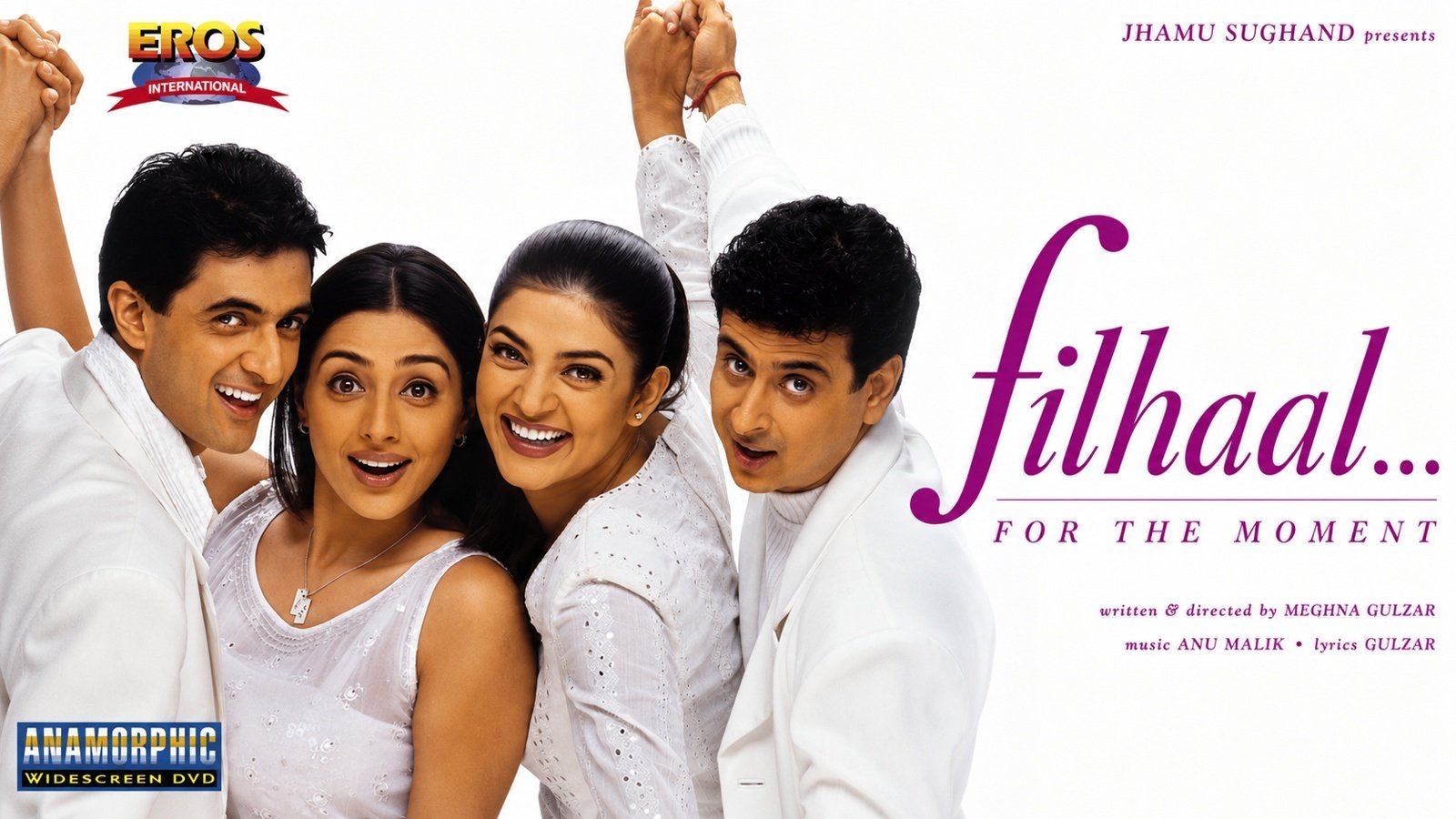
Filhaal (2002)
Starring: Tabu, Sushmita Sen, Sanjay Suri, Palash Sen
Director: Meghna Gulzar
Music Director: Anu Maliik
Synopsis: modern 'relationship' drama that doesn't quite work despite fine acting
Reviewed by: Faiz Khan
Meghna Gulzar's maiden venture arrived burdened with expectations well above the norm simply because of the surname she carries. Being Gulzar's daughter inevitably invited comparisons before she had even shot a frame, which perhaps makes her disappointment all the more pronounced than it might have been for any other debut director.
Filhaal... tells the story of two close friends, Rewa (Tabu) and Sia (Sushmita Sen). The film opens with a despondent Rewa leafing through a photograph album before immediately plunging into a flashback where the two friends are fencing together, Sia accidentally stabbing Rewa in the stomach. One initially wonders whether this incident is somehow responsible for Rewa's later inability to bear children, but that proves not to be the case. We are then whisked back to the present where a heavily pregnant Sia arrives at hospital accompanied by Dhruv (Sanjay Suri), who also happens to be Rewa's husband. Before the audience has had time to orient itself, the film slips back once more into flashback territory, gradually revealing how matters reached this stage.
Rewa marries Dhruv but tragically miscarries. Sia, a fiercely independent career woman with little interest in marriage to Sahil (Palash Sen) and even less desire to have children, watches helplessly as her closest friend slowly crumbles under the emotional weight of her loss. Out of love and compassion she offers to carry Rewa and Dhruv's child as a surrogate, believing that Rewa is unable to carry a pregnancy to full term. Rewa eagerly embraces the idea, while Dhruv remains understandably hesitant. Poor Sahil, meanwhile, barely seems to register as a factor in the proceedings.
The film then charts the changing relationship between the two women during the pregnancy, the subtle jealousy that gradually begins to creep into Rewa's emotions, the strains placed upon her marriage to Dhruv, and the inevitable consequences for Sia's own relationship with Sahil. Unfortunately, all of this is explored with surprisingly little depth and, more often than not, in a manner that simply fails to convince. As a result, what should have been emotionally involving often remains strangely detached and dramatically inert.
Meghna Gulzar's principal problem lies with the screenplay. Sia's transformation from an ambitious career woman into someone willing to become, in effect, a sacrificial womb for her best friend never feels entirely believable. The affection between the two women is portrayed with warmth and naturalness, yet the emotional build-up and Sia's almost casual acceptance of such an extraordinary decision leave far too many unanswered questions. Similarly, the marriage between Rewa and Dhruv is sketched rather than explored, and one is left with the distinct impression that Meghna is less interested in examining the emotional and psychological ramifications of surrogacy than merely using it as the framework for a relationship drama.
Ironically, the far cruder and considerably more commercial Chori Chori Chupke Chupke actually posed more interesting questions about surrogacy than Filhaal... ever manages. That, more than anything, illustrates how comprehensively Meghna misses her target. Nor does she appear to have complete command over the mechanics of storytelling. The frequent shifts between past and present often feel abrupt and confusing. Unlike Dil Chahta Hai, which blended timelines with effortless fluency, the flashback structure here adds very little and frequently interrupts the film's rhythm. The songs, meanwhile, appear almost at random and merely succeed in slowing proceedings further.
What ultimately rescues the film are the performances, and for that Meghna deserves considerable credit. Tabu is, as ever, virtually faultless, bringing enormous dignity and emotional truth to Rewa. Yet she is almost overshadowed by Sushmita Sen, who delivers the finest performance of her career. There is a remarkable naturalness and ease about her work here, and one cannot help wishing that such a performance had found itself in a stronger film. Sanjay Suri is also excellent, although his role is considerably less substantial than those of the two leading ladies. Palash Sen, however, remains resolutely wooden. Bland, expressionless and awkward throughout, he would do well to stick to singing.
Anu Malik, complete with his newly acquired extra "i", contributes a largely forgettable soundtrack, the lone exception being Asha Bhosle's lovely title song. The title itself is wonderfully evocative and perfectly suited to the story. Sadly, the film never lives up to it. Filhaal... remains an admirable attempt at tackling an unusual subject, but despite its fine performances it ultimately emerges as an uninspired and rather dull affair.

0 Comments
Leave a Comment