
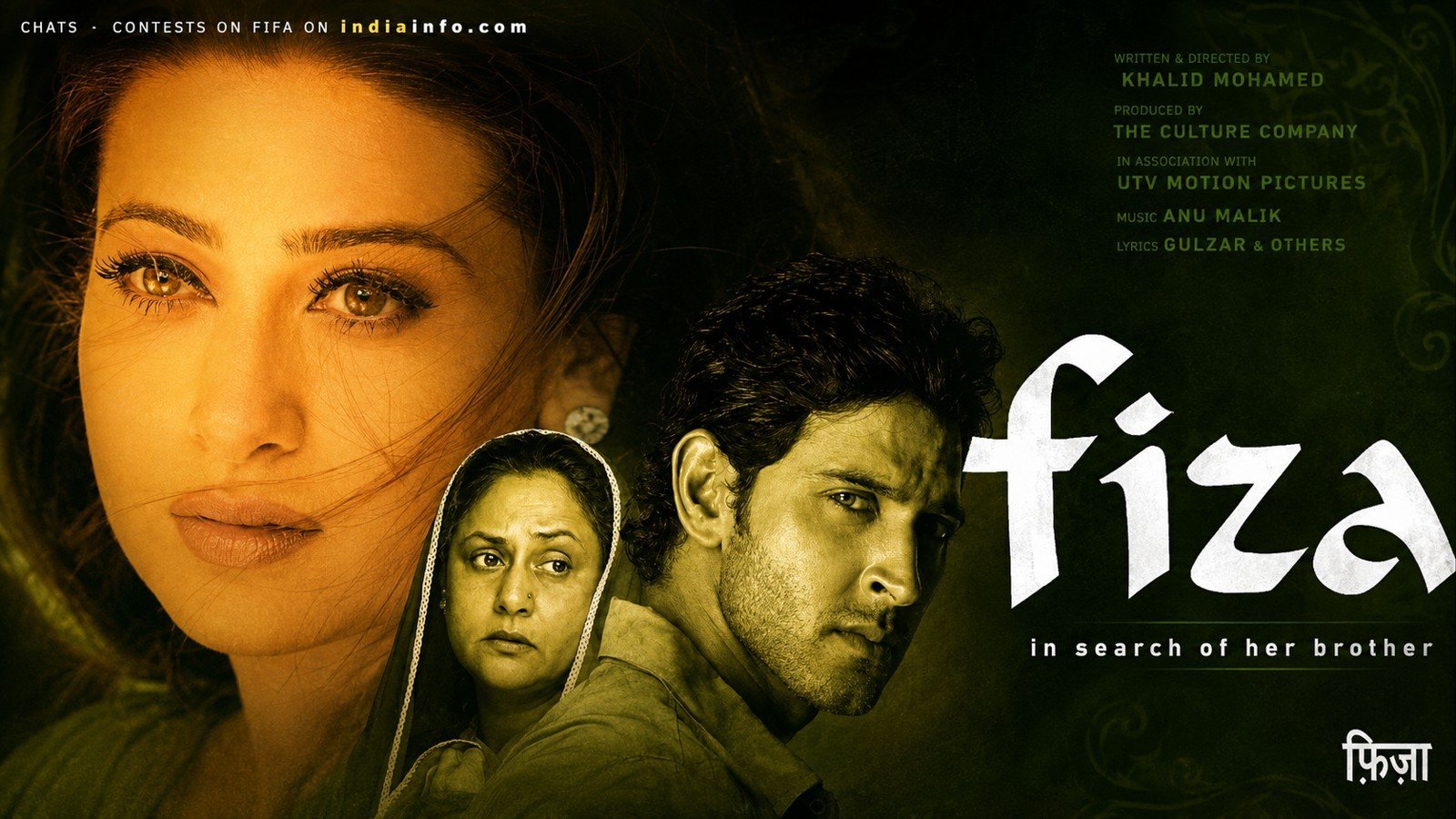
Fiza (2000)
Starring: Jaya Bachchan, Hrithik Roshan, Karisma Kapoor
Director: Khalid Mohamed
Music Director: Anu Malik
Synopsis: Sensitive and strongly acted drama of a family devastated by loss
Reviewed by: Faiz Khan
It is 1993, the time of the Bombay riots. Amaan (Hrithik Roshan) sits watching the epitome of innocence, Bobby, on television while his elder sister Fiza (Karisma Kapoor) oils his hair. It is late in the evening. They reminisce about happier times while their mother, Nishat Bi (Jaya Bachchan), sits quietly with them. Their modest home, with its aquamarine walls and old wooden windows, reeks of old Bombay and radiates a sense of warmth. This is a close, loving family. In the middle of the night, Amaan is summoned outside by a friend who urges him to come to the aid of fellow Muslims said to be under attack from Hindu mobs. The city erupts into violence and Amaan is swallowed up by the chaos. Fiza and Nishat Bi catch one fleeting glimpse of him disappearing into the crowd—and then he is gone.
Time moves forward to 1999. Yet for Nishat Bi, time itself has stood still. On the surface life appears to have resumed its normal course, but Amaan's absence hangs over every corner of the household. There has been no word from him since that terrible night and the loss has devastated the family. Nishat Bi clings desperately to the hope that one day her son will return. She makes her regular rounds of police stations and visits Haji Ali, where memories of happier days with Amaan still linger. Every ring of the doorbell is like a gunshot to the heart, bringing with it the eternal hope that perhaps this time it will be Amaan standing on the doorstep.
Nishat Bi continues her search quietly, often keeping her efforts hidden even from Fiza. One afternoon, while returning from yet another unsuccessful job interview, exhausted under the blazing sun, Fiza thinks she catches sight of Amaan across the road. Was it merely wishful thinking? A hallucination born of longing? Unable to silence the ghost of her missing brother any longer, Fiza resolves to confront the past and actively discover what really happened that dreadful night. She takes her story to the press, who seize upon it, and almost overnight she becomes something of a public figure. Politicians attempt to exploit her grief for their own agendas, but she refuses to be manipulated, remaining steadfast in her determination to find Amaan. Eventually she receives information suggesting he may have fallen into the hands of a terrorist organisation, leading her to the deserts of Rajasthan in search of him.
One fateful night she hears an intruder entering the house. Rushing downstairs, she comes face to face with Amaan, now a fugitive and, it would seem, a terrorist. She persuades him to return home to Bombay. But can Amaan ever truly return to the life he left behind? Can someone who has crossed such a terrible divide ever reclaim the innocence he once possessed?
Khalid Mohamed's directorial debut is a remarkable fusion of commercial Hindi cinema and serious art-house filmmaking. It is a story about innocence lost and the painful realisation that once it has disappeared, it can never truly be recovered, no matter how desperately one wishes otherwise. More than that, it examines the devastation wrought by the Bombay riots upon ordinary families—Hindu and Muslim alike—and reminds us that those who survived were often every bit as damaged as those who perished. It is a film about grief, humanity and moral frailty, told with extraordinary sensitivity and restraint. There are no sermons, no grandstanding speeches and no heavy-handed preaching, yet the film's message emerges all the more powerfully because of its understated approach. At its heart it remains the story of a sister searching for her lost brother, and Mohamed wisely never allows the narrative to lose sight of that emotional core. Through Fiza's journey we are confronted with uncomfortable questions about the value of human life itself—questions that linger long after the film has ended.
One slight reservation concerns the manner in which the film explains Amaan's disappearance. His flashback reveals part of the picture but remains frustratingly vague, with the audience left to piece together much of what happened through implication. This was almost certainly the result of censorship cuts rather than any failing on Mohamed's part. There is also the feeling that certain developments unfold rather conveniently, yet in a film such as this it is the symbolism of Fiza's search that matters far more than the precise mechanics of the plot.
The film boasts an exceptional cast, and every performance is first-rate.
Jaya Bachchan is simply magnificent as Nishat Bi. She underplays beautifully, creating a character of extraordinary dignity and quiet heartbreak. One feels as though one already knows this woman. Her pain is recognisable, deeply human and entirely believable. There are no histrionics here, merely a wonderfully restrained portrayal of a mother sustained by hope alone.
Karisma Kapoor carries the title role with tremendous assurance. Watching Fiza, one cannot help but admire the remarkable evolution she has undergone as an actress and the increasingly challenging material she has chosen. Here is a mainstream commercial heroine who, at a relatively young age, successfully crossed into films of genuine substance. That directors of this calibre were willing to entrust her with such roles says much about the respect she had earned. She rewards that faith with what is arguably the finest performance of her career.
To single out individual scenes would do both Karisma and the film a disservice, for doing so would inevitably reveal too much of the story. Suffice it to say that she is consistently superb throughout.
Hrithik Roshan, in only his second film, more than fulfils the promise shown in his debut. Amaan is an immensely complex character, torn between conflicting loyalties and haunted by his past, and Hrithik conveys that confusion and inner torment with remarkable sensitivity and maturity. It is another outstanding performance.
The dictates of commercial Hindi cinema inevitably intrude from time to time and, to a certain extent, that is something one simply has to accept. Khalid Mohamed, however, seriously misjudges the inclusion of the Asha Bhosle number "Nachoon", picturised on a westernised Fiza. It is an appallingly misplaced sequence that jars violently with the tone of the film and feels as though it has wandered in from an entirely different Karisma Kapoor potboiler. The title song, presented almost like a music video, also sits rather uneasily within the narrative. It is a pity because otherwise the soundtrack is excellent.
Rarely has such an understated film managed to burrow so deeply under the skin. Fiza is thoughtful, compassionate and quietly devastating—a film that deserves to be seen.

0 Comments
Leave a Comment