
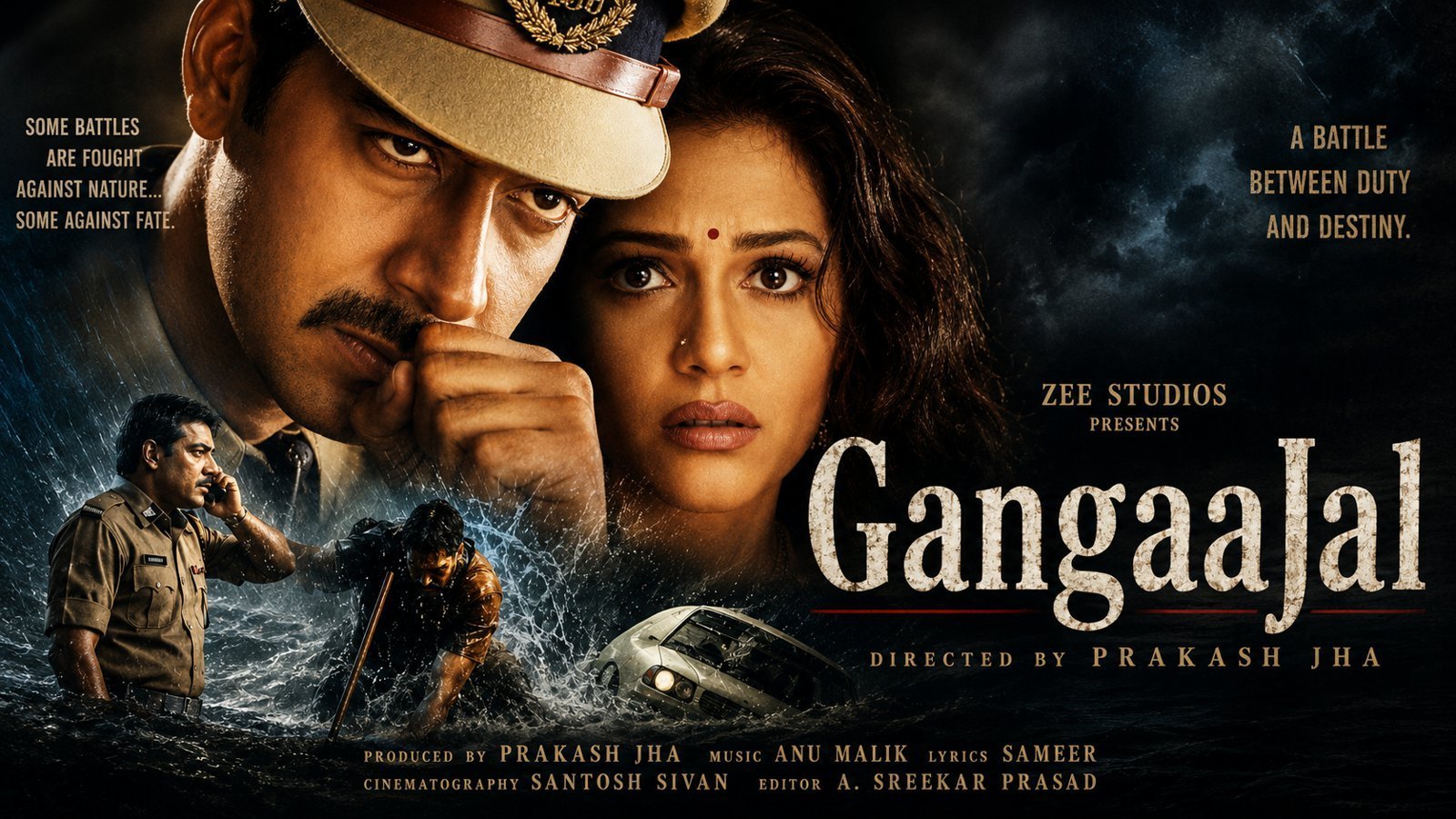
Gangaajal (2003)
Cast: Ajay Devgun, Gracy Singh
Director: Prakash Jha
Music Director: Wayne Sharpe
Synopsis: Excellent tale of dark dealings and police corruption and brutality
Reviewed by: Faiz Khan
Despite the disclaimer at the start of the film, Gangaajal is based on a true incident and aspires to delve into the moral dilemmas thrown up by the mass corruption that pervades every layer of Indian society. Prakash Jha returns to familiar territory after Mrityudand, another film set in a rural community where corruption, moral decay and hypocrisy seep from every pore of society.
Upright and utterly honest, Superintendent of Police Amit Kumar (Ajay Devgan) is posted to rural Tejpur, a volatile district where the local mafiosi rule with unquestioned authority, their power extending well beyond the reach of the law and deep into the police force itself. Amit is advised by his DIG (Mohan Agashe) that the secret to survival is to sit back, keep his head down and, if he encounters any problems, simply report them upwards. That, he is told, is how the system works.
On an impromptu visit to the Shikarpur police station, Amit immediately witnesses the reality of policing in the area. Bribes are openly accepted, authority is routinely abused, and almost everyone appears to be under the thumb of the all-powerful Sadhu Yadav (Mohan Joshi) and his vicious son Sunder (Yashpal Sharma). Even members of Amit's own team are compromised. Inspector Bachcha Yadav (Mukesh Tiwari), like much of the local police force, is firmly on Sadhu Yadav's payroll. To curry favour with the new Superintendent, Sadhu even arranges for Bachcha to deliver a local criminal into Amit's hands as a gesture of goodwill.
Amit immediately senses that something is amiss. Rather than expose Bachcha outright, he offers him an opportunity to decide where his loyalties truly lie, believing that somewhere beneath the corruption there remains an honest policeman worth saving.
Amit is a man determined to work strictly within the law and, inspired by his integrity, many of his junior officers gradually rally behind him. Together they begin taking on the seemingly untouchable Sadhu Yadav and his equally despicable son.
Given a second chance, Bachcha Yadav redeems himself by helping to trap Sunder. Yet justice proves hollow. Through influence and corruption, Sunder is quickly released, provoking outrage among the police officers who risked everything to arrest him.
One night they take matters into their own hands.
Picking up two of Sunder's cronies, they unleash a savage act of vigilante justice, blinding them by pouring acid into their eyes and mockingly referring to it as "Gangaajal"—the holy water said to cleanse sins. Their victims, they claim, are simply being purified.
The brutality horrifies Amit, who immediately vows to identify those responsible and bring them before a court-martial. But public opinion moves in precisely the opposite direction. Ordinary people, long denied justice by a hopelessly corrupt system, celebrate these acts as the first time criminals have truly been punished rather than buying their freedom. Before long, similar attacks begin occurring elsewhere, with "Gangaajal" becoming the symbol of this new and terrifying form of justice.
Prakash Jha has made a mesmerising film, stripped almost entirely of commercial frills and clichés. He tells his story in a direct, unfussy manner, concentrating squarely on the moral conflict facing Amit rather than allowing himself to be distracted by unnecessary subplots. The result is a powerful film that raises uncomfortable questions without ever pretending there are easy answers. Even the seemingly understated climax ultimately arrives at exactly the right moral conclusion.
Stark, uncompromising and deeply unsettling, Gangaajal paints a frightening portrait of corruption in Tejpur, a village that ultimately serves as a metaphor for a disease infecting society as a whole.
Ajay Devgan delivers yet another superb performance, restrained, dignified and utterly convincing as the incorruptible Amit Kumar. Gracy Singh has little more than an extended cameo, but the film wisely refuses to deviate from its central narrative simply to provide its heroine with additional screen time. Mukesh Tiwari is outstanding as the conflicted Bachcha Yadav, while Mohan Joshi and Yashpal Sharma make for thoroughly convincing villains.
Shot on location in Bihar, the film possesses a strong sense of authenticity that further strengthens its impact. Police-versus-system dramas are hardly new, but few have tackled the subject with the intelligence, restraint and conviction that Jha displays here.
It is not always an easy film to watch, particularly for the squeamish, but for everyone else Gangaajal is a gripping, intelligent and deeply rewarding piece of cinema.

0 Comments
Leave a Comment