
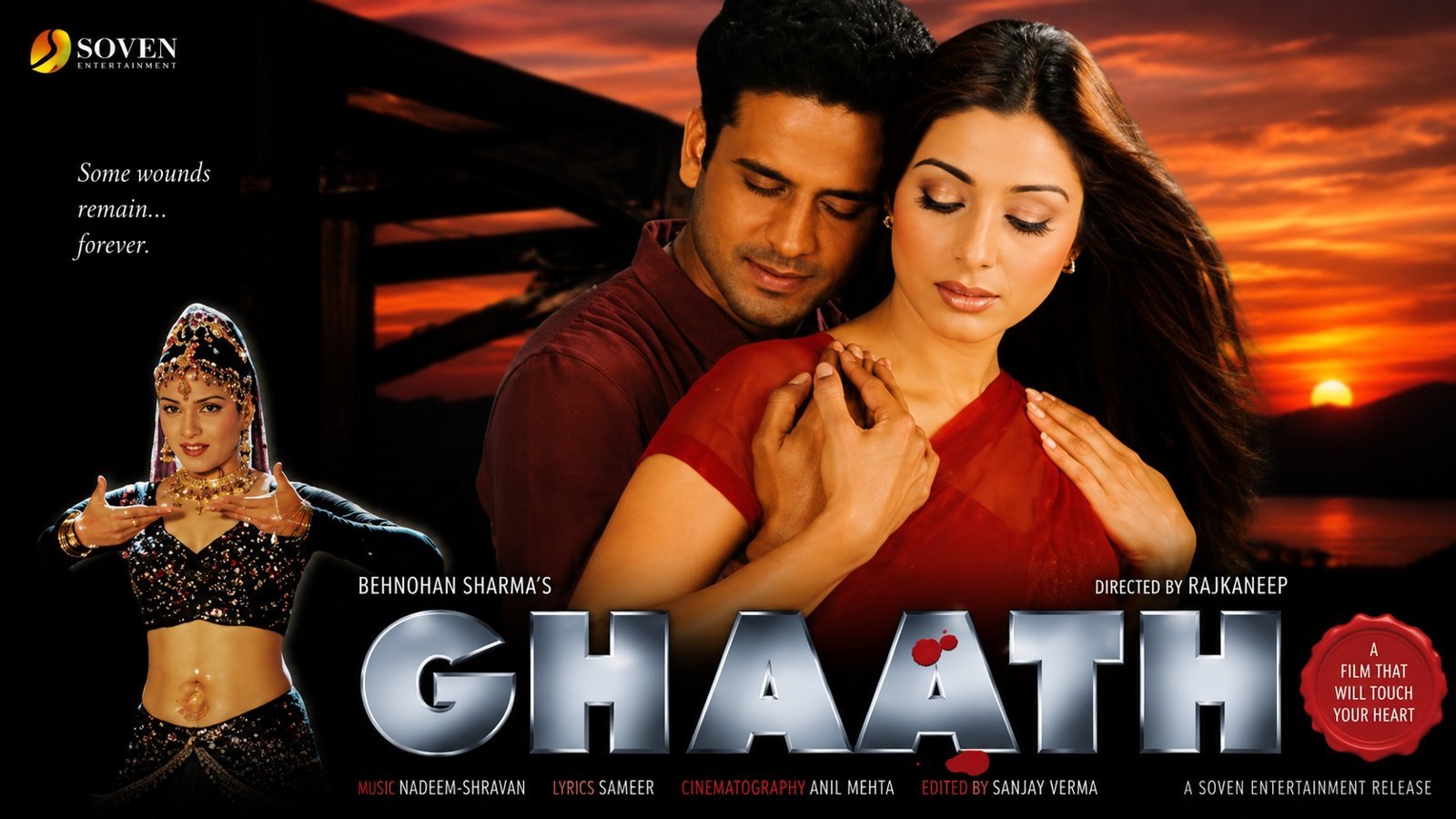
Ghaath (2000)
Starring: Manoj Bajpai, Tabu, Om Puri, Anupam Kher, Sheeba
Director: Akshadeep
Music Director: Anu Malik
Synopsis: Very stale wine in not so new a bottle....offers nothing fresh or novel at all
Reviewed by: Faiz Khan
The film opens with images of the streets of Mumbai, the sea stretching out on one side, accompanied by a voice-over from Om Puri and the distinct feeling that this may prove to be something rather more substantial than yet another corruption saga. Sadly, that feeling lasts for all of fifteen seconds before it becomes painfully obvious that this is, indeed, just another corruption flick.
There is, of course, nothing particularly unusual in that. Hindi cinema has always thrived on recycling a relatively small number of storylines. The real test lies not in originality but in treatment, and that becomes all the more important when dealing with a subject that has already been explored countless times before.
Krishna (Manoj Bajpai) is an aspiring police cadet, training at the Police Academy and convinced that he has all the qualities necessary to become an outstanding police inspector. He lives with his family and friends in a Mumbai basti. One day the notorious "Mamu" and his henchmen arrive with generous offers of alternative accommodation because they intend to replace the settlement with luxury high-rise apartments. The proposal is firmly rejected by the community under the leadership of Krishna's father Patil (Anupam Kher), and Krishna rather unwisely adds insult to injury by dismissing the gang as nothing more than "chors." Unsurprisingly, this proves to be a costly mistake. Before long, Krishna discovers that he has been denied entry into the police force, and a convenient voice-over informs us that Mamu was responsible.
Meanwhile, Krishna has also managed to assault Inspector Godbole (Mukesh Tiwari), a thoroughly sleazy police officer who attempts to molest Krishna's sister Mansi. Krishna is a man with an explosive temper, something we have already been warned about through the film's opening statement that "every citizen is a policeman without uniform." He cannot tolerate injustice and repeatedly finds himself involved in violent confrontations. Had he possessed even a little self-control early on, he might actually have fulfilled his dream of becoming a police officer—although one rather dreads to imagine what sort of policeman he would have made.
Godbole naturally sets about exacting his revenge. Krishna's friends are rounded up, hauled into the police station and brutally beaten. Krishna arrives with his former instructor, Inspector Pandey (Om Puri), only to be reminded by Godbole that Pandey has absolutely no authority within his jurisdiction. Fortunately, advocate Kavita (Tabu), who also happens to be Krishna's sweetheart, intervenes and secures the release of the unfortunate youngsters.
The film then wanders into another lengthy flashback as Pandey recounts his own tragic past. Years earlier, Mamu had attempted to bribe him. Pandey refused and was promptly transferred. Returning home unexpectedly one day, he found Mamu with his wife. In a fit of rage he shot his wife, while Mamu escaped unscathed. Ever since, Pandey has harboured thoughts of revenge and now sees Krishna and his friends as the perfect instruments through which to settle old scores.
As if this were not enough, tragedy strikes Krishna's family again. His sister is married, only for the building in which she and her husband live to collapse the very next day, killing the newlyweds. The construction is traced back to Mamu, who is eventually brought to trial following a series of murders connected with the scandal. Yet, in the finest traditions of Bollywood corruption dramas, insufficient evidence allows him to walk free.
The obvious question then becomes whether justice should be pursued through lawful means or whether vigilantism offers the only solution. No prizes for guessing which path the screenplay ultimately embraces.
There is very little to recommend this pedestrian and surprisingly stale effort from Akashdeep. In truth, it is a meandering, convoluted affair that borrows freely from films like Shool, Dil Pe Mat Le Yaar and countless other police-versus-corruption dramas, not least the vastly superior Kurukshetra. The film never quite decides what it wants to say. On the one hand, there is Godbole's petty vendetta against Krishna after suffering public humiliation. On the other, there is the supposedly wider issue of institutional corruption embodied by Mamu. Unfortunately, the latter never develops into anything particularly compelling, leaving the screenplay to rely increasingly upon Godbole's tiresome cat-and-mouse games simply to maintain momentum. Instead, it merely becomes more repetitive and increasingly dull.
The underlying message appears to be that idealism is futile and that corruption can only be defeated through violence because the legal system is hopelessly incapable of delivering justice. It is an astonishingly simplistic conclusion and one we have already seen recycled in hundreds of similar films. Even if the climax attempts to inject some moral ambiguity into these events, it certainly failed to convince me. In truth, I felt very little for any of the characters throughout.
Manoj Bajpai has made another unfortunate career choice. The role feels like a weaker variation of characters he has played before and far less successfully. It is probably one of his more forced performances, though much of the blame must rest with a screenplay that gives him remarkably little to work with.
Tabu is criminally wasted. Beyond the obligatory song and a handful of scenes, she contributes almost nothing to proceedings. Om Puri fares rather better and emerges as virtually the only spark in the entire film, although even his role deserved far greater development. Mukesh Tiwari makes for a suitably slimy Godbole without ever becoming memorable, while Irrfan Khan's Mamu is surprisingly lacking in menace.
Anu Malik's music is equally uninspired, failing to produce even a single tune worthy of remembrance.
This is a dull, stale and thoroughly uninvolving affair—released during Ramzan, perhaps for those in need of something guaranteed to help pass the fasting hours with a good, uninterrupted snooze.

0 Comments
Leave a Comment