
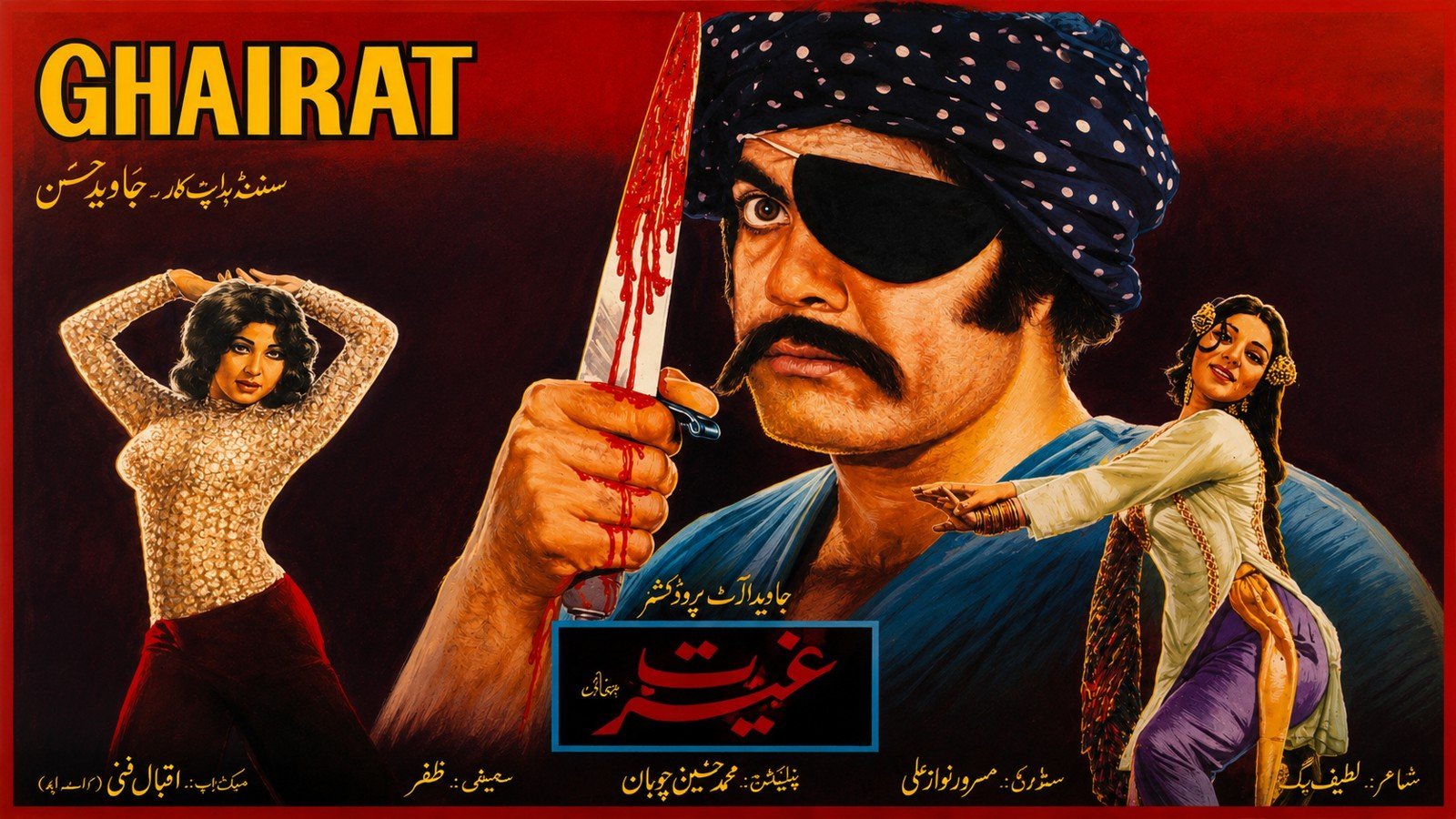
Ghairat (1976)
Cast: Sultan Rahi, Najma, Aalia, Jehangir Mughal, Ishrat Chaudhary, Seema, Parveen Bobby
Director: Javed Hassan
Music: Tafo
Synopsis: Tremendous amounts of shouting and violence, impressive wigs and some sizzling club moments but alas, an incomprehensible mess.
Reviewed by: Omar Khan
Ghairat should be epic by all accounts. It’s a 1976 pre-Zia scuzzy, black and white fleapit Lollywood Punjabi slice of masala. All the correct elements including music by Tafo, dance numbers set at the club, shady henchmen, wonderful weaves and bell bottoms.
Ishrat Chaudhary and Najma among the cast, Nahid Akhtar belting out a sizzler like “Koi Asli Chor” to the delight of uncouth, cheap frontbenchers such as yours truly. This film has elements that ought to elevate it to the classic status of Nawabzada, Pindi Wal, Khatarnak and Aaj Da Badmash. Will it live up to its potential?—that is the question.
Ghairat begins at a pretty frantic pace. Some shady old friends are celebrating the success of their smuggling enterprise. A Jagirdar type is caught up with the rigid rules of his social status, such as the horse he rides. If anybody else rides a horse, he feels immensely threatened, attacked and lashed out to maintain his relevance as a Jagirdar of repute. His old friend and smuggling mates are taken to wearing outlandish yet very attractive headbands, straps, and outfits that would appear quite perfect on the shelves of Dancehall Queen Spice's new clothes chain: tres chic with a wee Pound Shop vibe.
While the Jagirdar is pacifying his smuggler friend, explaining his rudeness is only because he is bound to fulfil the defined role of a Jagirdar and is nothing personal against him. The smuggler isn’t entirely convinced, but they are drinking and partying, so all is relatively hunky-dory.
Meanwhile, elsewhere on the city’s outskirts in the village, an earnest and upright Sawan receives news that his sister has been abducted by a group of goons and carried away in broad daylight.
He pleads with the Jagirdar to use his horse to rescue his sister, but the Jagirdar is again locked into these rigid status rules and refuses to dismount. After an extended bout of violence, the ghairatmand Sawan avenges his sister’s death but is dragged away to jail, where he is convicted as a killer. He instructs his wife, Seema, to make sure the kids grow up with a vengeance in their eyes, but before she can even begin her effort, she and the kids are abducted. Seema is gang-raped and left to die, and the little children are taken to the city. One is sold to a Madam and grows up to be Najma.
Najma luckily has an admirer in Aurangzeb, who swears true love and promises to lay his life on the line to take her away from the miserable life she has as a club dancer and give her a life of “Izzat and Ghairat”. Noble promises indeed, but the moral code of Lollywood films does not allow “tainted” women to regain their honour once it has been compromised. The odds are undoubtedly stacked against Najma and Aurangzeb.
Meanwhile, back in the village again, Aalia has a blind mother to look after, who worries that her ageing daughter is still unmarried. The feisty Aalia sells milk to support herself and her mother, and knows how to dish it out if any hoodlum decides to get overly fresh with her or refuses to pay for the milk they drink.
Ghairat
Aalia is a girl who knows how to take care of herself, but when she lashes out at Horsecart wallah Sultan Rahi, he lets rip and sends her flying to the ground, stunned. Then he drags her by the hair a few yards before questioning her if she has ever encountered a “real man” before. Being thrashed and having her hair pulled and dragged along the earth, a woman can only realize that this is true manhood; moments later, she is starry-eyed and weak at the knees in love. Ready to burst out into several saucy jigs, thrusting her bosoms and twitching her posterior in a delectable show of a typical Punjabi movie mating ritual.
Next, it’s back to the city where the saucy Ishrat Chaudhary displays some serious Kung Fu and good old-fashioned skills to impress the local goon, Shikra. And back at the club, Aurangzeb clashes with Najma’s fake father, forcing her into dancing endlessly to sustain his vices. Remember that Najma’s birth father is rotting away in jail and shall return one day.
Meanwhile, she is forced into a life of misery but still occasionally manages to get away to the park with Aurangzeb, where you would think the last thing she would want to do is dance – but a girl has got to do what a girl gotta do, and dance she must!
Then there are the usual mayhem and clan enmities with many bellicose, loud-mouthed men barking at each other about Ghairat and the usual vengeance-filled nonsense. Sultan Rahi’s beloved brother is gunned down at his wedding celebrations, and the cops are soon looking for him to retaliate against those who killed his brother. He still has time to listen to a song or two from his village girl, Aali,a as he plans his revenge.
Sultan Rahi infiltrates the Jagirdar’s home as a servant wearing an eyepatch and begins his gruesome cycle of revenge. The body count rises as Rahi lets his dagger do the talking. Unfortunately, Ghairat has one or two strands too many, and the different sub-plots have a tough time converging into something that resembles anything that resembles coherence. Besides the few saucy scenes at the club, the rest degenerates into an endless orgy of shouting and comic-book violence.
Even two rather catchy dance club numbers towards the end of the film, including the sizzling “Koi Asli Chor“, manages only to relieve the boredom and confusion but fail to elevate the movie from the chaotic mess. Unfortunately, this time, the legendary “Fighters Union” input doesn’t result in the spectacle that Zabata turned out to be.
This one contains excellent choreography, enjoyable fights, superb music, and sound effects in ccompaniment, but the plot is all over the place. The comic book violence and ridiculous posturing can’t save this film from the dreadful, shambolic mess that it sadly is. Other than for a few moments, Ghairat is a disastrous failure.


0 Comments
Leave a Comment