
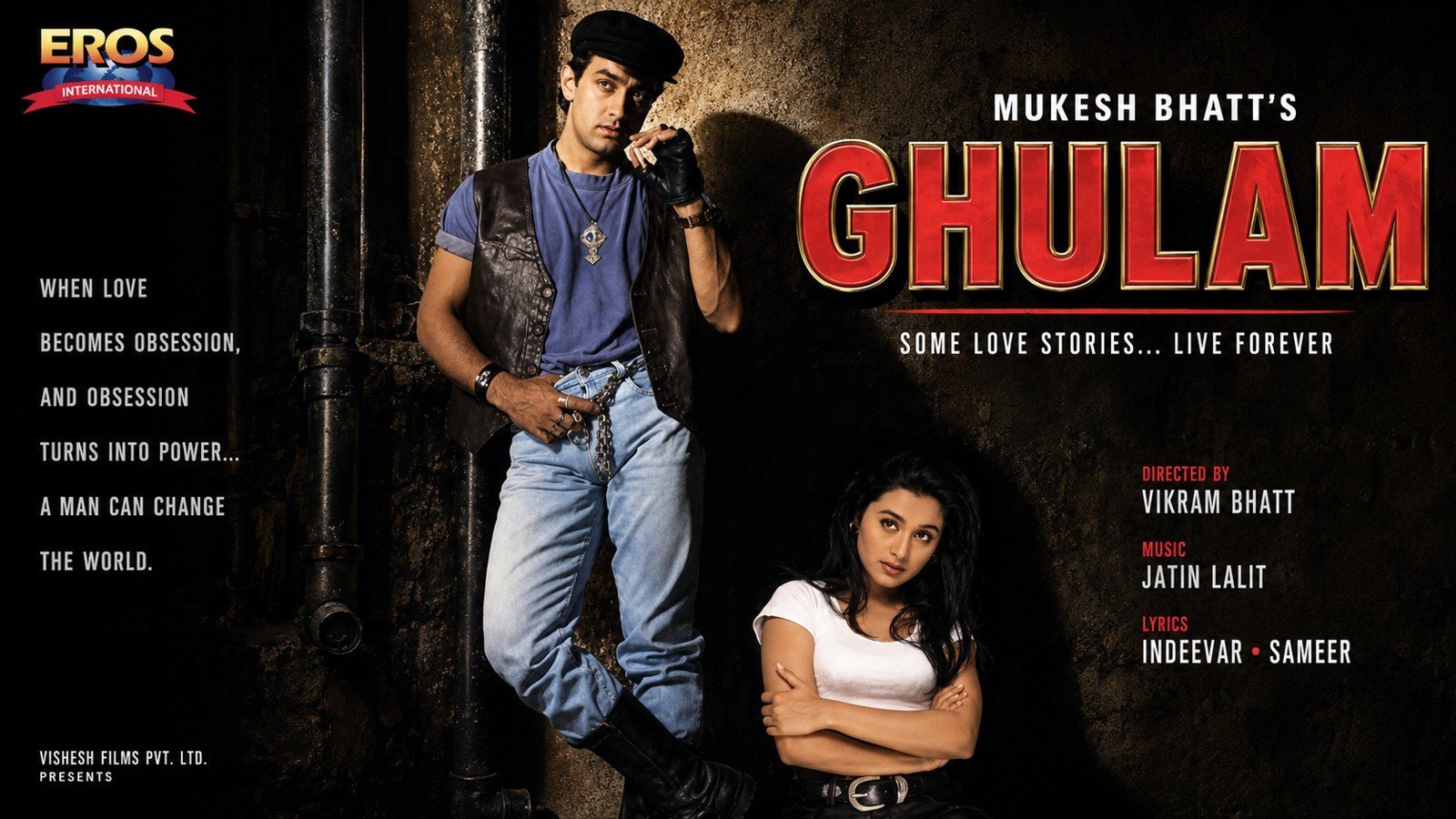
Ghulam (1998)
Starring: Aamir Khan, Rani Mukherjee, Rajit Kapur
Director: Vikram Bhatt
Synopsis: Well-constructed tale of two brothers on a collision course to destruction.
Reviewed by: Faiz Khan
Not much was expected of Ghulam, certainly not by me. It was, after all, being directed by Vikram Bhatt, whose previous efforts had shown little indication of the obvious talent that he unexpectedly displays here.
What emerges is a compelling, tightly constructed drama centred around two brothers.
The elder brother, Jai (Rajit Kapur), works for local strongman Raunaq Singh, better known as Ronnie, an ageing boxer turned gangster who now intends to legitimise his ill-gotten wealth by securing the contract to build a vast commercial complex. The younger brother, Siddharth—or Sidhu (Aamir Khan)—is something of a wastrel, forever getting into minor scrapes with the law, loafing around and occasionally carrying out odd jobs for Jai. Yet beneath his carefree exterior lies a troubled young man haunted by recurring nightmares involving fire and the death of a man falling from the top of a building—visions tied to deeply buried memories he cannot fully comprehend.
One day he encounters Alisha (Rani Mukherjee), a spirited young woman travelling around with what appears to be a motorcycle gang headed by Charlie (Deepak Tijori). Keen to impress her, Sidhu accepts Charlie's challenge to a "dus dus ki daud" at Sanpada railway station. After winning the contest, he drops Alisha home and, as expected, romance gradually blossoms despite the obvious differences in their backgrounds.
Meanwhile, Sidhu befriends Hari (Akshay Anand), an idealistic social worker who has moved into the locality and is encouraging the residents to stand up against Ronnie's reign of intimidation. Sidhu warns Hari that he is taking on forces far more dangerous than he realises, but slowly begins to admire his courage and convictions.
Hari soon becomes a serious thorn in Ronnie's side.
Using Sidhu as an unwitting intermediary, Ronnie lures Hari to a bridge where he is brutally murdered. Sidhu witnesses the killing and is overcome with rage, only to be restrained by Jai, who insists that silence is the only way to survive. The tragedy deepens when Sidhu discovers that Hari was, in fact, Alisha's brother, leaving him consumed by guilt and convinced that he bears some responsibility for the man's death.
His world then begins to unravel completely.
Jai destroys the image Sidhu has always held of their father, revealing that he was not the brave freedom fighter Sidhu had imagined but a man who collaborated with the British before ultimately taking his own life. Jai urges his younger brother to abandon his childish idealism and accept that survival means becoming more like Ronnie.
Instead, Sidhu's conscience finally catches up with him. He confesses everything to both Alisha and his lawyer and resolves to testify against Ronnie in court, setting the stage for the inevitable confrontation between Sidhu, Jai and Ronnie's criminal empire.
On paper, Ghulam sounds like familiar territory, but the film proves to be far more than another routine underworld drama. At its heart, it is the story of two brothers, and it is these scenes that give the film its remarkable emotional power. The quiet conversation over tea when Jai reveals the truth about their father, their exchange after the boxing match, and the unforgettable confrontation by the waterfront when Jai points a gun at Sidhu are among the finest moments in the film and linger long after it has ended.
This is intensely emotional material, yet it is handled with admirable restraint. There is very little of the melodrama or theatrical excess one normally associates with mainstream Hindi cinema. Even the famous sequence at Sanpada station is executed with tremendous confidence and precision. The screenplay is tightly constructed, and Vikram Bhatt directs with a level of assurance that few would have expected based on his earlier work.
Aamir Khan is superb as Sidhu, delivering one of his most natural and engaging performances. He is matched every step of the way by Rajit Kapur, whose understated portrayal of Jai gives the film much of its emotional weight. Rani Mukherjee, only in her second film, is a genuine breath of fresh air. Although her role is relatively straightforward, she brings warmth, spontaneity and considerable charm to every scene she appears in.
The music is consistently enjoyable, with Aati Kya Khandala and Jaadu Hai Tera Hi Jaadu emerging as the standout tracks. The background score is particularly impressive and is used with great intelligence throughout the film.
More than anything else, however, Ghulam belongs to Vikram Bhatt. After producing a succession of disappointments, he finally delivers a mature film, emotionally involving and technically accomplished.
Hats off to him for coming up trumps after so many previous turkeys.

0 Comments
Leave a Comment