
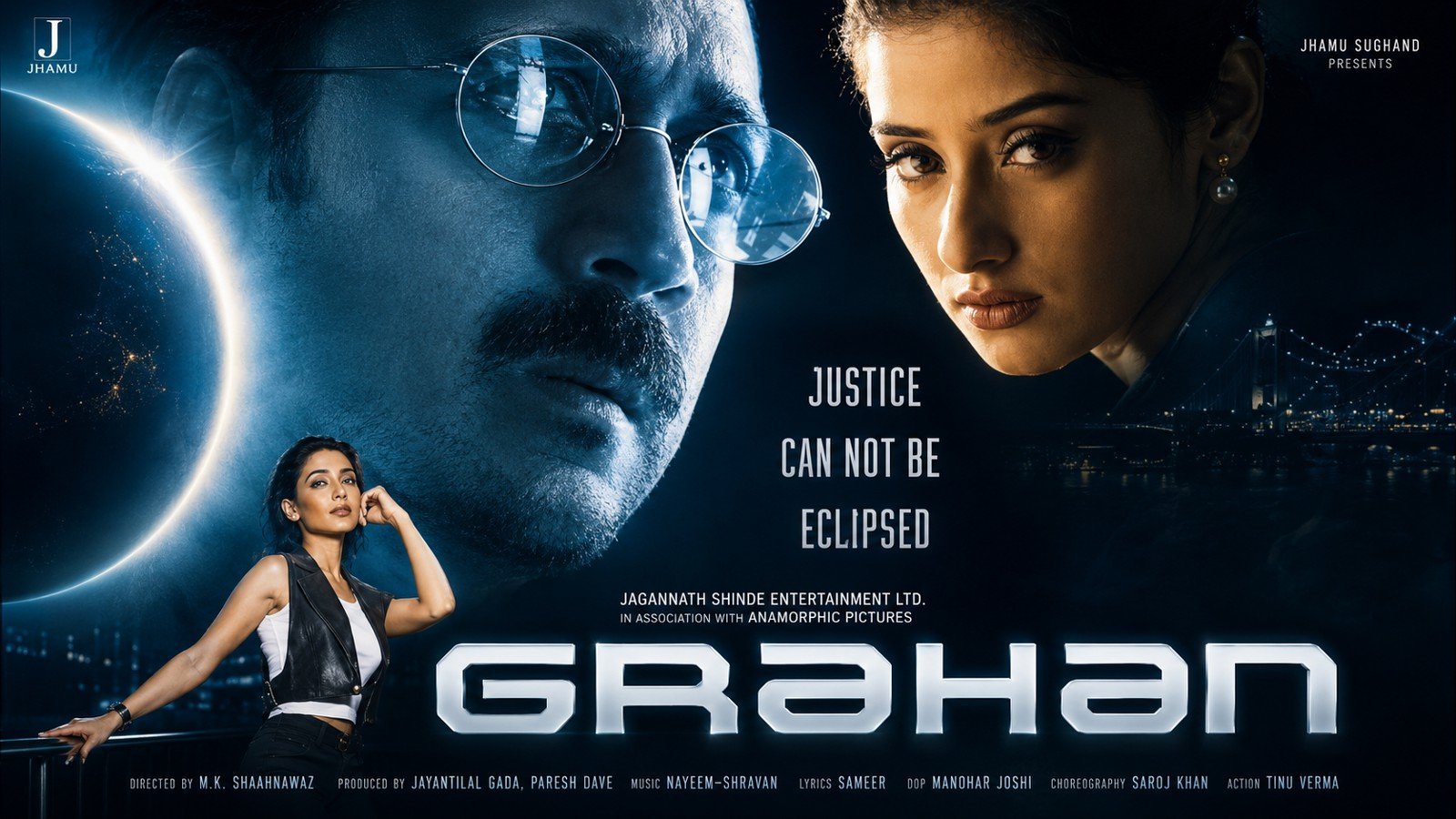
Grahan (2001)
Starring: Jackie Shroff, Manisha Koirala, Anupama Verma
Director: Shashilal Nair
Music Director: Kartik Raja
Synopsis: A familiar tale of wronged women seeking justice and vengeance
Reviewed by: Faiz Khan
Grahan finally limps onto our screens after a delay of more than a year. In that time, it is only natural that even the freshest and most topical of subjects would lose much of their immediacy and impact. Still, one hopes that confidence in the finished product suggests that its content is strong enough to survive the delay and retain the same power it might have possessed twelve months earlier.
Sadly, Grahan disappoints on almost every level. It is a film of missed opportunities, attempting to juggle several strands simultaneously yet failing to do justice to any one of them.
The film opens by introducing the innocent Parvati (Manisha Koirala), seen during the title sequence living a carefree existence and looking forward to her forthcoming marriage to Raj Zutshi. Her world is shattered when she catches the eye of Sanjay (Prasad Purandare), the son of the Chief Minister, who has her abducted to a farmhouse where she is brutally raped and held captive for more than a month.
Meanwhile, Sanjay's sister Suchitra (Anupama Verma) is romantically involved with Jaggu (Jackie Shroff), a respected lawyer.
Following the death of the Chief Minister, political pressure mounts for Suchitra to inherit her father's position rather than her volatile brother. Sanjay is eventually arrested for rape and, ironically, it is Jaggu who agrees to defend him. In court, he systematically destroys Parvati's credibility, portraying her as a prostitute and securing Sanjay's acquittal. As the verdict is delivered, the only outward sign of Parvati's devastation is the occasional nervous twitch, apparently intended to symbolise her gradual descent into mental collapse.
Life appears to return to normal until, at a party shortly afterwards, Sanjay casually admits to Jaggu that he was guilty all along. Horrified, Jaggu slaps him and leaves immediately, determined to seek out Parvati and apologise for having, as he puts it, "raped her again" inside the courtroom.
After a lengthy search, he eventually finds her wandering the streets, scavenging for survival, mentally broken by her ordeal. He takes her away to an isolated farmhouse where doctors explain that she is suffering from severe trauma and may recover with time and care. Jaggu devotes himself to rehabilitating her, much to the growing suspicion of Suchitra, who has been manipulated by her psychotic, cocaine-sniffing brother into believing that Jaggu has fallen in love with Parvati. Political rivals conveniently interpret the entire situation as little more than an opposition conspiracy.
Quite suddenly, and rather unconvincingly, Parvati regains her composure. Rejected by her former fiancé and his family despite Jaggu's efforts to help her rebuild her life, she ultimately appears at a political rally where she draws a gun and dispenses her own brand of justice.
The question then becomes whether justice itself will finally prevail or whether Parvati will once again become another victim of a corrupt system. Can Jaggu redeem himself for the damage he inflicted in court? Is there any future at all for Parvati?
Unfortunately, Grahan attempts far too much and ultimately achieves very little. For a film with genuine potential to squander it so completely is arguably a greater crime than producing an ordinary commercial potboiler that never aspired to anything more in the first place.
The screenplay simply cannot decide what sort of film it wishes to be. Is it the story of a rape victim struggling to rebuild her shattered life? Is it a study of guilt and conscience through the lawyer who seeks redemption? Is it a political drama exposing corruption and abuse of power? Or is it somehow intended to become a tender love story?
It certainly fails as the latter. There is never any genuine suggestion that Jaggu is emotionally drawn towards Parvati beyond his understandable desire to make amends for the wrong he helped inflict upon her. Even this relationship never acquires much credibility. Likewise, Suchitra's sudden rise to the Chief Minister's chair may well reflect the dynastic realities of Indian politics, but within the context of this particular story it never rings true.
The final courtroom sequence is another major disappointment. Instead of delivering the emotional knockout the film has spent two hours building towards, it simply fizzles away. We are repeatedly told that Parvati has done nothing wrong, yet where is her redemption? What compensation does she receive for the unimaginable suffering she has endured? In the end...nothing. And the audience leaves with much the same feeling.
Manisha Koirala never quite manages to make the impact one expects, though the fault lies less with her performance than with the writing itself. Her psychological collapse and subsequent recovery are both handled abruptly and in the most clichéd fashion imaginable. Too often she is asked to sob when a more restrained performance, conveyed largely through her eyes, might have proved infinitely more affecting. The disappointment stems largely from expecting far more of both the actress and the role. She does have isolated moments of considerable power, particularly the haunting sequence in which Jaggu finds her scavenging by the roadside, half child, half broken woman. But memorable scenes alone cannot rescue an underwritten character.
Jackie Shroff gives a competent performance and works hard to make Jaggu believable despite the screenplay repeatedly undermining him. Anupama Verma also acquits herself reasonably well, although her role offers little opportunity to leave a lasting impression.
One of the film's biggest weaknesses is its editing. Scenes frequently seem to end abruptly, often before they have developed any real dramatic force, robbing the film of much of its emotional impact.
Directed by Shashilal Nair, Grahan feels more like a return to the uneven filmmaking of his Falak days than the stronger work he produced later. Good intentions alone are never enough to make a good film, and Grahan is living proof of that.
One final regret—the best song in the film, the haunting piece heard over the opening titles, isn't even included on the soundtrack.

0 Comments
Leave a Comment