
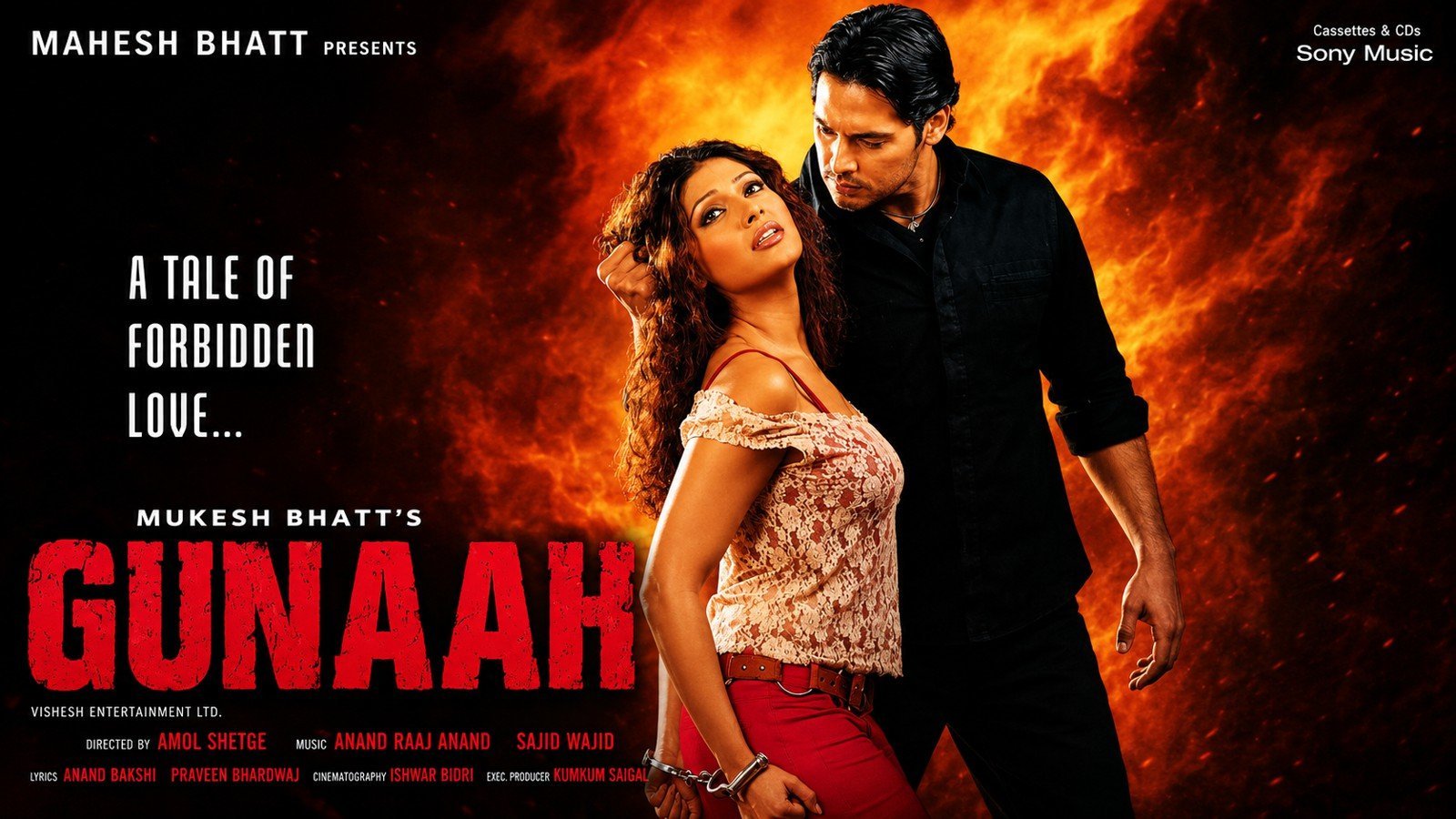
Gunaah (2002)
Cast: Bipasha Basu, Dino Morea, Irfan Ashutosh Rana
Director: Amol Shetge
Music Director: Anand Raaj Anand
Synopsis: Interesting premise about a bad cop goes sadly off the tracks
Reviewed by: Faiz Khan
The Bombay skyline introduces us to yet another tale set in the murky world of police corruption. A hot babe in a striking red dress lures the corrupt A.S.P. Pande (Irrfan Khan) into her parlour, only for him to discover that she is actually Inspector Prabha (Bipasha Basu), attempting to trap her superior officer. Needless to say, the operation achieves absolutely nothing beyond establishing the hostility between the two policemen.
Prabha is plagued by recurring nightmares which keep her awake at night. We later discover that she is the daughter of a prostitute who, during Prabha's childhood, murdered one of her clients—a corrupt policeman. Growing up within the shadow of that traumatic event, she joins the police force with the sole aim of rooting out corruption from within the system.
When a prominent businessman is murdered, the only clue is the face of a man captured by a security camera. Tracking him down, Prabha peeks into his bathroom and discovers the suspect, Aditya (Dino Morea), taking a shower. Modesty, after the briefest of ogles, finally prevails and she shuts the door—just long enough for her quarry to escape. During the ensuing rooftop chase Prabha slips and is about to plunge to her death when the very man she is pursuing reaches out and saves her life. Arrested shortly afterwards, Aditya steadfastly refuses to utter a single word.
Prabha is assigned the task of making him talk. Her chosen interrogation technique appears to involve dressing in a bright red sari, applying a generous pout and escorting him back to his own house in the hope that he may suddenly feel inclined to confess. Unsurprisingly, he remains stubbornly silent.
It gradually emerges that Aditya belongs to a group of young vigilantes determined to rid society of corrupt policemen through murder. His own hatred of the police stems from the fact that his journalist father was murdered years earlier by none other than A.S.P. Pande. Pande, meanwhile, is desperate to regain control of the investigation to bury every loose end connecting him to the earlier killing, while Prabha sees the case as her opportunity to expose him once and for all.
By now Aditya has, naturally, fallen in love with Prabha.
After his suspension, Pande launches a murderous assault upon her, shooting her and leaving her for dead before the film eventually staggers towards its bloody and entirely predictable conclusion.
Mahesh Bhatt, as story writer, appears to have concluded that realism simply consists of filling the screenplay with coarse dialogue, near-expletives and generally unpleasant behaviour. Unfortunately, genuine realism requires considerably more than colourful language. The script bears little resemblance to reality and whatever intentions Bhatt may have had are further undermined by the director, whose handling of the material results in a thoroughly unconvincing and rather unpleasant film.
Bipasha Basu struggles to make much of an impression, spending much of the film alternating between heaving emotionally and thumping people physically. Surprisingly, it is Dino Morea who emerges with the stronger performance and acquits himself rather better than many might have expected. Irrfan is reduced to playing an almost cartoonishly maniacal villain, while Ashutosh Rana barely registers despite his considerable presence.
The music is poor throughout.
The film might actually have worked better had it simply embraced its central villain and called itself Maniac Cop. Instead, it attempts to dress itself up as a serious examination of police corruption while simultaneously indulging in the very excesses that rob it of any credibility.
Not recommended.

0 Comments
Leave a Comment