
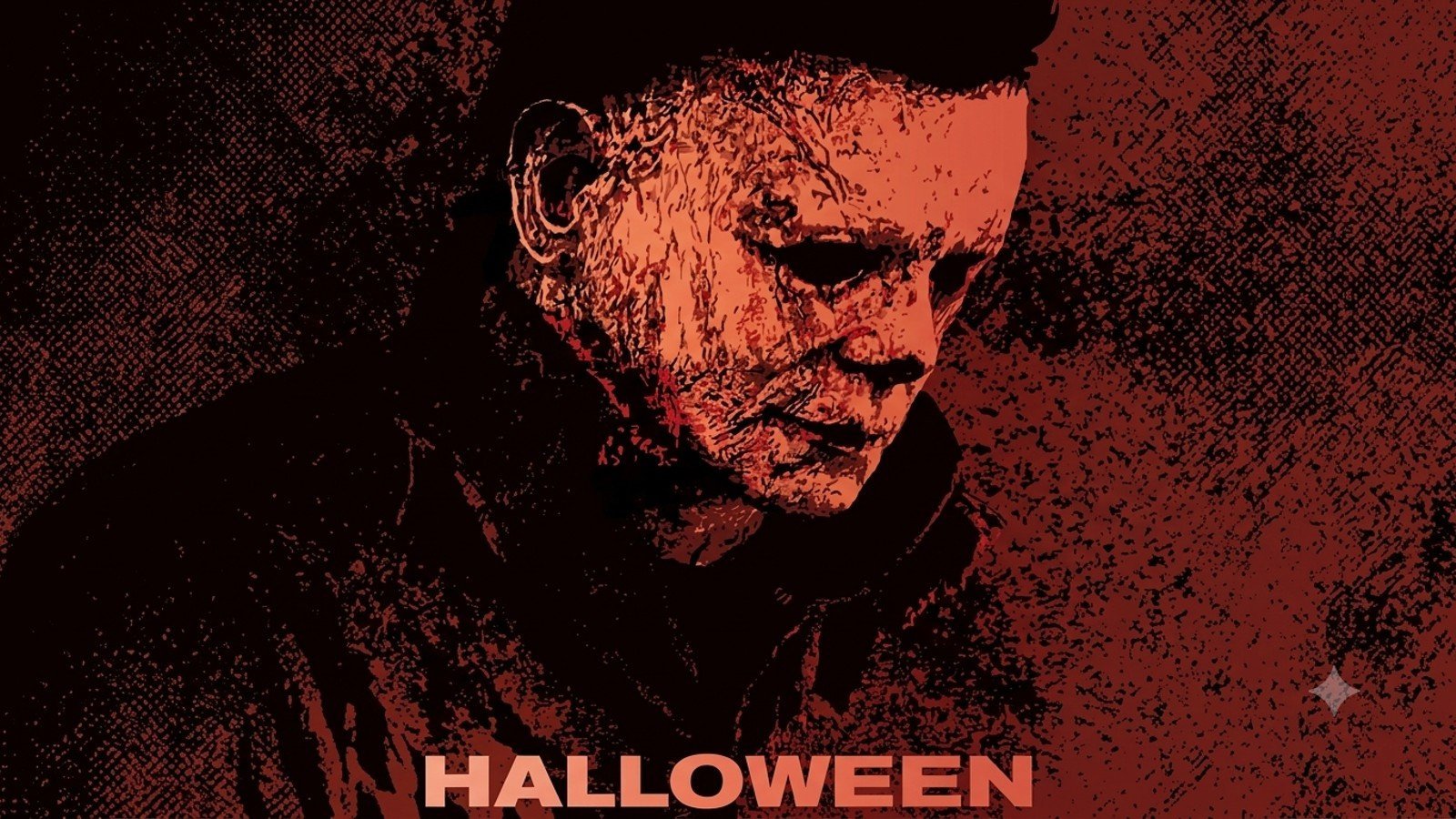
Halloween (2018)
Cast: Jamie Lee Curtis, Andi Matichak, Nick Castle, Judy Greer
Director: David Gordon Green
Nutshell: Myers is back and Laurie Strode awaits. Lots of Nods, Winks and Nudges to the 1978 original to delight the faithful and yet…
"It's just not scary."
— Brian Tallerico, RogerEbert.com
"The echo of the original is loud, but that's ultimately hollow."
— Brian Tallerico, RogerEbert.com
"Halloween largely wipes the slate clean after decades of disappointing sequels, ignoring increasingly elaborate mythology in favor of basic – yet still effective – ingredients."
— Rotten Tomatoes Critics Consensus
"A knowingly intelligent reboot of the 1978 masterpiece."
— Mark Kermode, The Observer / The Guardian
"Anything resembling an atmosphere [is] sorely missing."
— Benjamin Lee, The Guardian
"It's not quite the comeback one would have hoped for."
— Benjamin Lee, The Guardian
"An act of fan service disguised as a horror movie."
— Peter Debruge, Variety
John Carpenter's Halloween has spawned so many sequels over the years that it has become increasingly difficult to keep track of them all. Towering head and shoulders above the rest remains Halloween II (1981), after which came Halloween III and a succession of increasingly desperate attempts to wring every last dollar from what was, at heart, a remarkably simple idea.
With each new instalment, the franchise drifted further and further from its origins.
Of a thoroughly rotten bunch, Halloween H20 was perhaps less offensive than most, but by then the series had long since become creatively exhausted. Writers continually searched for new tangents in the hope of keeping the franchise alive, and in doing so merely demonstrated how extraordinary John Carpenter's original really was. Every sequel seemed determined to explain Michael Myers rather than simply allow him to exist.
The rot arguably began with the very first sequel.
The revelation that Laurie Strode was Michael's sister never truly rang true. Then came the increasingly convoluted Samhain mythology, occult backstories and endless attempts to provide psychological or supernatural explanations for a figure who was infinitely more terrifying when left unexplained. Each successive sequel merely piled fresh insult upon Carpenter's masterpiece, drifting ever further away from the elegant simplicity that made the 1978 film so enduring.
By this point, the franchise appeared beyond salvation.
Then came an intriguing proposition.
What if John Carpenter returned?
What if Jamie Lee Curtis came back?
Suddenly there was genuine cause for cautious optimism.
Although Carpenter chose not to direct, his involvement as executive producer and creative consultant immediately lent the project an authenticity absent from virtually every previous sequel. Better still, he returned to compose the score, while David Gordon Green—a filmmaker with obvious admiration for the original rather than simply another director for hire—was entrusted with the reboot.
For the first time in decades, Halloween fans genuinely had something to look forward to.
This promised to be a proper continuation rather than another cynical cash-in.
Jamie Lee Curtis's return naturally generated enormous excitement, although it has to be said that she has never appeared particularly affectionate towards the Halloween series itself. Over the years she has frequently expressed a certain indifference towards horror films—and indeed towards the franchise that launched her career. Her willingness to return has always seemed motivated more by the quality of the project, and perhaps the financial incentive, than by any deep personal attachment to Michael Myers.
None of that mattered.
Seeing Laurie Strode once again immediately reconnected the series with Carpenter's original and generated an optimism the franchise had not enjoyed for many years.
The film opens with two true-crime podcasters visiting Michael Myers in the institution where he has spent the past forty years. They also interview Laurie Strode, who has devoted those same decades to preparing for the day Michael inevitably escapes.
One particularly effective early scene sees Michael reunited with his old mask, subtly suggesting that something long dormant has finally awakened within him.
Soon afterwards, while being transferred to another institution, Michael predictably escapes, murders the podcasters, reclaims his mask and resumes his instinctive killing spree.
Laurie knows exactly what is coming.
This time, however, she intends to be ready.
There are numerous affectionate nods to Carpenter's original scattered throughout the film, and longtime fans will undoubtedly appreciate many of the visual callbacks and references.
Unfortunately, the qualities that elevated the 1978 masterpiece never truly materialise.
The original Halloween was drenched in atmosphere, suspense and unbearable tension.
This version is drenched in violence.
Carpenter understood that what the audience could not quite see was infinitely more frightening than what they could. Michael Myers lurking silently beyond the washing line, standing motionless outside a bedroom window or quietly watching Laurie from behind a hedge remain among the most unsettling images in horror cinema precisely because they rely upon suggestion rather than explicit violence.
David Gordon Green adopts an entirely different philosophy.
His Michael is rarely content simply to observe.
Instead, he launches into prolonged, brutally graphic assaults that leave very little to the imagination. The film substitutes dread with brutality, suspense with violence and subtlety with explicit carnage.
Both films feature essentially the same killer.
Yet they feel worlds apart.
Where Carpenter allowed terror to build almost imperceptibly, Green confronts the audience head-on. The result is certainly more visceral, but it is rarely more frightening.
To its considerable credit, Halloween (2018) wisely discards much of the absurd mythology that had accumulated throughout the sequels. Ignoring the sibling revelation and the increasingly ridiculous supernatural diversions was unquestionably the correct decision. In doing so, the film reconnects the series with its roots more successfully than any previous sequel managed.
Unfortunately, reconnecting with the original is not the same as understanding why the original worked.
That remains the film's greatest shortcoming.
Despite Carpenter's welcome involvement, Curtis's committed performance and Green's obvious respect for the source material, the film never manages to recreate the oppressive atmosphere or creeping sense of inevitable doom that made Halloween (1978) so extraordinary.
Nevertheless, this remains one of the stronger entries in an otherwise desperately uneven franchise. It is an honest attempt to restore dignity to a series that had wandered hopelessly off course, and for that alone it deserves considerable credit.
It may not recapture the magic of the original.
Perhaps no sequel ever could. Halloween II which was largely directed by John Carpenter from 1981 remains the truest of an increasingly dodgy lot.
But after decades of increasingly misguided follow-ups, Halloween (2018) at least reminds us why Michael Myers deserved a second chance.
Sadly...
it still falls some distance short of a bullseye.
New wine...
new bottle...
alas.
0 Comments
Leave a Comment