
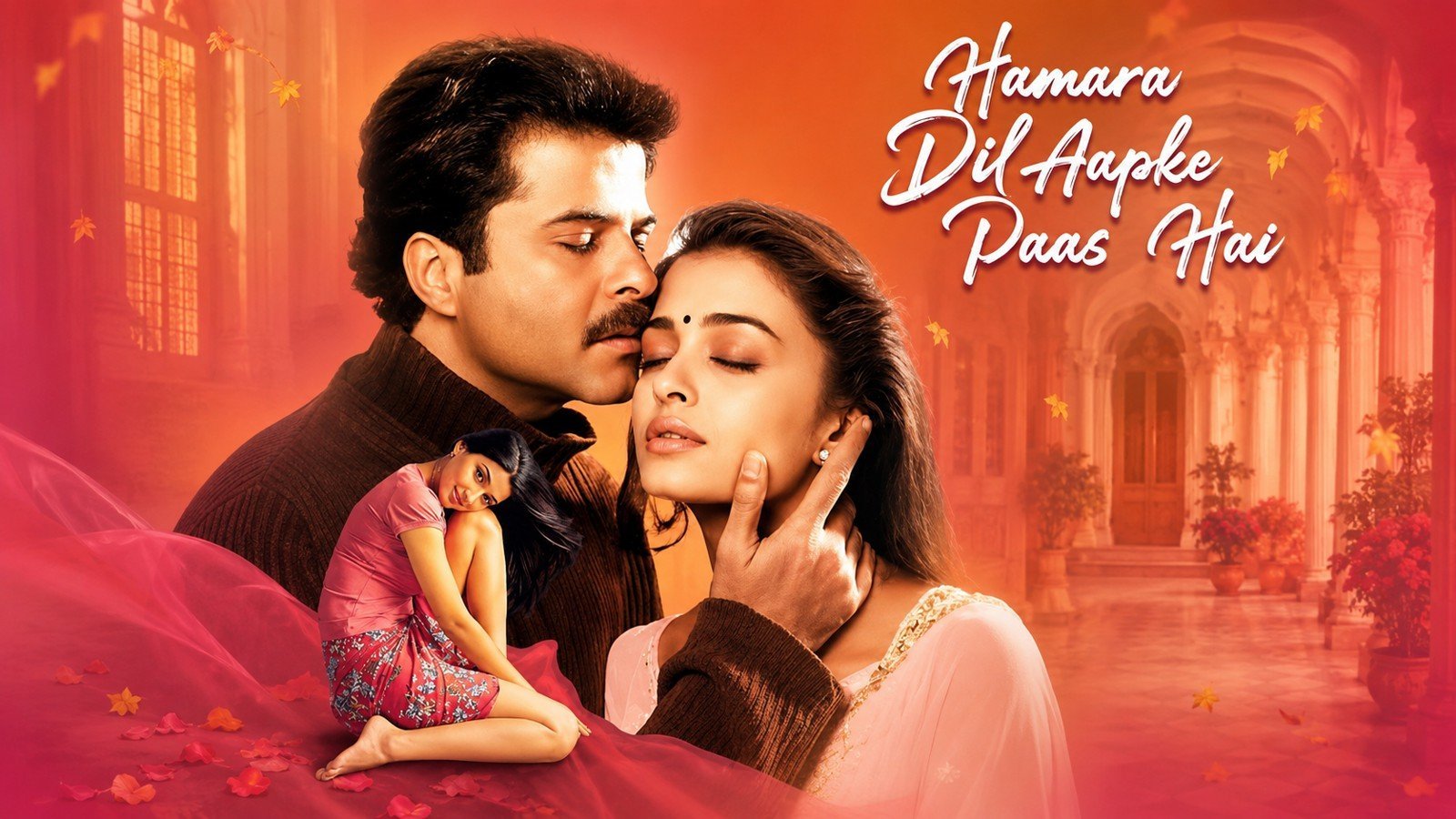
Hamara Dil Aapke Paas Hai (2000)
Starring: Anil Kapoor, Aishwarya Rai, Sonali Bendre
Director: Satish Kaushik
Music Director: Sanjeev Darshan
Synopsis: sensitively made and well acted, finally a slightly more mature film
Reviewed by: Faiz Khan
The film opens with what appears to be a picture-perfect family. In fact, there is a rather risible song entitled "It's My Family", determined to convince us that this is the happiest and most normal household imaginable. We have father Avinash (Anil Kapoor), mother Preeti (Aishwarya Rai) and two adorable children.
The illusion is shattered almost immediately when Preeti is arrested by the police on charges of prostitution. A stunned Avinash storms into the police station, resorts to his fists in typical Hindi film fashion, and is then informed that it was his own father who made the accusation. Avinash confronts him, only to be asked a simple but devastating question: what exactly is his relationship with Preeti?
Time for a flashback.
Preeti had been raped by a local goon and, instead of receiving sympathy, was cast aside by her own family for bringing them shame. Seeking refuge with a friend proves equally futile, as everyone she encounters is more interested in gossiping about her ordeal than offering compassion. Even in this day and age, society has precious little sympathy for the victim.
Avinash gives her both a home and a job, allowing her to rebuild her shattered life. We also discover that the two children are not his at all, but his father's illegitimate offspring from a clandestine affair with his secretary. Following the secretary's death, Avinash takes the children into his own home after his father refuses to acknowledge them.
As rumours about Avinash and Preeti begin to spread, he offers to marry her—not merely to silence society, but because he genuinely loves her. Preeti, however, sees this as yet another upkar, another act of charity bestowed upon her, and refuses.
Enter the third side of the triangle. Khushi (Sonali Bendre), freshly returned from the United States and Avinash's childhood friend, arrives determined to marry him.
Ah yes...the eternal love triangle.
Will Khushi prevail, or will Preeti finally admit that she loves Avinash?
After Hum Aapke Dil Mein Rehte Hain, Satish Kaushik returns with another old-fashioned melodrama, but one handled with a surprising degree of control and finesse. Nobody expects realism from a film like this, yet it does attempt to say something worthwhile about society's shameful double standards towards rape victims.
Preeti is not portrayed as the knife-wielding avenger of films like Zakhmi Aurat. Instead, she is a woman of quiet dignity who struggles to rebuild her life while remaining painfully vulnerable to the prejudices of the society around her. Yes, there are sermons, but mercifully they come not from the heroine herself but from the man who chooses to stand beside her.
The film's point is made clearly, if not always with great subtlety.
The first half is almost riveting. Kaushik constructs the narrative so effectively that expectations are extremely high by the interval. Unfortunately, the second half cannot quite sustain that momentum. The arrival of Khushi is necessary to move the story forward, but in shifting its focus towards the romantic triangle, the film loses much of the emotional force that had made the earlier portions so compelling.
Anil Kapoor delivers a mature, understated performance, perhaps one of his finest in recent years. Aishwarya Rai is so extraordinarily beautiful that it becomes difficult to look at anyone else whenever she appears on screen. Fortunately, she also delivers a controlled and sensitive performance, wisely avoiding melodramatic excess.
Sonali Bendre, however, is saddled with a role very similar to the one she played in Sarfarosh. Once again she is cast as the ditzy, bubbly airhead and, once again, the character quickly becomes rather irritating.
My biggest criticism of the film concerns the utterly unnecessary comedy track that runs throughout. Remove every one of those comic scenes and the film would probably be twenty-five minutes shorter—and considerably stronger. Instead, the filmmakers opt to play to the gallery, giving audiences what they assume they want. Each comic interruption breaks the dramatic momentum, although the director probably imagined it would provide welcome relief after the intensity of the surrounding scenes.
The music is pleasant without ever becoming exceptional. The title song is beautifully composed and elegantly picturised. Thankfully, the dreadful "I Love You" number has been reduced to little more than a brief refrain, while, oddly enough, two of the better songs have been removed altogether. What remains is a fairly ordinary soundtrack.
Nevertheless, I would recommend the film. It is well mounted, emotionally engaging for much of its running time, and I suspect it will perform very well at the box office.

0 Comments
Leave a Comment