
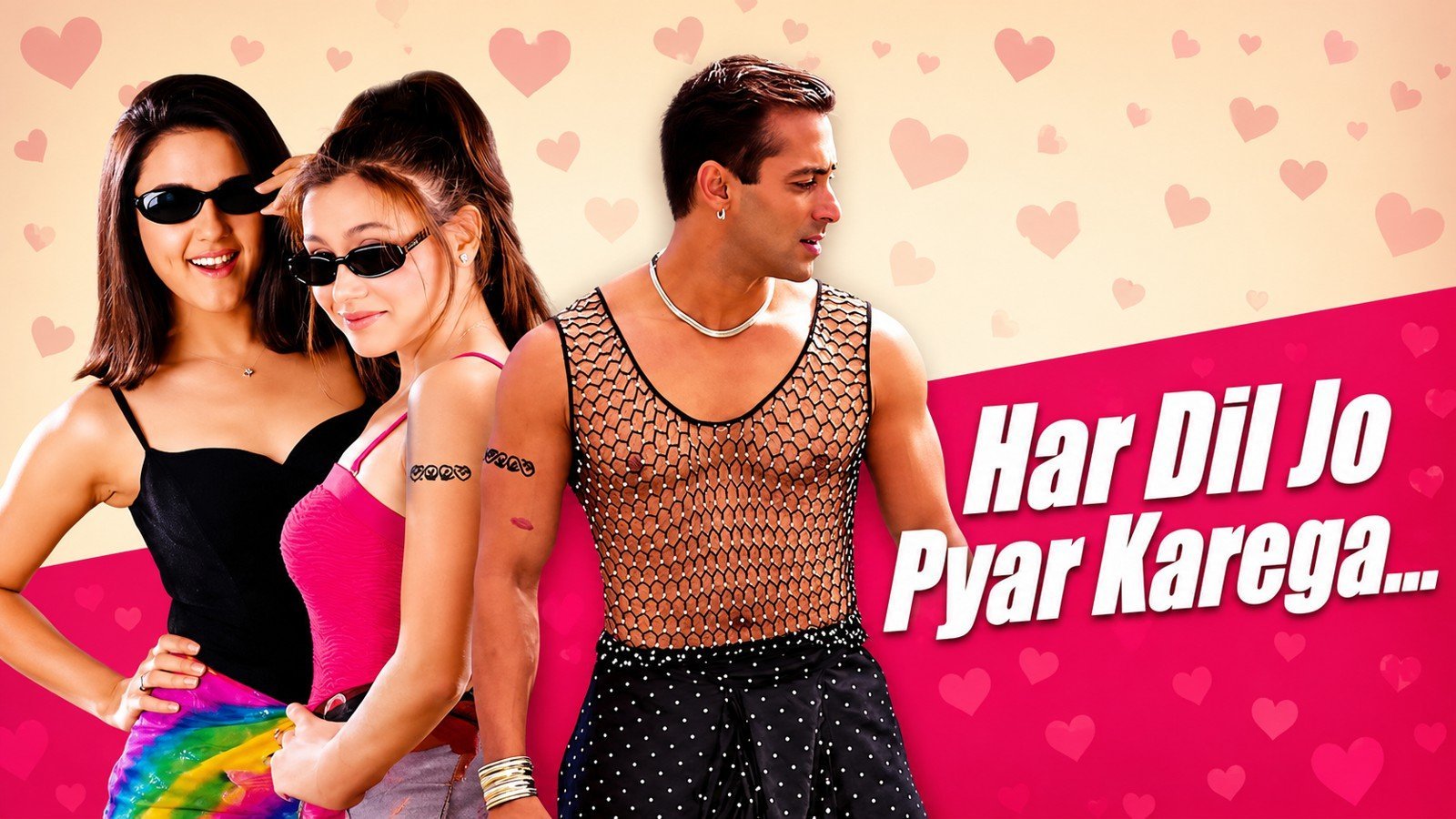
Har Dil Jo Pyar Karega (2000)
Starring: Salman Khan, Rani Mukherjee, Preity Zinta
Director: Raj Kanwar
Music Director: Annu Malik
Synopsis: insufferable dose of comedy and convoluted drama..........pretty horrid stuff
Reviewed by: Faiz Khan
Har Dil Jo Pyar Karega carried tremendous expectations. The promos had been on air for weeks, both heroines looked stunning, the songs were attractively picturised, and the film boasted the flavour-of-the-month Preity Zinta alongside the equally bubbly Rani Mukerji—not to mention a perpetually bare-chested Salman Khan. Add some peppy music and a director who usually knows how to hit the right spot, and you have a cocktail heady enough to make your head spin.
You certainly come out of the cinema spinning—but unfortunately not for the reasons you might have hoped.
The film opens with little more than a cup of tea and an explosion of fluorescent colours. Centre stage stands the perfect body, sometimes clad in fluorescent pink, sometimes sporting a skimpy sarong, swaying provocatively as the ultimate sex symbol.
Except it isn't a glamorous beauty with flowing hair and the perfect figure.
It's Salman Khan, wearing tight Lycra cycling shorts, bare-chested and gyrating to the strains of an awful Anu Malik-sung number.
Raj (Salman Khan) dreams of becoming a successful pop singer and arrives in Bombay determined to make his fortune. What follows is an excruciating fifty-five minutes of forced comedy as the director chronicles Raj's repeated attempts to become a pop star—and fail.
One laboured comic sequence follows another while the audience wonders if either of the heroines intends to appear before the interval.
Exactly fifty-five minutes into the film, salvation finally arrives in the form of a speeding car crashing through a billboard and plunging onto a railway track. A bangled arm emerges from the wreckage, and Raj heroically rescues the young woman, still dressed in her bridal finery, moments before an approaching train smashes into the vehicle.
The woman turns out to be Pooja (Rani Mukerji), who is rushed to hospital in a coma.
At this point the film begins to resemble While You Were Sleeping.
To cut a very long story short, Pooja's family mistakes Raj for Romi, the man she had intended to marry against their wishes. Raj decides to maintain the deception purely because it provides him with an opportunity to record an album through one of his supposed "father-in-law's" influential friends.
One family member (Paresh Rawal) discovers the truth but persuades Raj to continue the charade lest Pooja's father suffer a fatal heart attack.
Pooja's closest friend is Jhanvi (Preity Zinta), who is practically her sister. Returning from America, she meets "Romi" for the first time and, almost instantly, the two fall in love. She eventually learns that he is really Raj, not Romi, but by then her feelings have already taken root.
By this stage, nearly two hours have elapsed and poor Pooja is still lying in a coma, having uttered not a single word, although apparently she has been able to see and hear everything happening around her.
The lovers dutifully visit a temple to pray for Pooja's recovery and, naturally, upon returning they discover she has regained consciousness. Raj panics, convinced she will expose him, only for Pooja to awaken and lovingly call him "Romi."
Apparently hearing everything whilst unconscious has its advantages.
Needless to say, she has also fallen hopelessly in love with him.
So we finally arrive at the film's central dilemma. Pooja loves Raj. Raj loves Jhanvi. Jhanvi loves Raj—but also loves Pooja.
The film now enters its final twenty minutes.
No prizes for guessing who eventually gets the boy.
What an enormous waste of time and potential.
With two of the most popular young actresses in Hindi cinema sharing the screen, the film is at its strongest whenever Rani and Preity appear together. There is a genuine spark between them, perhaps best illustrated in the delightful Piya Piya number, which easily emerges as the film's highlight. Both actresses have rarely looked better, and they complement each other beautifully.
Unfortunately, apart from Piya Piya, Rani spends almost the entire first two hours lying unconscious in a hospital bed, meaning the opportunities to exploit the chemistry between the two actresses are few and far between.
That is perhaps the film's greatest disappointment.
Preity Zinta has the larger role and carries it off with her customary charm, spontaneity and naturalness. She simply feels real, and that quality should carry her a very long way.
Rani Mukerji, on the other hand, is sadly short-changed. It is very much the film's loss. She has rarely looked more beautiful, and one only wishes the screenplay had given her considerably more to do.
Salman Khan, however, is a complete disaster. The role is not written intelligently enough for him to poke fun at himself, as he did so effectively in Chal Mere Bhai, and instead he comes across as loud, irritating and, frankly, rather idiotic.
The music is pleasant without being exceptional. The title song is well picturised, while Piya Piya is unquestionably the standout. In truth, the opening fifty minutes could have been condensed into ten without losing anything of importance. Instead, the audience is subjected to MTV-style songs, desperately unfunny comedy, Salman's painfully forced attempts at humour and the utterly redundant presence of Shakti Kapoor. Sitting through that first hour requires remarkable patience.
There is a glimmer of hope after the railway accident that the film might finally settle into an engaging romantic drama, but it continues in the same half-baked comic vein right through to its conclusion.
Raj Kanwar has generally shown himself to be an accomplished storyteller regardless of genre. Judaai was extremely well made, as was Laadla, while Badal, though hardly outstanding, at least possessed a tightly structured narrative.
Here, however, he loses his way so completely that one begins to wonder whether he was asleep while making the film.
This could have been a cleverly reworked variation on While You Were Sleeping, balancing gentle comedy with genuine emotion. Instead, it emerges as a fluffy, pointless and deeply unsatisfying waste of time.
What an enormous disappointment.
The film will undoubtedly open strongly thanks to its star cast and a couple of popular songs, but I simply cannot imagine it becoming the blockbuster everyone seems to expect.
Personally, I'll just wait for Piya Piya to appear on television. It's about the only thing in the film worth experiencing a second time.
0 Comments
Leave a Comment